
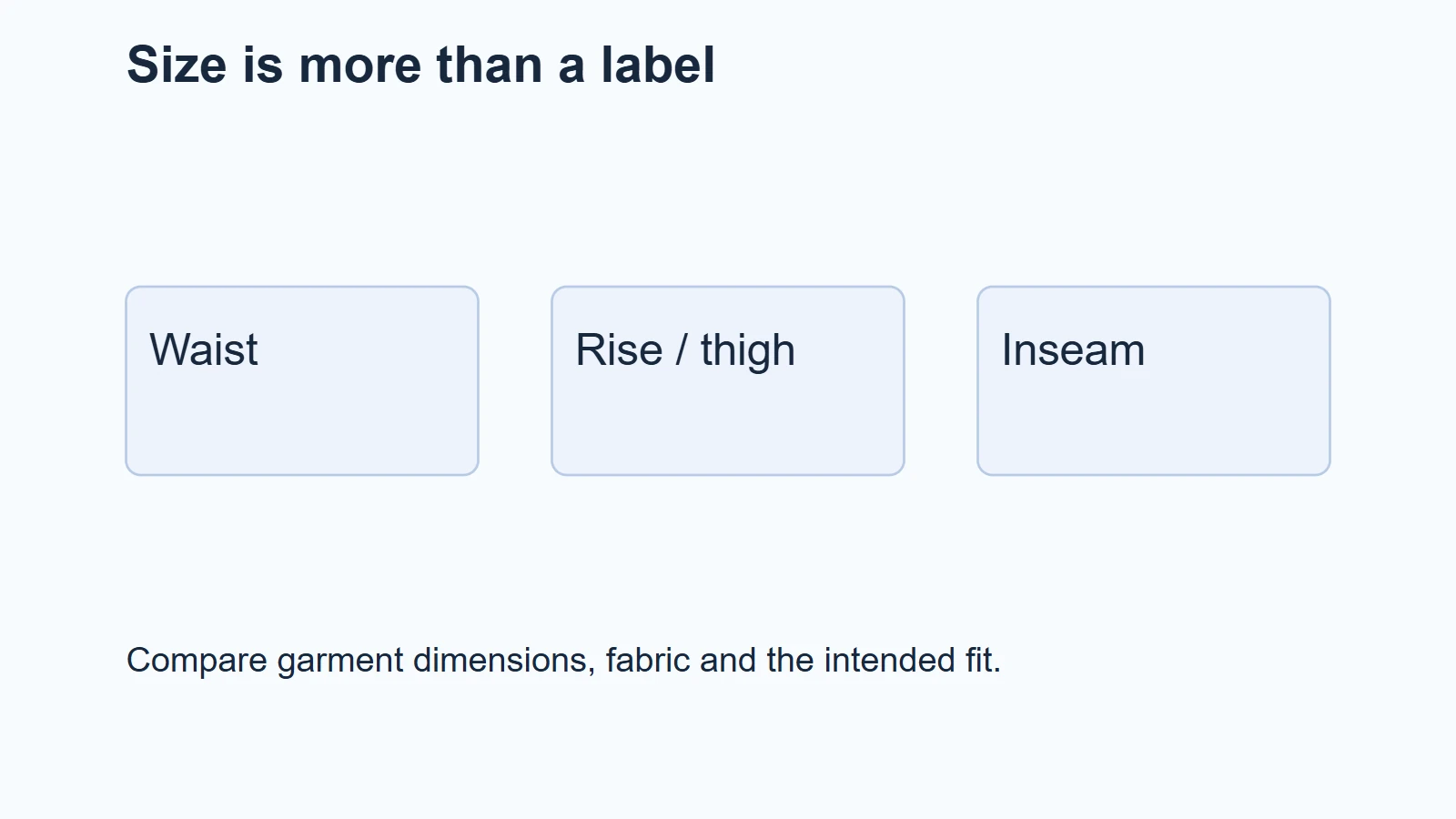
You can dropship jeans through ready-made clothing suppliers or a sourcing partner that fulfills individual customer orders. Choose the actual cut and fabric, then give buyers garment measurements they can compare with a pair they own. A size number or the word “baggy” does not explain the fit.
The hard part is keeping that promise consistent across size, wash and supplier pick code. A customer who orders the right listing can still receive the wrong experience if a long inseam becomes a short one or a stretchy fabric is replaced with a rigid version.
01
Pick the jeans before picking the supplier
Start with a wearer and use. Straight-leg everyday jeans, loose streetwear and stretch skinny jeans require different shape, fabric and size information. A small coherent range is easier to explain than several unrelated cuts imported under one generic size chart. Use the clothing dropshipping guide for the broader apparel setup; the checks below focus on denim.
Then choose the buying route. Ready-made dropship products can suit testing an existing style. Private-label or custom manufacturing may involve buying stock, development, labels and a separate fulfillment arrangement.
| Route to investigate | What to confirm |
|---|---|
| Ready-made catalog | Exact variant, current availability and individual-order delivery |
| Clothing supplier with a dropship service | Account acceptance, measurements, stock updates and returns |
| Sourcing partner | Exact product approval, inspection and per-order fulfillment |
| Bulk/private-label manufacturer | Minimum purchase, development and who holds and ships stock |
For current examples, CJ lists jeans as individual catalog products, and EPROLO has a ready-made denim catalog route. These pages are sourcing leads, not our approval of their quality, stock or delivery. Obtain account-specific charges for the selected size and destination.
By contrast, Denim Manufacturing’s public offers include minimum-quantity wholesale purchases. A wholesale unit price does not establish a service that sends one pair to your customer.
The clothing supplier comparison covers broader supplier models. For jeans, keep the shortlist tied to your actual cut, size range and order route rather than a provider-wide claim.
02
Publish usable garment measurements
Label your chart as garment measurements or body recommendations. They answer different questions. A garment chart describes the finished pair; a body chart recommends a fit for a person under the supplier’s sizing method.
For a proposed garment check, fasten the jeans, lay them flat without deliberately stretching them and use a documented measuring method. Record the points that determine the fit:
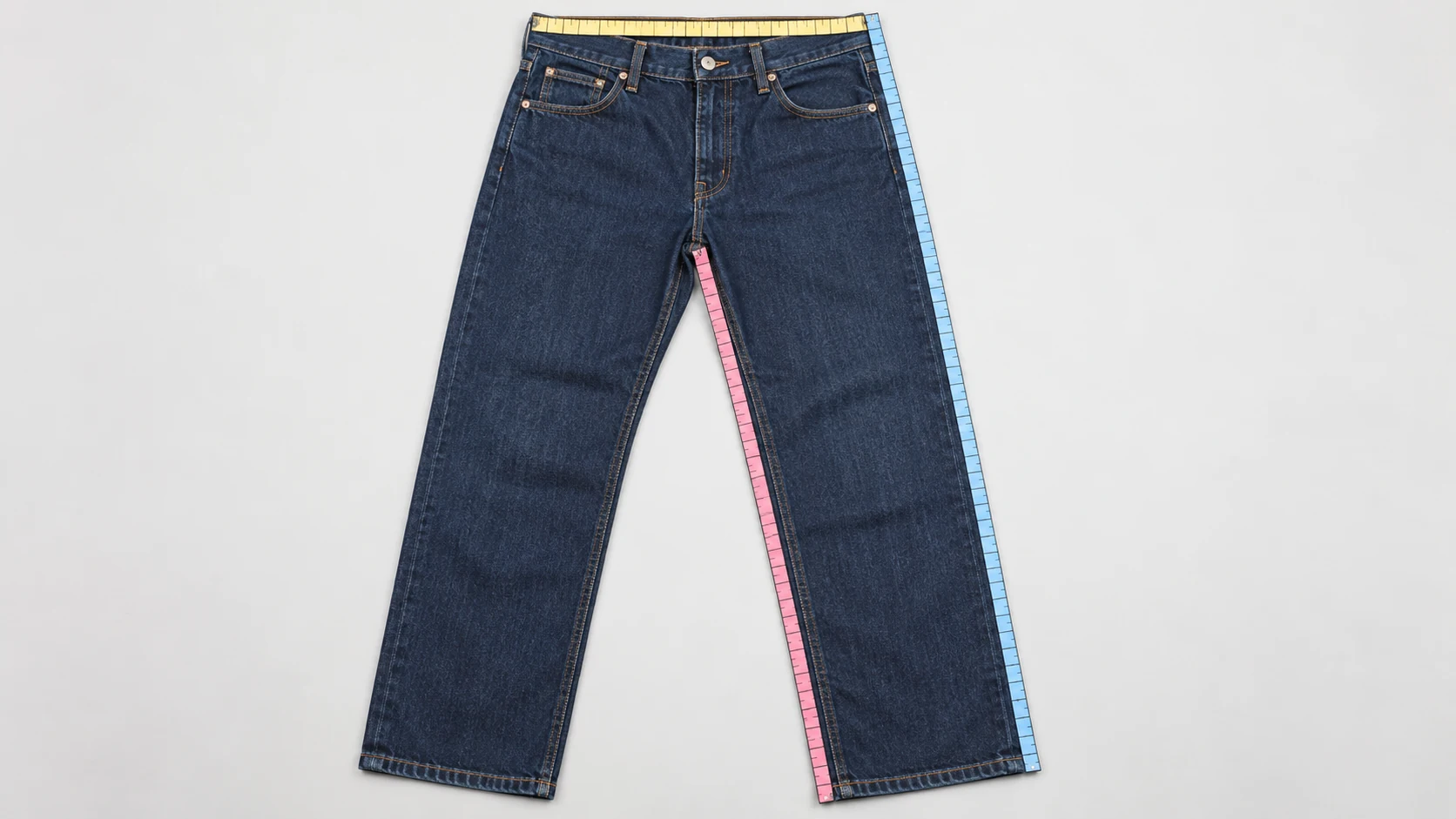
| Measurement | What it describes | Common confusion |
|---|---|---|
| Waist laid flat | Width across the fastened waistband | Mistaking it for body circumference |
| Front rise | Crotch seam to front waistband | Assuming all “high rise” styles match |
| Inseam | Crotch seam along the inner leg to hem | Confusing it with total outside length |
| Thigh | Width at an explicitly defined point | Comparing charts measured at different points |
| Leg opening | Width across the hem | Treating “straight” as a fixed measurement |
Here is a measurement illustration, not a supplier size recommendation. A 40 cm flat waist is approximately 80 cm around the garment. It does not automatically recommend an 80 cm body waist, because shape, stretch and wearing ease matter.
Likewise, a pair with a 76 cm inseam can have a 104 cm outseam. Publishing the outside length under “inseam” gives the buyer the wrong comparison. A customer expecting 79 cm inside-leg length would face a 3 cm difference from the illustrated 76 cm pair.
Provide units and measurement origins. If converting, use the actual conversion rather than relabeling centimeters as inches. Keep the source values so rounding does not hide a meaningful difference.
Help the buyer make one useful comparison
Ask the buyer to measure a pair they like using the same method. Explain where the new style differs in rise, thigh or opening. This is more useful than telling every customer to size up because the supplier is in another country.
If your supplier gives a tolerance, identify what it applies to. A large tolerance around a crucial measurement can change the suitability of the product. Do not hide it in a small generic disclaimer beneath a precise-looking chart.
03
Explain rise and stretch beside the measurements
Two pairs can share waist and inseam measurements while fitting differently through the seat and thigh. One waistband may sit higher on the body; one fabric may give as the wearer moves; another may stay rigid.
Describe those relationships beside the size choice. For example, “relaxed through the thigh with a tapered opening” helps only if the actual cut supports it. Front, back and side views can show shape more clearly than a close-up of a distressed patch.
Fiber composition is useful, but it does not tell you a precise stretch or recovery percentage by itself. Avoid turning a small elastane percentage into a promise that every body shape will fit comfortably.
If you use model photographs, keep the model’s actual measurements and worn size when available with permission. Do not invent that information to make a chart feel complete. Generated jeans illustrations may explain measuring points, but they cannot demonstrate a real person’s fit.
When a supplier cannot supply consistent measurements for each relevant size and wash, narrow the range or seek another product. Attractive photography does not remove that information gap.
04
A different wash may need a different promise
Denim can change during manufacturing washes and later care. Raw, shrink-to-fit and prewashed products should not receive one universal shrinkage statement.
Levi’s shrinkage guidance distinguishes its own product types, and its care guidance gives brand-specific washing advice. These are useful examples of why product type matters. They do not establish a shrinkage percentage or care method for an unrelated supplier’s jeans.
Use the selected product’s actual care label. For a proposed sample check, record measurements before care, follow those instructions, let the garment reach a comparable dry condition and measure the same points again. Record fabric, wash variant, size and care conditions with the result.
An invented example shows the calculation: if the same measurement changes from 80 cm to 78 cm, the decrease is 2 divided by 80, or 2.5%. That figure belongs only to the example. Do not put it on a product page without a real supported result for that product.

Keep color and size evidence together
A dark and a light wash may not behave identically merely because both share a style name. Ask whether they have the same fabric composition and finished measurements. Check shade, distressing, seams, closures and visible color transfer using appropriate product evidence or testing.
Home observation can identify a problem worth investigating; it is not a substitute for a required laboratory or product-safety test. Describe what was actually checked and keep stronger claims within the available evidence.
05
Keep the sale tied to the exact size and wash
Create a clear relationship between the customer’s selection and the supplier’s pick. For example, JEAN-STONE-32-30 might be your internal code for one stone-wash variant. Confirm whether the supplier’s “32” is a label, a body recommendation or a measured waist, and whether “30” really describes inseam.
Do not assume the store’s labels and supplier codes use the same logic.
Before opening a large range, run a proposed controlled order:
- Choose the intended size and wash on the mobile storefront.
- Compare its chart, images, price and available quantity.
- Confirm the supplier order picks that exact reference and quantity.
- Check supplier payment and the parcel’s tracking relationship.
- Compare the received pair, tags and measurements with the approved offer.
If the wrong pair arrives, identify the cause. The wrong pick code suggests a mapping or picking problem. A correctly coded pair outside the agreed measurements suggests a product or production issue. Correcting the size chart would not fix the first; simply reconnecting the app would not fix the second.
Hold the affected variant while it is investigated. Preserve evidence of what the customer selected and what was supplied, correct the actual issue and repeat the relevant check. Avoid changing every size or silently substituting another wash.
06
Price the pair and the possible size problem
Calculate the completed order, then check what happens if the fit is wrong. Outbound freight, a second shipment, return transport and unsellable stock can change the economics.
Here is an invented $49 order:
| Cost or remainder | Amount |
|---|---|
| Jeans | $17.00 |
| Shipping | $7.00 |
| Payment processing | $1.80 |
| Advertising acquisition | $10.00 |
| Planning allowance for returns/problems | $3.00 |
| Left before overhead and tax | $10.20 |
The $3 allowance is a planning assumption, not a measured return rate. A single replacement still needs another pair and delivery; the allowance only makes sense over the actual order mix and outcomes you later observe.
Before promising exchanges, obtain the return destination, eligibility, authorization process and costs. Separate an unwanted but correctly supplied pair from a wrong item or a pair that does not match its description. Your customer obligations and supplier reimbursement terms are not interchangeable.
Our returns guide covers that distinction. If you need help sourcing a defined cut, checking measurements or arranging packing, send AIDrop the product brief. Include the size chart, wash variants, destination and expected order size so the request can be assessed concretely.
07
Jeans dropshipping questions
Should customers always order one size larger?
No. Use the exact product chart and explain the intended fit. A universal size-up instruction can make the right product wrong for a different body or cut.
Is inseam the same as total trouser length?
No. Inseam follows the inside leg from the crotch seam to the hem. Outside length starts elsewhere. Label the measurement and show its origin so buyers compare the same thing.
Can I use one size chart for every wash?
Only with evidence that it applies. Confirm fabric and finished measurements for the actual variants. Shared style names do not prove the same size result.
Can I launch my own brand without holding stock?
Ask the supplier which labeling, customization and fulfillment services it actually offers. A ready-made dropship listing does not establish custom manufacturing without minimums. Treat development and stock ownership as separate decisions.
Does an intact sample settle quality?
It establishes what happened with that sample and those checks. Keep its reference, compare future production and investigate changes. It does not guarantee every order or prove unsupported safety, material or durability claims.

Clothing Dropshipping: Sizes, Variants, Samples and Returns
Verify apparel sizes, variants, samples, labels and returns before launch. Build a clothing dropshipping offer around accurate
Clothing Dropshipping Suppliers: 5 Options for Different Stores
Compare Trendsi, Printful, Printify, Apliiq and BrandsGateway by clothing model, fit information, stock, shipping and return costs.
Shoe Dropshipping: Sizing Evidence, Variants and Return Exposure
A shoe listing needs model-specific fit evidence, exact size-color stock and a workable exchange route. Compare one
