
You can dropship baby products when a supplier ships an identified item for each sale your store makes. Begin with one product and use, confirm that an actual supplier can ship individual orders to your market, then match the product records and delivered cost before listing it.
The first choice matters: a parent’s diaper bag, a caregiving cloth, a pacifier and an infant sleeper serve different users and face different requirements. A catalog’s “baby safe” badge cannot classify them all.
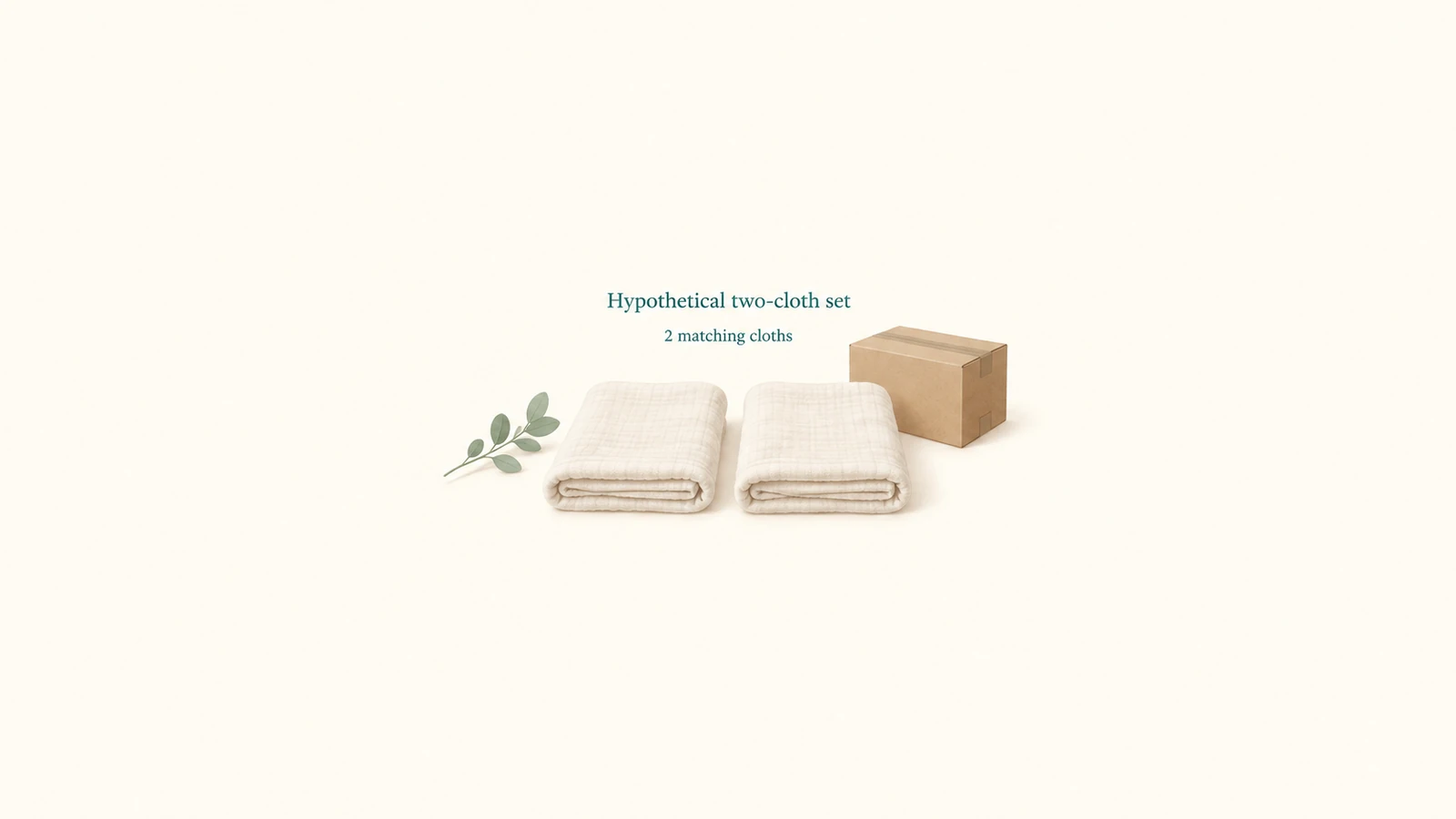
This guide uses US requirements and a hypothetical two-cloth set for a caregiver’s changing or burping routine. The set is not crib bedding or a tested product; the actual design, use and market determine what you can sell.
Explore this topic
01
Choose the job before choosing the product
Choose a routine you can support, such as carrying supplies or cleaning up after a feed. For each item, you need its exact contents, instructions and a workable customer remedy.
| Product branch | Useful offer details | What makes the choice different |
|---|---|---|
| Parent’s diaper bag | Compartments, dimensions, closures, straps and what is included | The caregiver uses the bag; that differs from a product intended for the child |
| Bib, burp cloth or baby clothing | Material, size, count, closures, care and intended use | Child contact and the particular design/materials affect the applicable requirements |
| Pacifier or teething item | Exact design, materials, age/use instructions and product identification | Mouthing and product-specific rules make a generic “baby safe” claim inadequate |
| Stroller, carrier, highchair or sleep product | Exact model, configuration, instructions and required product records | These can have specific standards, labeling and other requirements; sleep products also raise distinct restrictions |
On a phone, swipe the table sideways to compare every column.
A caregiver’s bag and a child’s item differ
CPSC explains that a diaper bag intended for a parent or caregiver is a general-use product, while the diaper used by the child is a children’s product. That is a useful distinction, not an exemption for everything in a parent’s shopping basket. Classification depends on the actual design, use and marketing.
For our hypothetical offer, the brief is two identical 80 × 80 cm cloths for a caregiver’s changing or burping routine, with the exact material, color and care instructions still to be established. These are illustrative requested dimensions, not a real supplier’s verified product. They are not a promise that loose cloths belong in a baby’s sleep space.
Write those details for your actual item: user, intended age and use, material, dimensions, count, components, instructions and destination. If the category still feels too broad, compare it with the dropshipping products guide.
02
Compare the actual item and supplier terms
Compare the same use, set and destination. A wholesale page, app listing and retail listing may describe products accurately yet offer very different access and shipping terms.
| Actual record reviewed | What the page identifies | What it does not establish for your order |
|---|---|---|
| KEAN security-blanket wholesale page | Stock-color bulk minimum of 1,000 pieces; dropshipping discussed for qualified wholesale partners | An approved individual-order account, final destination quote or verified certificate for your chosen version |
| Spocket’s Lavender Charlie Starfish Swaddle listing | Cotton muslin, 120 × 120 cm | A matched quote for our hypothetical 80 × 80 cm set, a tested sleep claim or approval for your market |
| Fareto F524 retail listing | Cotton muslin, six layers, 110 × 104 cm, in an India retail record | A wholesale dropshipping agreement, identical cloth to the Spocket item or US product clearance |
On a phone, swipe the table sideways to compare every column.
KEAN’s page makes the access question clear: bulk minimums and a conditional partner dropshipping offer are different commitments. MOQ means minimum order quantity. Ask whether individual orders are available to your account, how they are packed, and what you must pay or commit before that service starts.
Similar catalog items are not the same set
The Spocket listing and Fareto record describe different dimensions; Fareto also specifies six layers. These are seller descriptions, not sample measurements. Do not map them to one store variant because both say “cotton muslin.”
Compare one exact set and destination
Keep a candidate only when the supplier can quote the same item, count, use and destination you plan to advertise. For the two-cloth example, a larger single blanket is a different product, even if its headline price is lower. Put unresolved product evidence and individual-order access ahead of price when narrowing the shortlist.
Request a quote like this for your chosen offer:
Please quote the exact item, model/version, color and set count for this destination. Confirm material, dimensions, layers where relevant, intended use/age, care and instructions. Supply the applicable product-specific test/certificate and labeling information, identifying the version covered. Explain stock, lot identification, individual-order access or minimum commitments, packed weight/size, product/packing/shipping charges, dispatch timing, cancellation cutoff and missing/damaged-item return procedure.
Establish which photos and statements you may use. Hold a variant when its size, documents or delivery territory remain unconfirmed; do not fill gaps from photos or supplier sleep-safety claims.
For a proposed China-side route, AIDrop’s product sourcing service can discuss supplier, sample, packing and shipment coordination for the specified item. Send the product link, destination, intended use and current documents so the team can confirm the feasible work. Product classification, required testing and safety or sleep conclusions belong with the appropriate responsible parties and specialists; the sourcing discussion does not approve a baby product.
03
Match the product to the right requirements
For US sales, classify the actual product and intended use before asking for a certificate. Design, packaging and marketing matter; an age label alone cannot settle classification. A parent’s bag and a child’s pacifier do not share one universal baby-product test.
Match documents to the exact version
Before you list one item, match four things to that item and version:
- The certificate. Where applicable rules require a Children’s Product Certificate (CPC), obtain it from the domestic manufacturer or importer. It identifies the product, rules, certifier, production and testing details. A “CPC available” badge on a supplier page does not tell you whether it covers your version.
- The supporting test reports. Check the actual model and materials. Applicable children’s-product testing generally uses a CPSC-accepted third-party lab, subject to relevant exceptions or determinations. A testing exception does not automatically remove certificate duties, and a toy report cannot stand in for a different product’s requirements. CPSC’s certificate guidance explains the particulars.
- The production lot. Children’s products need required permanent tracking information on the item and packaging, to the extent practicable. Keep the lot linked to customer orders so affected units can be found. Durable infant or toddler products may also need additional marking and consumer registration; registration is a separate duty.
- The importer and filing route. For a US import requiring CPSC certification, name the importer and confirm with its customs broker how matching certificate data will be filed electronically. CPSC’s eFiling FAQ gives July 8, 2026 as the general start and January 8, 2027 for specified foreign-trade-zone entries. A low shipment value does not remove eFiling for a product requiring certification, and emailing a CPC does not file the data with customs.
Some categories need their own specialist work
US strollers/carriages, highchairs and soft infant/toddler carriers have distinct rules—16 CFR parts 1227, 1231 and 1226 respectively. Applicable incorporated standards can depend on manufacture date. Obtain the exact model’s rule/version information, instructions and required labels/registration material rather than picking one supposedly latest ASTM standard for all three.
Pacifier attachments need their own check
Pacifiers have their own rule too. CPSC says they cannot be sold or distributed with ribbon, string, cord, chain or similar attachments. Separate clips or lovies fall outside the pacifier definition but still have their own applicable children’s-product requirements. That distinction is not a blanket approval or ban for every separate clip.
If the supplier cannot establish the product version and required evidence, hold the offer and choose an item you can support.
Keep sleep products and sleep claims separate
Changing the name does not change sleep use
CPSC’s infant-sleep-product standard addresses products intended or marketed for sleep accommodation for infants up to five months old that are not already covered by five existing sleep-product standards, such as the crib and bassinet standards. Actual design and marketing matter. Calling a sleep product a daytime lounger does not necessarily remove it from scope.
Check the actual banned-product definition
The Safe Sleep for Babies Act bans defined inclined sleepers for infants and crib bumpers. Its inclined-sleeper definition uses a sleep-surface angle above 10 degrees and sleep accommodation for infants up to one year old. Non-padded mesh liners are outside the Act’s bumper definition, but that exclusion does not make them a safe-sleep recommendation.
Caregiving cloths do not belong in infant sleep space
NICHD’s safe-sleep guidance calls for a firm, flat, level sleep surface with a fitted sheet and an otherwise empty sleep space. Loose blankets, pillows and toys do not belong in that recommended setup. Car seats, strollers and carriers are not recommended for routine infant sleep. Do not turn a muslin’s softness or breathability into a SIDS-prevention or overheating guarantee, or sell a monitor as a substitute for safe-sleep practices.
04
Check a sample and write an accurate offer
Check the set that will ship
Request the exact version you intend to list. For our hypothetical set, check that the package contains both cloths. Compare their dimensions, material, seams, color, care label and packing with the supplier’s description. Record what a real sample shows and what remains unknown; we have not inspected one.
A sample wash is not future safety proof
Follow the manufacturer’s care instructions. An ordinary wash check can show what happened to that sample, but it cannot guarantee that every shipment will resist shrinking or fading. Do not turn the supplier’s adjectives into an invented test result.
Keep safety evidence separate from a sample check
A tidy seam or sample photo cannot replace required safety testing. Do not improvise choking, load or infant-sleep tests at home. Match the exact product to its applicable documents and instructions, then revisit those records if materials, components or design change. The quality control guide explains what ordinary inspection can and cannot establish.
Show exactly what the buyer will receive
For a two-cloth offer, photograph and describe two cloths. Show their actual count, dimensions, material, color options and care instructions. Keep carton measurements separate from cloth measurements; do not substitute the supplier’s larger single blanket for this variant. Images should show a supported use without implying an approved sleep setup or an unverified health benefit.
Publish only when the listing, supplied version and necessary product information agree. The customer should be able to tell what arrives in the box.
05
Price the whole set and a missing-item remedy
Use the complete customer offer in your calculation. The following hypothetical US-dollar amounts are for our two-cloth set, not a quote from any supplier named above.
| Item | Amount |
|---|---|
| Customer pays for the set | $34 |
| Two-cloth set | −$11 |
| Packing | −$2 |
| Shipping | −$6 |
| Payment charge | −$1 |
| Cost to acquire this order | −$8 |
| Remaining contribution | $6 |
On a phone, swipe the table sideways to compare every column.
The $6 contribution is what the order leaves toward other business expenses, before overhead, taxes, refunds and costs not counted here. Add actual platform, insurance, product review/testing, import and other applicable expenses. A supplier’s item price alone cannot show net profit; unknown charges are not zero.
Compare the cost of a replacement and a refund
A missing cloth adds another parcel cost
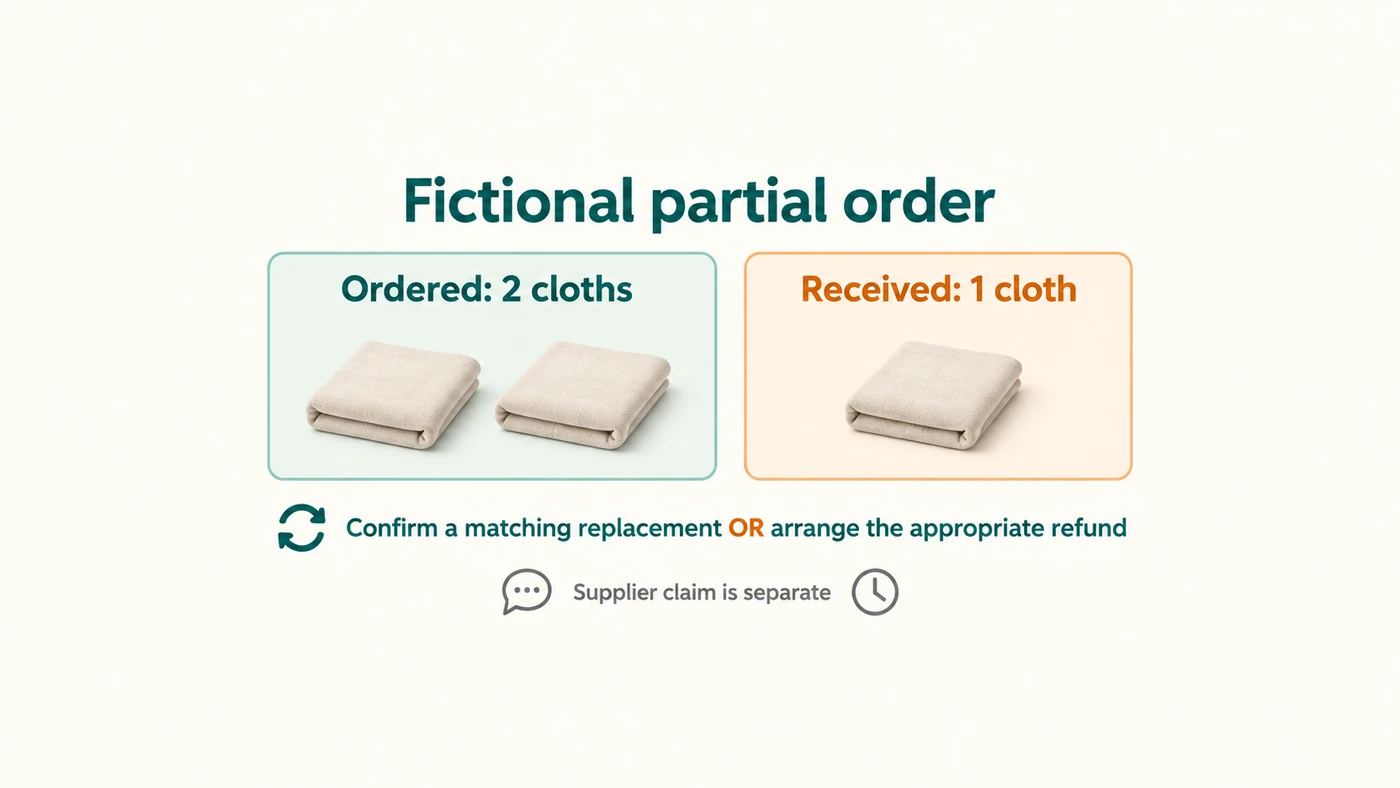
Now imagine one cloth is missing. For this example only, split the $11 set cost evenly: $5.50 per cloth. If a confirmed matching replacement cloth costs $5.50, plus $2 packing and $6 shipping, completing the order adds $13.50. With no supplier recovery or extra payment/advertising cost, the order becomes $6 − $13.50 = −$7.50. The extra parcel costs more than the original contribution.
A full refund is a separate calculation
Alternatively, a full $34 refund with all original costs still spent, no supplier recovery and no new return expense gives $6 − $34 = −$28. This is a separate outcome, not a refund added to the replacement example. The original $11 set cost was already counted when calculating $6; do not subtract it twice. Choose the proper customer remedy under the actual rights and terms, not simply the cheaper result.
Leave enough cash for the first orders
If fifteen initial orders need $19 each for the set, packing and shipping before payout, those supplier payments require $285. Marketing and other bills may need cash in the same gap, and a remedy can need money before a supplier pays a claim. Build the payment timeline with your actual quote. The unit economics guide explains the wider cost calculation.
06
Send the complete set and resolve customer problems
Give the supplier the exact product/version, color and set count, linked to the customer’s order. Confirm stock and acceptance. For our hypothetical offer, the packing instruction is two matching cloths in the agreed parcel, with the applicable labels and care information. One cloth or a different-sized blanket is not the same order.
Packing count and carrier handoff need checking
Have the supplier confirm the packed count and parcel, retain the required product/lot references, and track actual carrier acceptance. A tracking label alone is not dispatch. Agree cancellation cutoffs and get a confirmed stop when one is possible; a cancellation message does not prove the parcel was stopped. Hold unapproved substitutions rather than making the customer resolve a product change after delivery.
Complete a partial order without guessing
Check what was promised and packed
Compare the product description and paid order with the supplier’s packed count and the buyer’s report. Two cloths were promised. One received cloth and one tracking number do not establish that the complete set arrived.
If there is a real second parcel
Confirm that the second cloth is in a genuinely agreed shipment linked to this order. Give the buyer its actual tracking and delivery information. Do not invent a parcel or treat an unconfirmed supplier message as dispatch.
If the cloth is missing
Choose a supported remedy for the missing item. The replacement must match the original item and version, as explained below. Keep the order marked as needing the missing-item remedy until that action is actually completed.
A replacement should match the original item and version and be available on a usable route. If that cannot be established, offer the appropriate refund or other remedy under the customer’s rights and your terms. Give clear return instructions and an authorized receiving address if a physical return is needed.
Buyer remedy and supplier recovery are separate
The store can resolve that customer issue while separately requesting reimbursement from the supplier. Record the missing item, customer remedy and supplier claim, then distinguish a requested credit from money actually received. The returns guide explains that separation. Update the picking instruction or set-count mapping that caused the short shipment.
A safety problem needs product-specific action
Stop affected dispatches and identify the actual product
If the customer reports a possible safety problem, do not ask them to keep using the item or run a home test. Identify the actual model/version and lot, stop affected sales or dispatches while the responsible parties determine the action, and follow the applicable manufacturer or regulator instructions.
Follow the actual recalled-product notice
For example, CPSC’s September 17, 2026 SHEIN teething-toy recall identifies specific Pull & Chew Montessori Teething Toys and packaging SKUs, including sa25092843915310553. It tells affected owners to stop use, remove the toys from children and contact SHEIN for a refund, with specified destruction, photo and disposal steps. Check the actual notice’s product identifiers and instructions. Those steps apply to the recalled products; they are not a universal return procedure for every baby item.
Keep affected order records and customer communications together. A supplier credit or a new product name does not clear recalled stock for resale. The customer needs the correct next step for the actual product, while the store separately handles reimbursement and the underlying supply problem.
07
Questions before your first sale
Is one supplier certificate enough for every baby product?
No. Match the actual product, applicable rules, materials and version to its supporting information. A parent’s bag, textile, pacifier and stroller do not become one tested item because they share a catalog. Durable-product registration and tracking also have different purposes from certification.
Does breathable fabric mean a blanket is safe for infant sleep?
No. A fabric description does not establish an approved sleep use or a SIDS-prevention effect. Keep the supported product use and instructions accurate, and follow the safe-sleep guidance rather than adding loose textiles to a sleep space to demonstrate your offer.
Can I start without holding inventory?
A usable supplier may hold and ship the goods, but your store still needs money for orders and remedies, accurate product information and a working customer response. Finish one product/use brief, matched supplier quote, applicable document record and funded order routine before expanding the assortment.
Dropshipping Products: Practical Ideas and How They Compare
Compare concrete dropshipping product ideas, from pouches and phone stands to apparel and wall art, with shipping,
Gift Basket Dropshipping: Choose a Supplier and Keep the Gift Promise
A gift basket can be dropshipped, but the recipient must get the contents, message and delivery experience

Wedding Favor Dropshipping: Get the Count and Event Date Right
Wedding favors can ship directly to a host or venue, but the sold unit, guest count and
