
Supplement dropshipping means your store sells a specified supplement and a supplier ships it directly to the customer. Start with one product and destination, compare usable supplier routes, match the formula and label to your offer, and agree costs and customer responses before listing.
A bottle with your logo is still a product someone will swallow. Your store needs to explain what is inside, send the correct version, and act when a customer reports damage or a health problem. A supplier can handle fulfillment without settling all of those responsibilities for you.
This guide uses US requirements as a practical example and follows a clearly hypothetical capsule order. It does not recommend a supplement, dose or health benefit. Other destinations have their own product, claim and import rules, so a US offer cannot simply be copied into every market.
01
Choose one bottle offer
Choose a format you can describe precisely: capsules, softgels, gummies, a powder or a liquid. Then establish the actual formula, package size and intended market. Two bottles called “magnesium” need not contain the same ingredients or amounts. A flavored powder also brings ingredients and storage questions that a product name alone cannot answer.
Under FDA’s supplement definition, the product is intended to supplement the diet and is ingested. A topical cream or inhaled product does not become a dietary supplement because a supplier puts it in a wellness catalog. A product presented as conventional food or a sole meal has a different classification, and disease-treatment claims can bring a drug question.
Existing brand or private label?
Decide whether you will resell an existing brand or use a private-label offer. Resale keeps another brand’s product identity, subject to the right to sell and use its materials. Private label puts your brand on a supplier’s product. That creates label and responsibility questions; it does not necessarily mean you designed a new formula.
Turn the product name into a specific bottle offer
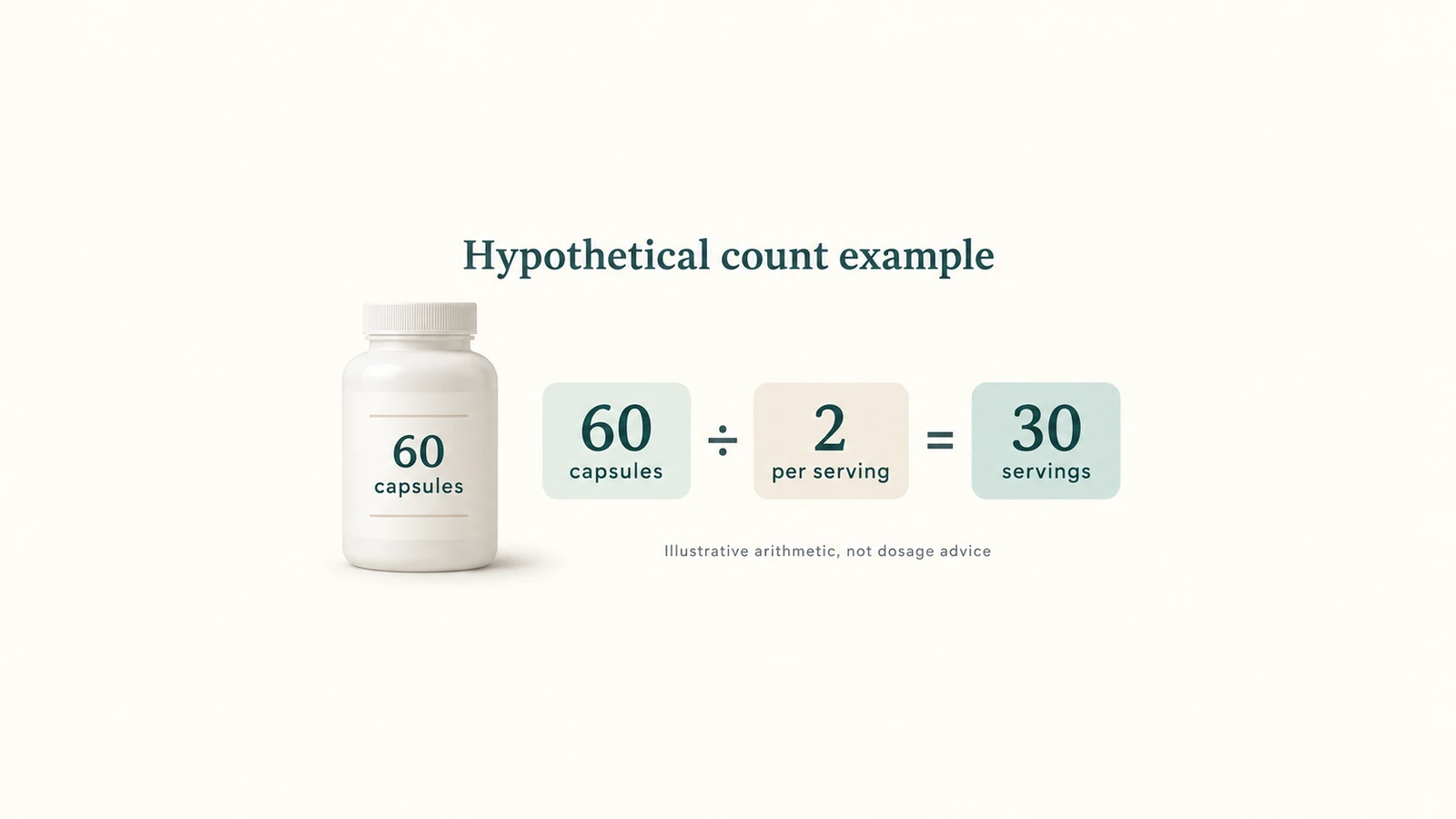
For our hypothetical offer, imagine a bottle containing 60 capsules with a declared serving size of two capsules. That is 30 servings, not 60. This is arithmetic to explain the listing, not advice to take two capsules or a verified formula. The actual product’s directions, warnings and serving information must come from the matched, properly reviewed product information.
Your product brief should identify the supplier’s product code, form, formula and ingredient amounts, bottle count or net quantity, servings, other ingredients, relevant allergen information, directions, warnings and storage. Add the intended destination, current label version and every health statement you plan to publish. The broader products guide can help you compare this work with other categories before committing to supplements.
02
Compare suppliers for your destination
Compare suppliers against the same product brief and delivery destination. A large catalog is less useful than a supplier able to provide the exact bottle, current product information, a usable parcel quote and a clear response when something goes wrong.
| Route | Actual example reviewed | What to establish before choosing it |
|---|---|---|
| US private-label fulfillment | Supliful describes US-manufactured products, label branding and individual-order fulfillment | Exact formula and label, account terms, stock, processing and shipment charges, and who handles product and health reports |
| EU branded-product resale | Dropply describes a business-only catalog, language feeds and direct parcels within its listed EU destinations | Account eligibility, valid EU VAT number, local product/claim suitability and a quote for the country and weight |
| Direct manufacturer arrangement | A product-specific manufacturing or supply agreement | Formula and production responsibilities, minimum commitments, labeling, storage, fulfillment and destination duties |
On a phone, swipe the table sideways to compare every column.
Supliful’s page advertised 48-hour US fulfillment and two-to-five-business-day US delivery when reviewed on September 28, 2026. Those are provider statements, not delivery results we tested. Confirm what starts the processing clock, whether a label check can hold the order, and what happens when stock runs out.
Dropply describes an EU route with country and weight-based shipping charges. Its EU account and translated product feed do not establish a US route or approval for every local claim. Do not copy one country’s starting shipping price into another destination’s cost sheet.
Send a request that makes the supplier’s reply comparable:
Please quote this exact product and label version for this destination. Confirm the formula, bottle quantity and servings; supply the current ingredients, directions, warnings and storage information. Identify who manufactures, packs, labels and holds it, what product/batch documentation is available, and how lot information reaches our order record. Give the packed size and weight, product/label/packing/shipping charges, stock and processing terms, cancellation cutoff, and damaged-bottle and health-report contacts.
Ask for a sample and applicable selling/image rights too. A supplier saying “registered facility” or “GMP certified” should not replace the requested product and manufacturing information. GMP refers to good manufacturing practice; its relevant US scope is explained below. We have not opened these accounts or approved either provider’s products.
If a China-side supplier is part of your proposed route, AIDrop’s product sourcing service can discuss whether supplier, sample, packing and shipment coordination is feasible for the specified item. Send the product link, destination and available product documents for that scope discussion. Product legality, formula and claim review, food-import duties and any necessary testing require the appropriate responsible parties and professionals; this is not a product-approval or medical service.
03
Make the label and product page describe the same product
Get the current label for the exact formula before designing a logo or listing the bottle. For a US dietary supplement, check the product identity, net quantity, Supplement Facts, other required ingredient information and the named manufacturer, packer or distributor. Your brand name alone does not fill those fields.
The Supplement Facts panel describes the serving and dietary ingredients. Other Ingredients identifies other constituents, such as relevant binders or flavors, separately as required. Match both to the actual formula. A retailer should not reconstruct a complete panel from a catalog photo or an old generic template.
Put the bottle beside your draft product page and compare the count, servings, ingredients, directions, warnings and storage line by line. If the supplier changes a formula or label, pause the affected listing until you know which version will ship. Supliful’s label verification page describes its own review and possible order holds; that review is not FDA approval or clearance for every destination.
Replace placeholders with the right real contact
Supliful’s generic RLC4FISS Omega-3 PDF illustrates the problem: its extracted text identifies 100 softgels, but the business and contact fields remain placeholders. Do not send a placeholder to print. We checked the PDF text, not the full visual panel or the underlying formula, so this example does not approve that label or product.
For the covered US adverse-event contact requirement, FDA specifies a full domestic US mailing address or a domestic telephone number, including the area code. Email or a website may be additional contacts; they do not replace that required contact. Both address and phone are not mandatory under this particular requirement. Separately retain the applicable name-and-place-of-business labeling information.
If your draft says “phone or email,” replace it with the correct real contact and have the entire current label reviewed before printing or publishing. Also check that the named business matches the party that will receive and handle reports.
Keep health statements within their actual support
Statements about curing, treating or preventing disease can change the product’s regulatory position. Do not paste a supplier’s promotional paragraph into your store and assume it is acceptable because the ingredient appears in a supplement catalog.
Certain structure/function statements—statements about the body’s normal structure or function—have their own US conditions, including substantiation, the required disclaimer and notification to FDA within 30 days after first marketing where applicable. FDA’s claim guidance does not turn a disclaimer into permission to make an unsupported claim.
Advertising has a separate practical test. The FTC’s health-products guidance requires appropriate support for objective express and implied health claims. Consider what the whole page, image or testimonial communicates. Until the particular statement has suitable support and review, describe the verified product contents and format without inventing a health result.
04
Know who makes, holds and imports the product
Trace one bottle from production to the customer. Write down who makes it, who packs and labels it, and whose warehouse holds it. Then ask two separate questions:
- What does each party do? US dietary-supplement current good manufacturing practice (cGMP) requirements cover relevant manufacturing, packing, labeling and holding activities. A factory’s registration does not approve the finished bottle. FDA’s cGMP guide describes a retail-establishment exception, but it does not exempt a separate retailer warehouse that holds supplements. If you start storing or relabeling bottles yourself, review that new role before moving the stock.
- Does this formula raise an ingredient question? A new dietary ingredient may require premarket notification at least 75 days before introduction, depending on the conditions and exceptions. This is neither a filing for every bottle nor FDA approval. Have the manufacturer and qualified advisers check the actual ingredient before you promise the product.
Agree who receives and forwards health reports
A hospital message needs its own route
A customer writes, “I took this and went to hospital.” That message belongs in a health-report process, not an ordinary return ticket. Before selling, give support a named contact and a same-day forwarding route.
Identify the named responsible party
FDA’s reporting guidance links the responsible person to the manufacturer, packer or distributor named on the label. If your store is named, establish whether a qualifying agreement assigns reporting to the manufacturer or packer; still forward any report your store receives.
Know what starts the reporting clock
For covered serious reports received through the label’s address or phone, the responsible person generally has 15 business days to report once the minimum information is known: an identifiable patient and reporter, the responsible person’s identity and contact, the suspect product and the serious event.
Follow-up information has its own deadline
New medical information received within one year has its own 15-business-day deadline, and required records are kept for six years. FDA recommends prompt reporting on the same timeframe for serious information arriving through other channels.
Give support a real recipient
Write the responsible party and forwarding method into the supplier agreement. A support agent should be able to send the actual customer message to that contact today, without searching for the party after a report arrives.
Keep the information available
Record the message as received, the customer and reporter details available, the exact bottle/order and any known lot, plus when it arrived and when it was forwarded. Leave unknown details identified as missing and seek them promptly. Do not invent a lot or require the buyer to prove causation before routing the report.
A foreign shipment needs a separate import plan
Plan the actual food import
For a US commercial import, establish applicable food-facility registration and prior-notice arrangements. FDA’s import overview explains these requirements and exceptions; it does not approve individual food products, labels or shipments. A small parcel is not a blanket exemption for a commercial supplement sale.
Direct foreign shipping needs an importer
Identify the importer before promising direct foreign shipment. Under the Foreign Supplier Verification Program, or FSVP, that is generally the US owner or consignee, or a specified consenting US representative if neither exists. The duties depend on whether the shipment is a finished supplement or an ingredient and on the parties’ manufacturing duties. A finished supplement is not automatically exempt; some verification focuses on supplement cGMP requirements. Have the actual product and route reviewed before making foreign parcels your normal fulfillment method.
05
Check the sample and price the whole order
Order the exact bottle and label version you intend to offer. An ordinary sample check should compare the product code, count, printed information, seal, lot identification, condition and finished parcel. A lot is a production group that helps link an individual bottle to its source and related orders.
Ask how the supplier stores the product, manages dated stock and protects it on the proposed route. FDA does not generally require a supplement expiration date, but a date used should have support. Do not invent one from another product or promise the same remaining shelf life on every order without an agreement.
Inspection does not establish potency
Looking at a bottle cannot establish its ingredient amounts, potency, contamination status or the compliance of every production batch. Request the relevant manufacturing and product/batch records for review by the appropriate parties. Do not use a customer trial or a home tasting test as product verification. The quality control guide helps distinguish an ordinary inspection from questions it cannot answer.
Now price the complete order. These hypothetical US-dollar amounts illustrate the calculation; they are not Supliful’s or another supplier’s quote.
| Item | Amount |
|---|---|
| Customer pays | $36 |
| Bottle | −$12 |
| Label and packing | −$2 |
| Shipping | −$5 |
| Payment charge | −$1 |
| Cost to acquire this order | −$8 |
| Remaining contribution | $8 |
On a phone, swipe the table sideways to compare every column.
The $8 contribution is what this order leaves toward other business costs. It is before overhead, taxes, refunds and expenses not included above. Add actual platform fees, professional/product review, insurance, import charges and other applicable costs. Unknown costs are not zero, and contribution is not net profit.
Compare replacement and full refund separately
If you send a free replacement, another $12 bottle, $2 label/packing and $5 shipment add $19. With no supplier recovery or extra payment/advertising charge, the result is $8 − $19 = −$11. Alternatively, a full $36 refund with all original costs still spent, no recovery and no new return expense gives $8 − $36 = −$28. Those are separate remedies. The original bottle cost is already in the $8 calculation; do not subtract it a second time when calculating the refund.
Twenty bottles need supplier cash before payout
If twenty first orders require those $19 supplier payments before your provider pays out, you need $380 for supply alone, plus any marketing and other cash needed in the gap. Agree the payment and payout timeline before offering more orders than you can fund. The unit economics guide explains how to use your own actual inputs.
06
Ship the correct bottle and act on complaints
When an order arrives, confirm the exact product code, formula and label version, destination and available stock with the supplier. Do not allow a different formula or strength as a substitute without resolving whether it is an appropriate, properly supported offer. A familiar product name is not enough to authorize that change.
Connect the lot to the actual order
Have the supplier’s lot information associated with the order, and retain the fulfillment and carrier references. Confirm the packed item and actual carrier handoff; a created tracking number does not establish dispatch. Establish cancellation cutoffs before taking orders. Supliful’s reviewed policy says a prepared product may no longer be cancellable even if it has not shipped, and a label change can hold active orders.
A damaged bottle needs a customer remedy
Suppose our fictional customer reports a broken seal. Ask them not to use that bottle, collect the order and lot/label information and suitable photos, and explain the appropriate replacement or refund under the applicable rights and your terms. Do not send another bottle from a potentially affected supply without resolving the problem, or put an opened returned bottle back into saleable stock.
Keep the customer’s remedy separate from a supplier claim. Supliful’s policy describes a 30-day submission window for damaged, defective or misprinted products, photos and an explanation, followed by provider review. It also excludes certain cases such as buyer’s remorse or customs rejection. These are provider terms, not a universal consumer return period or a health-report deadline.
Confirm cash versus supplier credits
Its refund-method wording also conflicts: one passage describes the original payment method, while another describes Supliful credits and a separate request for cash. Ask which method applies to your account and approved claim. A supplier credit request, an account credit and money received are three different states. The returns guide explains how to track those alongside the customer remedy.
A health report needs its own response
If a customer reports a health problem, treat that message separately from the request for a refund. Direct them toward appropriate medical care, record what they report along with the order, product and lot, and promptly forward the message to the responsible contact you identified before launch. Do not wait for the supplier’s refund decision or demand proof of causation before forwarding a possible adverse event.
Inpatient admission is more specific than a visit
Serious events include outcomes such as death, a life-threatening experience or inpatient hospitalization; the full official definition and reporting requirements govern the actual assessment. Use the responsible party’s qualified reporting process, including the deadlines explained above, rather than waiting for a supplier refund decision.
A refund does not clear affected stock
If there is a suspected product safety problem, hold affected sales or dispatches while the responsible parties establish the appropriate action. Identify the actual product and lots, retain records and follow any applicable recall instructions. A refund resolves a money issue; it does not by itself resolve a health report or clear the remaining stock.

07
Questions before listing
Does an FDA-registered factory make the supplement FDA approved?
No. FDA does not generally approve dietary supplements before marketing. Registration, a provider’s label check and a manufacturing statement do not establish that your particular formula, label or advertising is acceptable. Resolve the actual product and role requirements described above.
Can I sell the same offer through every Shopify service?
Do not assume so. Store hosting, Shopify Payments, the Shop sales channel and Managed Markets have different eligibility rules. Managed Markets restricts ingestible products such as vitamins and supplements within that service; that is not a statement that every supplement is banned from every Shopify store. Check the actual country, product, payment provider and channel. Stripe also identifies restricted nutraceutical activities and unsafe or harmful claims; a lawful product is not automatically approved for an account.
What should I have before accepting the first order?
One defined product and destination, a current matched label and supported product page, named manufacturing/holding/import/reporting responsibilities, a confirmed supplier quote and channel route, and a funded customer-remedy plan. Start with that complete offer. More catalog entries can wait until you can repeat the same work accurately.
Dropshipping Products: Practical Ideas and How They Compare
Compare concrete dropshipping product ideas, from pouches and phone stands to apparel and wall art, with shipping,

Beauty Products Dropshipping: Claims, Ingredients and Supplier Records
Choose an explainable beauty range with actual supplier examples, product and label questions, a worked bottle-cost example,

Hair Extension Dropshipping: Choose the Length, Texture and Order Route
Compare actual hair vendor routes, fill a precise bundle or wig request, budget app access and a
