
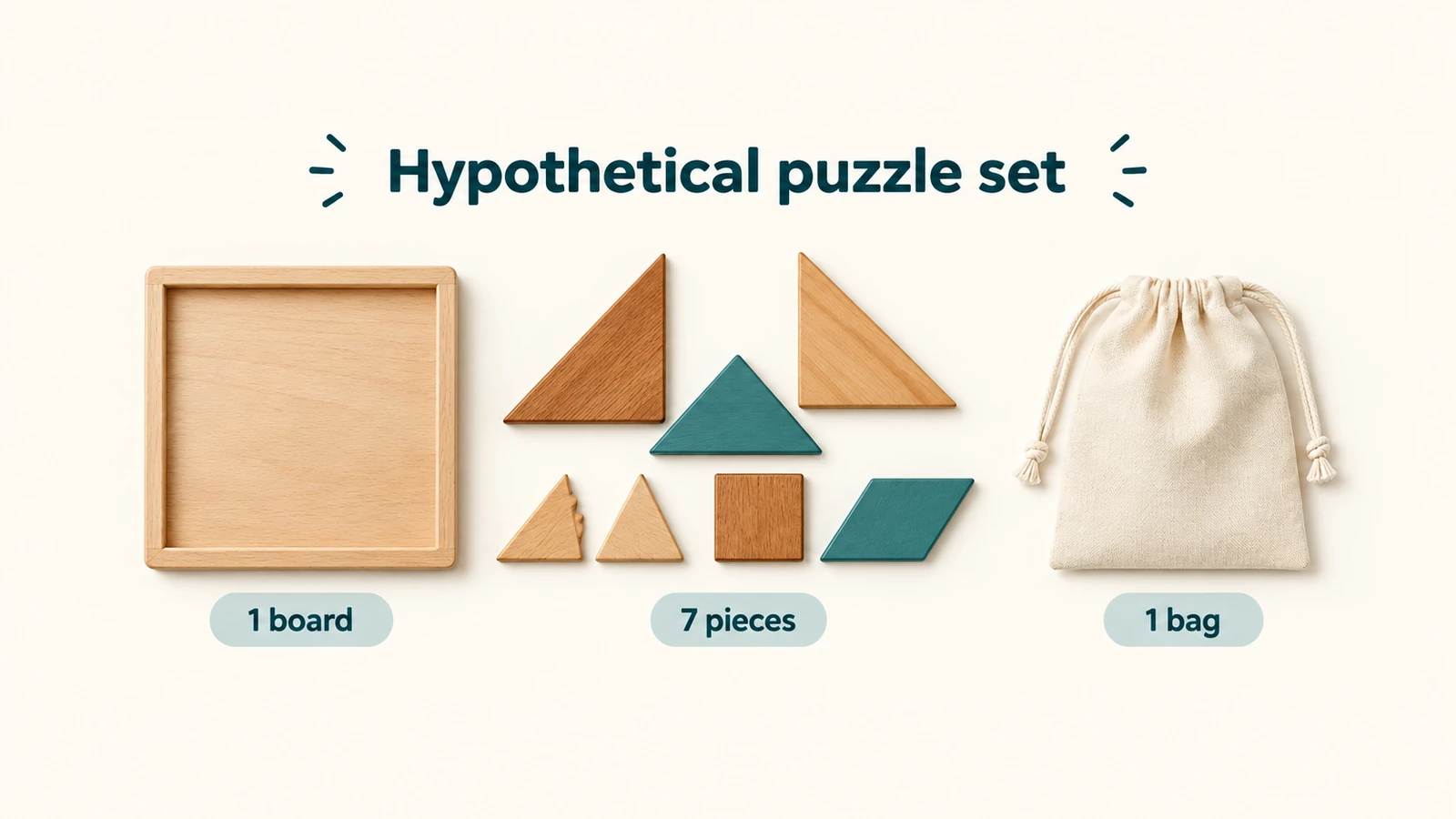
Toy dropshipping means a supplier ships each customer order while your store sells and supports the toy. Start with one play activity and an intended age, then compare suppliers for that exact toy, destination and complete set. Confirm the product evidence, delivered cost and missing-item remedy before listing it.
A parent ordering a puzzle needs to know which pieces arrive, who it is for and when it will arrive. Your store has to answer those questions and resolve problems even if it never handles the box.
This guide uses a hypothetical seven-piece wooden puzzle to show how sourcing, costs and customer support connect. It is an example to work through, not a tested or approved product. The regulatory examples concern US sales; other destinations need their own product and import review.
Explore this topic
01
Choose a play activity before choosing a catalog
Start with the play activity your customer is buying for. School-age puzzles and infant teethers call for different age, component and product-rule checks. A gift buyer also needs to see the complete set and its packaging.
Compare a few groups before choosing one to source:
- Puzzles and construction sets: Check piece count, dimensions and included items; small parts or magnets can change the review.
- Plush toys: Check size, fabric, filling, attachments and care instructions. Photos must show the actual scale.
- Creative kits: Identify every material and tool; liquids or sharp tools change what you need to assess.
- Toy vehicles and powered toys: Separate simple models from battery-powered versions, which may need different instructions, packing and shipping.
One board, seven pieces and a bag
For our hypothetical puzzle, the proposed offer is one board, seven puzzle pieces and one storage bag for a school-age play activity. The final age recommendation still needs support from the actual design and product assessment. Specify those contents before comparing a supplier’s price for a board alone with another supplier’s price for a complete set.
“Wooden,” “Montessori” and “educational” do not establish safety or a learning result. Describe a supported activity—such as arranging the pieces into shapes—without inventing developmental benefits. Also watch for products mixed into toy catalogs: a baby rocker is a separate infant-product decision, not automatically an ordinary toy.
Use the broader dropshipping product guide if you are still choosing a category. Once you choose toys, narrow the offer enough that you can explain and support each item.
02
Compare toy dropshipping suppliers for the same destination
Curated brand catalogs, fulfillment platforms and direct suppliers can all be starting points. Compare each for the same toy and destination. Before choosing, confirm account access, stock and written terms for individual orders.
| Sourcing route | A real example to investigate | What to establish before choosing it |
|---|---|---|
| Curated brands and store integration | Hertwill publishes a toy catalog and a product-import/order workflow | Its catalog has EU/UK shipping filters and login-only wholesale prices. Confirm the exact brand, destination, stock, delivered quote and returns arrangement for your account. |
| Platform sourcing and fulfillment | Zendrop advertises toys and store-based fulfillment | Confirm the precise product, documents, ship-from location, destination service, packing and fees. Platform safety or delivery marketing is not proof for your toy. |
| Direct supplier or manufacturer, with coordination if needed | An identified supplier quoting your selected toy or custom version | Establish individual-order fulfillment versus an upfront batch purchase, product-version documents, sample and packaging costs, substitution rules and who handles exceptions. |
On a phone, swipe the table sideways to compare every column.
These are routes to compare, not approved-supplier rankings. The public Hertwill catalog and Zendrop toy page describe their offers; neither establishes that your proposed toy and market have been approved.
Shortlist only routes that can ship to your customer’s destination and identify the exact version. Then compare the complete set, product records, packed delivery quote and remedy terms side by side. A board-only listing and a complete-set quote are not comparable until you know what each customer would receive.
Read the product page, not only the category promise
A specific listing reveals more than a broad category promise. At the September 28 check, ShipToMoon’s wooden tangram page showed seven variants and marketed young ages, including under three, but did not give an exact board dimension. Seven variants do not mean seven included pieces. That page alone is insufficient to write your final size, contents or age recommendation.
Send a request the supplier can answer. For our hypothetical offer:
Please quote the exact puzzle variant for individual US customer orders. Confirm the board, seven pieces and bag; materials, dimensions and proposed age/use; manufacturer and product-version references; applicable certificate and test-report details; current stock and substitution policy; packed weight and dimensions; processing time, destination shipping and all charges. Explain the cancellation cutoff and remedies for missing pieces, damage and an incorrect item. Please also confirm permission to use the product photos.
Compare replies against the requested variant and destination. A generic certificate for another toy leaves the document question open. If individual-order service requires prepaid stock, include that commitment in your funding plan.
For a China-side sourcing question, AIDrop’s product-sourcing service can help coordinate supplier comparisons, sample requirements and packaging details within an agreed scope. Send the product link, destination, intended use and the specific unanswered question. A sourcing review does not approve the toy’s age classification, laboratory testing or legal compliance.
03
Match the age, documents and product version
An age label must match the actual toy
The proposed age has to make sense for the actual toy. In the US, CPSC considers the manufacturer’s reasonable age statement, packaging and advertising, how consumers recognize the product, and its age-determination guidance. An older-age sticker alone cannot turn a toy designed and marketed for toddlers into an adult product. CPSC’s children’s-product guidance explains those factors.
A warning cannot make an under-three hazard acceptable
Small pieces deserve particular attention. Products intended for children under three can be banned if they present a covered small-parts hazard, including parts released during the prescribed use-and-abuse tests. A warning does not make a prohibited design acceptable. Let a qualified product specialist determine the applicable requirements; do not improvise destructive tests at home. CPSC’s small-parts guidance gives the scope and exceptions.
Ask which rules and reports cover this toy
Ask the supplier for a short evidence pack for the exact puzzle version. Check it in this order:
- Age and applicable rules. The US toy standard covers toys for children under 14; children’s testing and certification requirements primarily concern products intended for children 12 or younger. ASTM F963-23 has an April 20, 2024 effective date under the manufacture-date rules. Which sections apply depends on the toy. A battery-powered car and our wooden puzzle need different assessments. Start with CPSC’s toy-safety guidance.
- Materials and coatings. For covered children’s products, CPSC distinguishes a 100 ppm total-lead limit for accessible components from a 90 ppm limit for paint and similar coatings; certain phthalates have a 0.1% limit for covered accessible components. Whether each rule applies depends on the materials and product. “Natural wood” does not settle it. Check CPSC’s lead and phthalates guidance.
- Certificate and test reports. Where a Children’s Product Certificate (CPC) is required, the domestic manufacturer or importer issues it for the actual model and version, listing the applicable rules, certifier, testing and production details. Match its reports to that version and confirm the lab is CPSC-accepted for tests that require it. A report for another puzzle does not answer the question. Changes to materials can require another review; a testing exception does not automatically remove certification duties. See CPSC’s CPC and third-party-testing guidance.
- Batch or lot traceability. Ask which production group each customer order comes from. Children’s products and packaging need the required permanent tracking marks to the extent practicable, identifying the manufacturer or private labeler, place/date and batch. Those marks help you find affected orders; they serve a different purpose from the CPC. See CPSC’s tracking-label guidance.
Establish who handles the import
For a US import, establish the importer and who supplies and transmits the required certificate information. eFiling means submitting the required certificate data electronically for the import. CPSC’s general implementation date is July 8, 2026; the specified foreign-trade-zone entry requirements take effect January 8, 2027. A product requiring certification has no Section 321 shipment-value exemption from eFiling.
At our October 11, 2026 check, CPSC still describes initial warnings for missing filing data rather than entry rejection solely for that omission. Certificate requirements remain enforced. Preparing the certificate and submitting its import data are separate jobs; ask the actual importer and broker who will complete each.
How the certificate reaches the import filing
CPSC’s eFiling guidance describes two ways to provide certificate data. Agree on the route with the actual importer and broker before dispatch.
Full PGA Message Set
The filing includes the seven certificate-data elements: product identifier, applicable rule citations, manufacture date and place, testing date, testing laboratory and the certificate-record contact. Match them to this toy version; a supplier logo or generic report is not a substitute.
Reference PGA Message Set
The broker uses the Certifier ID, Product ID and Version ID for the corresponding certificate in CPSC’s Product Registry. Give the broker the actual matching identifiers. Saving a certificate in that registry is not itself the customs filing.
For this import example, the importer still needs the real product/version and certificate. These instructions do not establish that a certificate exists, that an import has been filed or that the toy has passed testing.
What should be resolved before the toy goes live
Before listing, you should have a supported age/use decision, the applicable product-version documents, labels and a clear import arrangement. If a material question remains unanswered, keep that toy unpublished while the responsible specialist resolves it. A supplier’s “all certificates available” message does not finish that work.
04
Check the complete set and show what the customer gets
Order the exact variant you plan to sell and identify the version it represents. For the hypothetical puzzle, count the seven pieces, board and bag against the agreed contents. Record the actual dimensions and measurement method. Look for visible damage, finish differences, missing instructions and labels that do not match the product information.
Those ordinary checks help you understand the sample. They do not replace the required safety tests or establish that every future unit will match it. The quality-control guide explains how an approved reference becomes specific inspection and packing instructions.
Measure the parcel that keeps the set together
Review the package too. Can the supplier keep every piece together and protect the board using the agreed packing method? What are the complete parcel’s weight and outer dimensions? A picture of the toy alone cannot answer the shipping-cost question.
Write the product page from confirmed information:
- Show the exact variant, complete contents and useful measurements. Make it obvious if an accessory in a photograph is not included.
- Give the supported age recommendation and relevant instructions and warnings. Keep the wording consistent with the reviewed product.
- Explain processing time separately from carrier transit, with destination conditions and the actual delivery offer.
- Make contact, cancellation and return information available before purchase.
Use photos you may publish that show the supplied version. Demonstrate how the pieces form a shape without promising a developmental result.
Agree that the supplier will tell you before changing the materials, components, labels or packing. A different paint, piece size or manufacturer reference can reopen questions you already resolved. Review the changed version before accepting it as a substitute.
05
Work out the cost of a paid order
Price the complete delivered offer, including the packaging needed to keep the set together. The following USD amounts are hypothetical, not supplier quotes, standard fees or expected results.
| Amount per puzzle order | Illustrative amount |
|---|---|
| Customer payment | $32 |
| Puzzle set | −$10 |
| Packing | −$2 |
| Shipping | −$5 |
| Payment cost | −$1 |
| Customer acquisition | −$7 |
| Contribution before other costs | $7 |
On a phone, swipe the table sideways to compare every column.
Contribution is the money remaining from that order after the costs counted above. Here, $32 − $10 − $2 − $5 − $1 − $7 = $7. It is not net profit: store subscriptions, samples, product review and required testing, business overhead, taxes and other applicable expenses still need treatment in your budget. Import duties or additional fulfillment charges belong in the order calculation when your business bears them.
Use the actual destination quote. A $10 toy with $5 shipping is a different offer from the same toy with $9 shipping. With all other assumptions unchanged, the second leaves $3 instead of $7. A gift bundle needs a quote for its combined package, not the sum of unverified shipping estimates.
Replace estimated problems with actual refunds
Refunds change the result. If 100 identical orders initially contribute $700 and five receive full $32 refunds, contribution falls to $540, assuming original costs stay spent and there is no supplier recovery or new return expense. The five refunds are illustrative, not a forecast. The original product costs are already in the $700 calculation.
Cash needs a separate calculation. If the supplier requires the $10 product, $2 packing and $5 shipping before your payment-provider payout arrives, 20 orders require $340 for supply alone. You also need to fund any acquisition spending and customer remedies due in that period. Setting aside refund cash does not automatically make it an expense, but it does limit the money available for more orders.
Fill your own cost sheet and payment timeline before promotion. The unit-economics guide takes the calculation further. Increase orders only when the complete offer and the payment gap are supportable.
06
Follow one order through packing and dispatch
Once the offer is ready, make sure a paid order reaches the supplier as the exact item the customer selected. For our puzzle, a title such as “wooden puzzle” is insufficient: the supplier needs the agreed variant reference, quantity and delivery details.
- Obtain order acceptance. Confirm the variant and usable stock. A shared stock feed does not reserve the item unless the supplier’s arrangement actually does so.
- Prepare the correct set. Give the packer the agreed contents and version. Count the seven pieces, board and bag; a similar-looking puzzle is not an approved substitute.
- Pack and identify the order. Use the agreed protection, instructions and labels. Keep the customer order linked to the supplier order and available batch reference.
- Confirm carrier handoff. A generated tracking label does not establish that a carrier has received the parcel. Follow the actual shipment event.
- Follow delivery and exceptions. Send useful updates and investigate missing movement or a delivery complaint against the route’s real service information.
Do not build a delivery promise from carrier transit alone. Supplier processing happens first, and destination conditions can change the supported offer. Use times the supplier and route can substantiate; this article does not supply a universal dispatch or delivery deadline.
If the selected toy is unavailable, hold the order and give the customer a supported choice under the applicable terms and rights. Do not quietly ship another color, size or version. A product change can affect both the purchase and the review that made the original toy suitable to list.
For cancellation, obtain confirmation that fulfillment has actually stopped. Changing a store status after the parcel has left cannot recall it. Record the physical shipment status and the customer remedy separately.
07
Resolve the customer's problem before chasing supplier credit
Suppose the hypothetical puzzle arrives without one triangle. Identify the customer’s ordered variant and compare the received contents with the promised set. A clear photo may establish the missing piece; ask for what helps resolve that issue rather than making the customer complete unnecessary supplier paperwork.
A replacement piece is an option only if the supplier can provide the correct, reviewed component for that version and the customer agrees to the remedy. An unverified loose piece from another puzzle is not an acceptable fix. If a suitable replacement cannot be supplied, determine the appropriate refund or other remedy under the customer’s rights and your sale terms.
A buyer refund is different from pending supplier credit
In this fictional example, the store approves a full $32 refund without requiring a return and separately requests $10 from the supplier for the product cost. The customer refund is one action; the $10 is a claim awaiting the supplier’s decision. It is not money recovered yet, and refusal of that claim does not undo the customer’s refund.
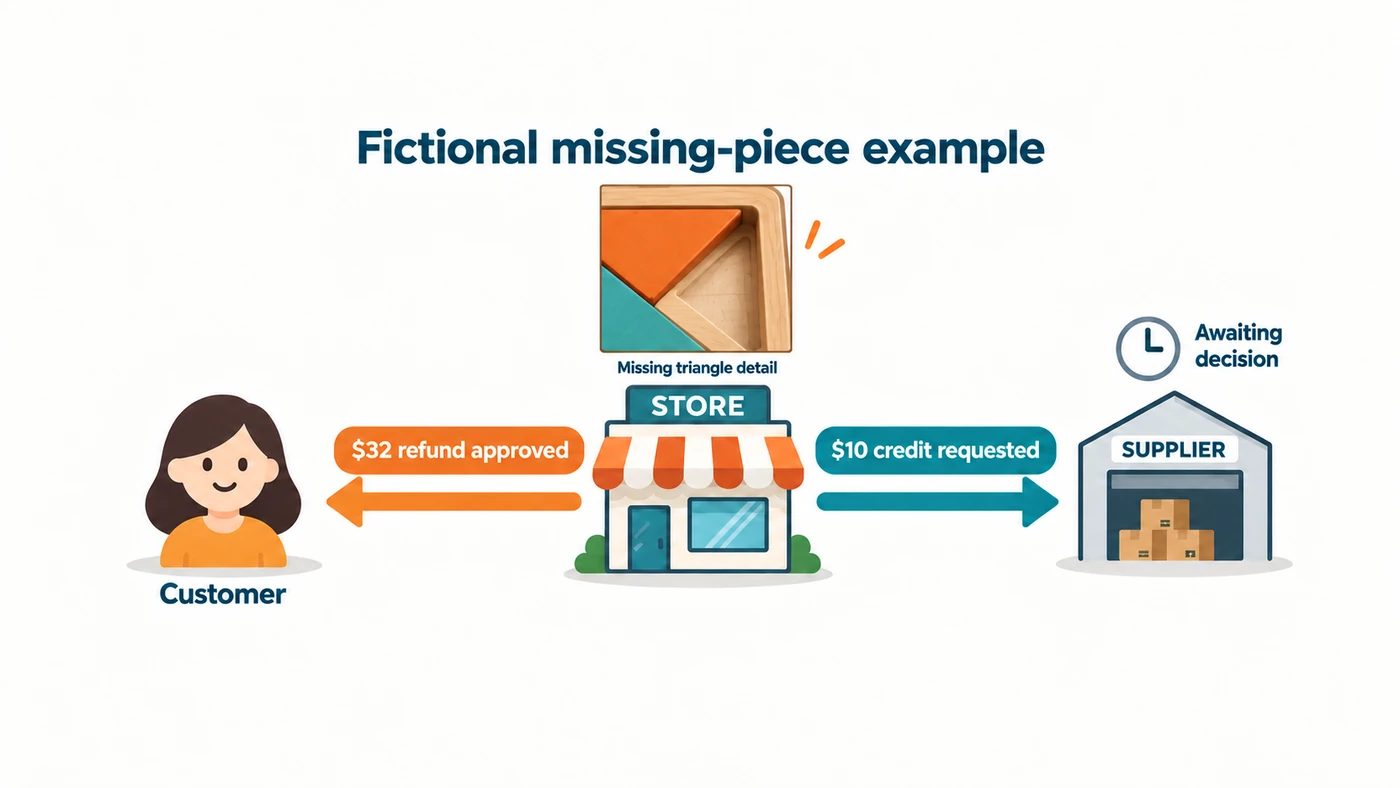
For damage or the wrong set, also decide whether a physical return is appropriate and where it can actually be received. The returns guide explains why customer handling, returned goods and supplier reimbursement need separate records.
Treat a safety concern differently from an incomplete order
If a report suggests choking, a hazardous detached part or another unsafe condition, stop affected sales and dispatch while the product-specific response is established. Tell the customer to stop using the potentially unsafe toy, alert the responsible manufacturer or importer, and address the applicable reporting and recall obligations. Identify affected models, versions, batches and orders. A replacement from the same unresolved stock can repeat the hazard.
Follow the instructions for the affected model
Use actual recall instructions when a product is affected. The September 17, 2026 CPSC notice for SHEIN Pull and Chew Montessori teething toys identifies particular SKUs, the choking hazard and the stop-use/refund instructions. Its requested cut-string photograph is specific to that recall; it is not a general instruction to destroy every toy or a finding that every SHEIN product is recalled.
Close the customer action when it has actually been completed, and continue tracking any supplier recovery separately. Then correct the cause: a missing-piece packing step, wrong variant mapping, failed packaging or a product problem requiring a different response. A refunded order alone does not make the next shipment ready.
08
Questions before your first toy order
Are wooden or Montessori toys automatically a good choice?
No category label establishes suitability, demand or margin. Compare the actual design, intended use, materials, dimensions, product evidence and complete order cost. Explain the play activity truthfully instead of relying on a fashionable name.
Can I simply label a toy for older children?
An age recommendation needs to be reasonable for the design and how the product is represented and used. You cannot resolve an unsuitable toddler product merely by changing the listing’s age badge. Obtain the product-specific age and rule assessment before publishing it.
Do I need money if the supplier holds the stock?
You may still need money for samples, product preparation, supplier payments, marketing and refunds. Confirm whether the arrangement truly accepts individual orders or requires a stock or packaging purchase. Compare those commitments with when customer payouts become available.
Your first sale should follow a specific product record and a matched supplier quote: the right toy, supported age/use, complete set, current version, destination, costs and remedy arrangement. That gives you an offer you can explain and an order you can manage.
Dropshipping Products: Practical Ideas and How They Compare
Compare concrete dropshipping product ideas, from pouches and phone stands to apparel and wall art, with shipping,
Gift Basket Dropshipping: Choose a Supplier and Keep the Gift Promise
A gift basket can be dropshipped, but the recipient must get the contents, message and delivery experience

Wedding Favor Dropshipping: Get the Count and Event Date Right
Wedding favors can ship directly to a host or venue, but the sold unit, guest count and
