
The sources reviewed for this article do not establish a reliable industry-wide dropshipping success rate. Common claims such as “90% fail” or “10–20% succeed” often omit the people counted, the period followed and whether success means sales, staying open or earning a profit.
Those percentages cannot tell you your store’s odds. Dropshipping changes who holds and sends the goods; you still have to attract buyers, pay the supplier and serve the customer. A useful starting question is whether your actual offer, orders and available cash can support those jobs.
01
What the common success-rate numbers really show
In the September 28 source review, Dropcommerce’s failure guide attributed “90% fail within 120 days” to Shopify research. Its link opened Shopify’s ecommerce launch guide, which discussed a survey of 500 merchants established for two or more years. The returned page did not provide the claimed new-store failure study.
That is a gap in the inspected citation, not proof that no historical study could exist. Replacing 90% with another unsupported estimate would leave the same problem.
Count the whole starting group
Imagine following 200 new stores for twelve months. At the end, 60 are still open and 20 have made an operating profit. These are teaching numbers, not a measured dropshipping success rate.
Count everyone who started
60 ÷ 200 = 30% still open. Separately, 20 ÷ 200 = 10% profitable. Record the same period and profit definition for the whole starting group.
Count only the survivors
20 ÷ 60 = 33.3% of open stores profitable. That answers a different question. It omits the 140 closed stores, so it cannot tell a newcomer that one in three entrants earns a profit.
This is survivorship bias: successful or still-visible businesses are easier to find than the ones that disappeared. Shopify’s current success FAQ does not supply a measured universal percentage.
Read who the survey actually counted
Its launch-guide survey covers 500 merchants already established for at least two years. That is not everyone starting today. The BLS method tracks establishments from their first positive employment; those survival figures are not dropshipping profit rates.
Other numbers describe different groups:
| Evidence | What it actually describes |
|---|---|
| BLS establishment-survival data | US establishment cohorts defined through positive employment. It does not identify dropshipping stores or measure their profit. |
| FTC March 2025 Click Profit announcement | A complaint alleging Amazon blocked, suspended or terminated about 95% of stores in one named business-opportunity scheme, not 95% of ordinary dropshipping shops. |
| A successful founder’s sales screenshot | A selected shop’s reported revenue. Without its costs and a defined group of entrants, it supplies neither net profit nor population-wide odds. |
On a phone, swipe the table sideways to compare every column.
The FTC’s dated Click Profit allegations also concerned misleading AI and earnings claims, management fees of at least $45,000, extra inventory spending and ongoing charges. They do not establish a typical startup budget or the outcome of every delegated-store service. Treat promised passive income as a reason to examine the actual duties, fees and earnings evidence.
02
Start with the problem you can see
Choose the first row that resembles your shop. Investigate that step before increasing traffic.
| What you see | What to do first |
|---|---|
| Visits but few paid orders | Compare the buying reason, delivered price and destination checkout with alternatives. |
| Sales but little money left | Include acquisition, payment fees, discounts and customer remedies in order costs. |
| Wrong goods or repeated delays | Stop the affected offer and resolve the exact variant, stock or dispatch problem. |
| More orders but less bank cash | Calculate supplier and ad payments due before the next available payout. |
| Buyers waiting for replies | Assign a reachable person to tracking questions and refund or replacement decisions. |
On a phone, swipe the table sideways to compare every column.
Define success before measuring it
For an owner-run shop, consider four results together:
- Orders contribute money: payment left after the costs of supplying and acquiring that buyer.
- The month pays its bills: contribution across orders covers recurring business costs.
- The bank can fund obligations: accepted orders and customer remedies remain payable before payouts arrive.
- Customers receive the promised service: the owner can handle the work within the available time.
Sales revenue alone answers none of these. Include owner pay, taxes and recovery of startup spending when deciding whether the business is worth your time. Refunds arriving next month can change the result of this month’s sales.
Checkout conversion is not business success
Conversion rate is a different measure. If 20 of 1,000 store sessions complete checkout, the checkout conversion rate is 2%. Assuming one order per completed session, that would be 20 orders. It is not a 2% probability that the business succeeds, and it does not establish profit.
03
Give the buyer a reason to choose the offer
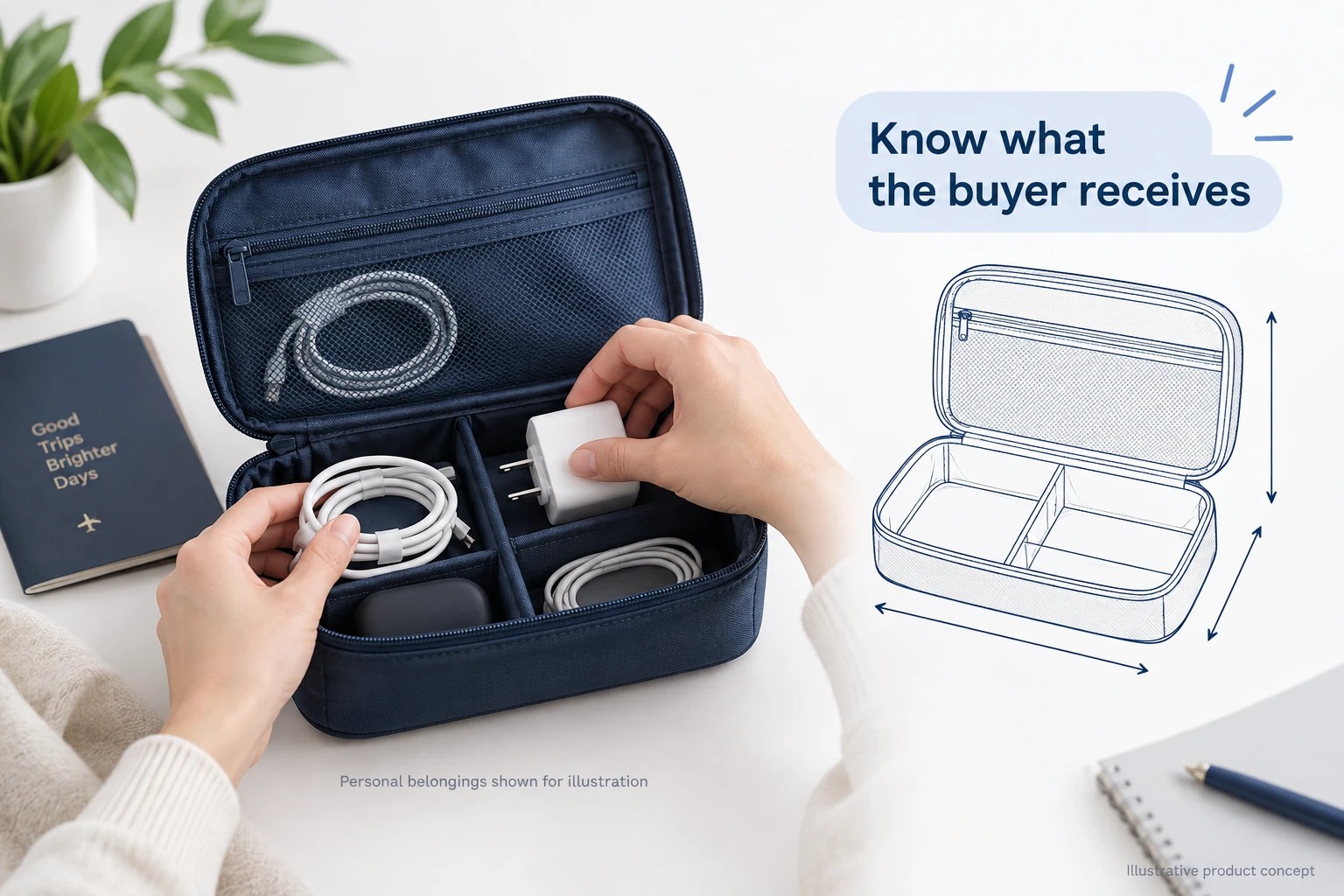
Imagine selling a travel pouch. A useful listing could show how its pockets hold the buyer’s small travel items, with the actual dimensions, opening and compartments visible. A generic “trending accessory” description leaves those questions unanswered.
Show what is included
Explain what arrives in the parcel. A charger or bottle used in a demonstration is not automatically included. If the pouch cannot hold the item shown, change the photograph or the product; a discount cannot repair an inaccurate promise. The illustration here is a product concept, not a sample we measured.
Work through three practical checks:
- Compare the buyer’s alternatives. Open relevant listings in the intended market. Compare delivered price, fit, included pieces, arrival information and returns. Identify a useful difference the proposed offer can actually deliver.
- Answer the unresolved buying question. Inspect the exact supplier variant and ask prospective buyers what they need to fit inside it. Show the relevant pocket or dimension clearly. Do not infer demand from the supplier’s claim that it is popular.
- Complete the destination checkout on a phone. Look for unexpected shipping charges, unavailable payment methods or a confusing variant selection. Repair the actual problem before paying for more visits.
An abandoned cart tells you where a visitor left, not why. If the delivered price is unattractive, clearer photographs alone may not solve it. If the advertisement attracts people needing a larger pouch, the page needs a matching product or a different audience. Choose the change that addresses the evidence you found.
04
Calculate what each order actually leaves
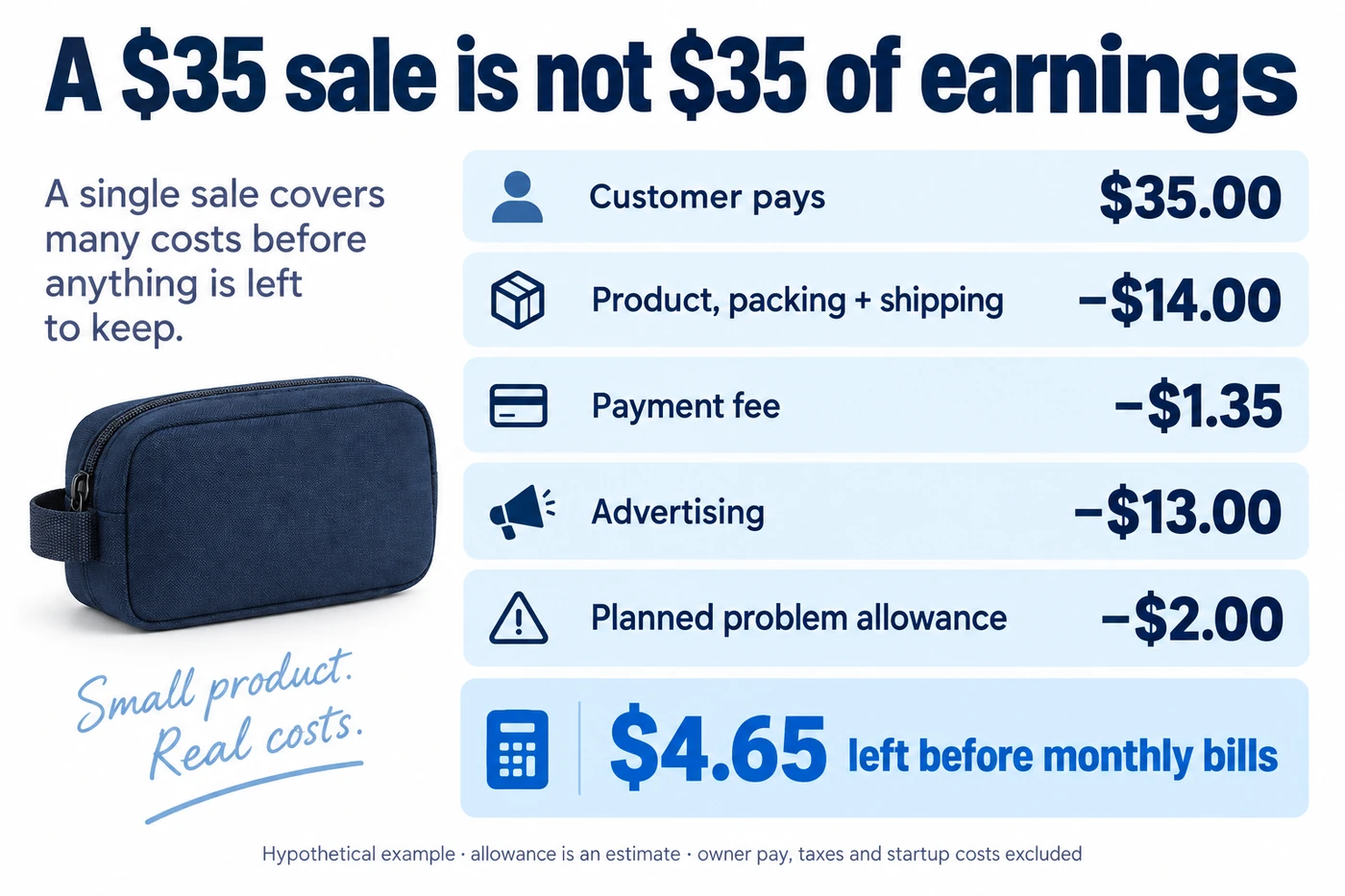
Suppose the pouch sells for $35 and its supplier charges $14 for the item, agreed packaging and shipment. The $21 difference is not profit. All amounts in this example are hypothetical USD costs, not supplier or advertising quotes.
- Customer payment: $35.00
- Product, packaging and shipment: −$14.00
- Payment processing: −$1.35
- Advertising to acquire the buyer: −$13.00
- Estimated refunds and other order problems: −$2.00
- Contribution before monthly bills: $4.65
After these order costs, $35 − $14 − $1.35 − $13 − $2 leaves $4.65. This contribution is the money available for recurring bills and eventual profit; it is not net profit.
Replace the allowance with actual remedies
The $2 problem allowance is an expected average, not the cost of every refund. Replace it with a realistic estimate and later reconcile actual remedies. Include import, currency and other route-specific charges where payable, and deduct discounts rather than counting the undiscounted listing price as revenue.
More sales can increase a loss
Forty $35 orders produce $1,400 in sales. With $150 in recurring monthly bills, the result changes sharply when the cost of acquiring a buyer rises:
| Hypothetical 40-order month | $13 acquisition cost | $18 acquisition cost |
|---|---|---|
| Contribution per order | $4.65 | −$0.35 |
| Contribution across orders | $186.00 | −$14.00 |
| Result after $150 monthly bills | $36.00 | −$164.00 |
On a phone, swipe the table sideways to compare every column.
A sales screenshot misses the costs
Neither result includes owner pay, taxes or recovery of startup spending. A $1,400 sales screenshot would hide both the small positive result and the loss.
If the margin is inadequate, choose a repair you can substantiate: obtain a better delivered supplier quote, reduce avoidable damage or wrong-item costs, improve the buying offer, or test a less expensive acquisition channel. Increasing orders with negative contribution deepens the problem. Pause an unaffordable campaign while making that change.
05
Fix the parcel problem before it repeats
The supplier needs a clear order: product and color, included pieces, packing, recipient address and the agreed shipping service. Before selling, confirm stock updates, substitution approval, dispatch timing, tracking and the return address. Try the intended variant through the ordinary order route; one acceptable sample does not guarantee every later parcel.
Agree on the common exceptions while obtaining the quote:
- Wrong color or missing part: what evidence is needed and who authorizes a replacement?
- Broken zip or damaged parcel: who reviews the photos, pays for a remedy and handles the carrier claim?
- Unavailable stock or delayed dispatch: how soon are you notified, and can the order be canceled before shipment?
- Return request: where can the buyer return it and who pays the actual transport cost?
For an existing affected order, follow this sequence:
- Identify what went wrong. Compare the customer’s ordered variant, supplier instruction, dispatch status and photographs where relevant. Stop new orders for the affected offer if you cannot supply it correctly.
- Give the buyer an answer. Explain the available lawful remedy and its timing. A customer who needs a refund cannot be left waiting indefinitely for your supplier’s credit.
- Seek reimbursement separately. Send the supplier or carrier the relevant order and evidence under the agreed claim process. Budget for the possibility that payment arrives late or the claim is refused.
- Correct the cause. Fix the product description, variant mapping, stock feed or supplier arrangement before restarting the offer.
For covered US merchandise orders, the FTC shipment rule requires a reasonable basis for the advertised shipment time. If none is stated, it generally uses 30 days. If timely shipment becomes impossible, follow the required delay-consent process or promptly refund the unshipped goods; silence does not always count as consent.
That rule concerns shipment, not a promise that every parcel arrives within 30 days. Add processing time to a transit-only carrier estimate, and apply the duties of the market where the customer actually buys.
06
Limit new orders to the cash and work you can handle
Customer money can appear in the store before it becomes available in the bank. Meanwhile, suppliers may require payment before dispatch and advertising may already be due. Positive contribution does not remove that timing gap.
Using the same hypothetical pouch costs, start with $600 and pay $150 in monthly bills. Each new order needs $14 for the supplier and $13 for advertising before any payout, or $27 upfront.
| Before any payout | Fund 15 orders | Fund 12 orders |
|---|---|---|
| Cash after monthly bills | $450 | $450 |
| Supplier and advertising payments | −$405 | −$324 |
| Remaining bank cash | $45 | $126 |
| Cash beyond a held $100 buffer | −$55 shortfall | $26 available |
On a phone, swipe the table sideways to compare every column.
Keep the held cash inside the bank balance
If you want to hold $100 for problems, only $350 is available for those upfront payments. $350 ÷ $27 funds at most 12 whole orders, leaving $126 in the bank. The $100 is held inside that balance, not another expense. It is an illustrative buffer and may be inadequate for the real refund exposure; samples and other startup costs would also reduce the available cash.
Read your own payout notice
Use the actual account’s payout dates, not a universal waiting period. Shopify distinguishes settlement, scheduled payout and bank processing. Reserves can hold money for disputes and refunds; a reserve alone does not mean every account must stop accepting payments. Read the notice and fund existing customer obligations before paying for more traffic.
Give each daily job a reachable owner
At the present order volume, someone must:
- Notice unavailable variants before accepting the next sale.
- Send correct supplier orders and follow missing or late tracking.
- Answer customer messages and authorize the applicable remedy.
- Reconcile supplier charges, refunds and bank payouts.
If the work exceeds your available hours, simplify the range or arrange specific help with agreed access, fees and responsibilities. “Automated store” is not a job description for handling a wrong item.
Read the actual marketplace conditions
Selling through a marketplace adds its account rules. Amazon’s public introduction describes seller-of-record and customer-return responsibilities; it is not the complete seller policy or permission for every procurement arrangement. Review the actual marketplace conditions before using a delegated service.
When comparing dashboard periods:
- Measurement: Shopify’s behavior-report guidance notes a September 21–23, 2026 session-measurement change that can affect reported metrics without the same change in customer behavior.
- Action: Compare consistent reports and actual checkout outcomes before rebuilding an otherwise functioning offer.
Choose one repair and a funded next test
Turn the diagnosis into a short plan you can execute:
- Name the observed problem. For example, buyers reach checkout but cannot select a payment method available in their country.
- Make the relevant repair. Complete that destination’s checkout after changing the payment arrangement. Keep the product and price stable enough to understand the result.
- Set the affordable spending and order limit. Include supplier prepayments and possible remedies, then compare actual paid orders, contribution, bank cash and customer outcomes over consistent periods.
Pause affected orders when the item is misrepresented, customer obligations cannot be met or accepted orders cannot be funded. If the model itself exceeds your money or available time, our is dropshipping worth it guide helps evaluate that larger choice.
For a specific China-side order issue, AIDrop’s returns and exceptions service can help coordinate the supplier, order information and remedy discussion. Send an inquiry with the product link, destination and actual problem. Agree on responsibilities and costs; supplier reimbursement and store profitability are separate outcomes.
Questions about dropshipping success rates
Is a 2% conversion rate a 2% chance of succeeding?
No. In the example, 20 paid checkouts from 1,000 sessions give a 2% checkout conversion rate. They do not tell you the probability that the business survives or earns a profit. Add the order costs and monthly bills before judging the result.
Why do successful-store interviews not establish the average?
They can explain a useful product or operating decision, but the stores selected for an interview are not everyone who started. A reliable rate needs a defined starting group, time period, outcome and treatment of closed or missing stores.
What should I check instead of trusting a universal percentage?
For your offer, calculate contribution after acquisition and order costs, monthly result after bills, cash needed before payout and whether you can fulfill and remedy the orders. The pouch examples show how each can change even when sales increase.
Is Dropshipping Worth It? Work Through Profit, Cash, and Time
Decide whether dropshipping is worth your time and money with transparent profit calculations, acquisition sensitivity, cash requirements,
Is Dropshipping Legal? What Your Store Is Responsible For
Learn the US responsibilities behind dropshipping: product safety, licenses, taxes, shipping promises, intellectual property, imports and customer

Dropshipping Taxes: The Records and Questions to Prepare
Income tax, sales tax and import charges follow different rules. Use a US operating baseline to separate
