

A dropshipping privacy policy should explain who runs your shop, what customer information you collect, why you use it, who receives it, how long you keep it and how customers can exercise their applicable rights. Include the supplier and carrier if they receive order details to deliver the goods.
Start with what your store actually does, then adapt a policy to those facts. Replacing the name in another shop’s policy can leave you promising something your checkout, apps or supplier do not do. The structure and sample sentences below help you write your own draft; they are illustrations, rather than a policy approved for every country.
01
Start with the details one order sends
Imagine someone buying a desk organizer from your shop. Your checkout takes the name, email and delivery address. A payment provider handles payment. The supplier receives enough information to send the organizer, and a carrier returns tracking updates. If the customer also joins your newsletter, that creates a separate marketing activity.
Use the following hypothetical order to find the facts your policy needs. Replace each row with your actual providers and settings; some stores will have fewer activities, others more.
| What happens | Information involved | Who may receive it and why |
|---|---|---|
| Someone visits the store | Browser or device details, pages visited, cookie identifiers where used | Store platform and configured analytics or advertising apps |
| The customer orders | Name, contact details, address, item and order number | Store platform to take and manage the order |
| The customer pays | Payment details and payment status | Payment provider to process payment; the store’s access depends on its setup |
| The organizer ships | Order reference, item, delivery name and address; a phone number if needed for delivery | Fulfillment supplier and carrier to prepare and deliver the parcel |
| The customer asks for help | Order number, message and any relevant photos | Store support staff and the provider helping resolve that issue |
| The customer subscribes | Email and the recorded marketing choice | Email provider for the newsletter the customer chose |
On a phone, swipe the table sideways to compare every column.
A supplier shipping the organizer does not automatically need newsletter choices or browsing history. Keep those fields out of a delivery feed unless there is a separate, justified purpose. Whether the supplier needs a phone number depends on the actual delivery arrangement; it is not a universal dropshipping requirement.
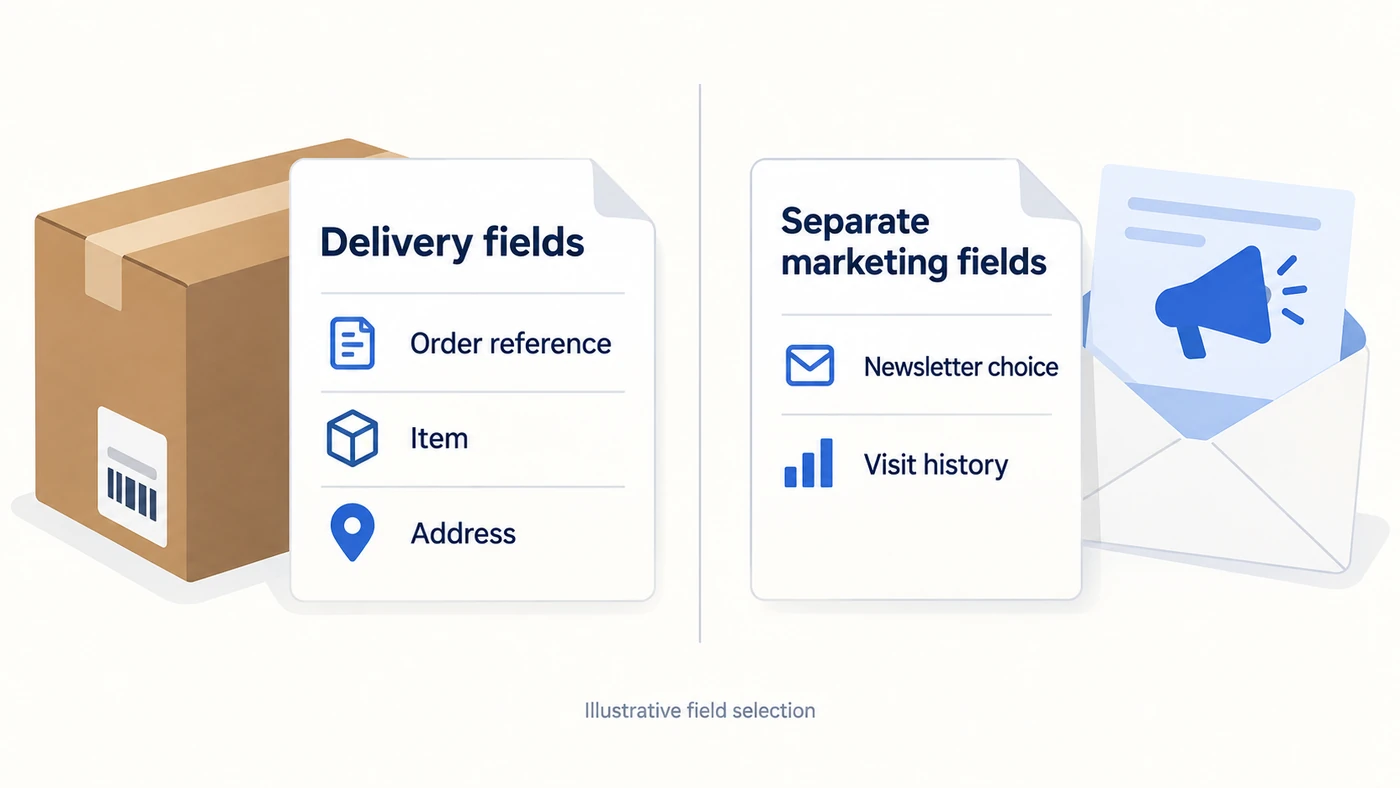
A payment provider does not expose every card detail
The payment provider receiving card details also does not mean your staff or supplier can see the full card number. Describe the information each party actually receives. This small distinction prevents a policy from overstating both collection and sharing.
02
Choose the rules for the customers you serve
Your location, the people you sell to and how you track them determine which additions the policy needs. The examples here cover EU and California rules; the UK and other US states have their own requirements. Broader registration and product obligations belong in the dropshipping legal guide.
EU customers
The GDPR is the EU’s personal-data law. Its scope includes:
- Relevant processing by an EU-established business.
- A business outside the EU offering goods or services to people in the EU, or monitoring their behavior there.
A low sales figure is not a general exemption. A website that an EU visitor can open is not, by itself, the same as deliberately serving that market. Commission application guidance
Where GDPR applies, explain the legal ground—the reason the law permits each use—along with relevant overseas transfers and customer rights. Necessary order details can be processed for the sales contract. An unrelated newsletter needs its own appropriate ground and any required permission.
California customers
CalOPPA, section 22575, requires a conspicuously posted policy for commercial websites or online services collecting personally identifiable information from California residents who use or visit them. Required disclosures include:
- Collected information categories and recipient categories.
- An effective date and how material changes are announced.
- Applicable tracking disclosures.
The CCPA’s business test concerns a for-profit business doing business in California that decides the purposes and means of processing. The current CPPA thresholds require any one of:
- At least $26.625 million gross revenue in the preceding calendar year.
- Buying, selling or sharing information of at least 100,000 California residents or households.
- At least 50% of annual revenue from selling or sharing residents’ information.
Related entities and recipients can have additional obligations. A covered store needs the relevant disclosures and working rights methods, including applicable sale/sharing opt-outs. Falling below the thresholds does not erase CalOPPA or other privacy obligations.
03
Write these eight parts of the policy
The following sentences belong to a hypothetical organizer shop. Use them as writing examples, with the bracketed facts replaced and the surrounding explanations applied to your actual store. They do not cover every legally required clause. The Commission’s notice guidance explains why customers need understandable information about purposes, recipients, retention and rights.
1. Who runs the shop and how to contact it
Name the business behind the storefront, not just its trading name. Give a working privacy contact and any required address, representative or data-protection-officer details. A supplier’s contact does not replace yours.
Sample wording: [Legal business name] operates [store name and website]. For questions about your personal information, contact [privacy email and applicable address].
2. What you collect and where it comes from
Use the actual order table to describe categories, including information customers provide, technical information collected during visits and relevant information received from other sources. Do not paste in health, location or identity-document categories your store does not collect.
Sample wording: When you place an order, we receive your name, contact details, delivery address, ordered items and payment status. When you contact us, we receive your message and the order details you provide.
Add actual account, device, cookie and other-source information where used.
3. Why you use it and, where required, the legal ground
Tie each purpose to a recognizable activity: take payment, send the organizer, answer a delivery question, prevent a specific kind of fraud or send an optional newsletter. Avoid a broad phrase such as “improve your experience” as the only explanation.
Sample wording: We use your order and delivery details to process payment, fulfill your order and provide order support. Where the GDPR applies, we process information necessary for these activities to perform our sales contract.
Match each purpose to its legal ground
The Commission’s legal-ground guidance distinguishes contract, legal obligation, consent and other grounds. Use legal obligation only for the applicable obligation, and legitimate interests only after the required assessment. A marketing purpose should have its own explanation; a general “I accept the policy” box does not settle every use.
4. Who receives order and payment information
Name meaningful recipient categories and their purposes. Platform hosting, payment processing, parcel fulfillment and advertising are different activities. Explain relevant independent uses where they occur; do not label everyone a service provider simply to make the list sound safer.
Sample wording: We share your order reference, ordered item, delivery name and address with our fulfillment supplier and delivery carrier so they can prepare and deliver your parcel. We use [payment provider] for payment processing.
Add a delivery contact number only if that arrangement needs it, and describe other actual disclosures separately.
5. Cookies, advertising and marketing choices
Explain the technologies actually enabled, their purposes and how visitors can change applicable choices. Where relevant, include sale/sharing opt-outs, preference signals and the tracking disclosures required in your market. Do not promise “no tracking” while an advertising app is running.
Sample wording: If you choose to receive our newsletter, we use your email for those messages. You can stop them through the unsubscribe link in each email.
This example assumes that is how the shop obtains permission and honors it; local electronic-marketing rules still matter.
Describe the actual response to browser Do Not Track signals where required. Do Not Track and California sale/sharing opt-out preference signals are not interchangeable, so a sentence about one cannot stand in for the other.
6. How long you keep different information
Give actual periods or intelligible criteria for each purpose. A newsletter list, an unresolved delivery case and a legally required sales record need not have the same lifetime. “Forever” and “until you ask us to delete it” are poor substitutes for a real retention plan.
Sample wording: We keep order records for [the applicable tax/accounting period], and information needed for an unresolved claim while that claim remains open. We keep newsletter information for [the actual subscription/retention arrangement].
Replace these placeholders with supported periods and explain any further required retention. Do not copy an arbitrary five- or seven-year number.
7. Customer rights and the route to use them
Explain the rights that apply and how to submit a request. Depending on the law, these can include access, correction, deletion, restriction, portability, objection, withdrawal of consent and complaints to a regulator. State the applicable limits rather than promising immediate deletion of everything.
Sample wording: Contact [privacy email or applicable request method] to ask about your information or exercise rights available to you. We may need information to confirm your identity. Some information may need to remain where the law requires it or where it is needed for a legal claim.
Add the applicable request methods, timing and regulator details. A covered California store may need specific opt-out links and preference-signal handling; an ordinary customer-service address alone does not necessarily cover every right.
8. Changes and the policy date
Use a real effective date and explain how you communicate material changes where required. A supplier moving work to another country or a new advertising app can change what the policy needs to say.
Sample wording: This policy takes effect on [date]. We publish updates on this page and [actual notification method for material changes].
Do not insert a notification promise the store cannot carry out.
If the shop processes sensitive information, serves children or makes relevant automated decisions, add the disclosures and protections those activities require. Leaving those activities out of the example is not an exemption. Likewise, a platform’s merchant privacy policy is about its own relationship with merchants; it is not your customer-facing store notice.
04
Explain overseas suppliers and platform roles
Under the GDPR, a controller decides why and how personal data is processed. A processor handles it on the controller’s documented instructions. A supplier preparing a parcel may act as a processor for that work, while a separate use of customer details can raise a different role. Its label as a “dropshipping supplier” does not decide the answer.
Ask the supplier five concrete questions:
- Which delivery fields does it receive?
- In which countries can staff access them?
- Which carriers or other recipients get them?
- How long does it retain them?
- Does it use them for any purpose it chooses itself?
The answers belong in the notice and relevant contract. A proposal to use buyers’ details for the supplier’s own promotions needs a separate decision; permission to ship the organizer does not cover every later use.
Check the Shopify service, not just the platform name
Platform roles also vary by activity. Shopify’s DPA generally describes processing for merchants, but Appendix E treats certain enhanced services differently, with Shopify acting as a controller or business. Use the terms for the services you actually enable.
A transfer clause needs the corresponding arrangement
For overseas access, explain the countries or recipient locations and required safeguards. If an EU transfer relies on Standard Contractual Clauses, use the Commission’s SCC guidance to address:
- The parties’ roles.
- The applicable clause module.
- The required transfer assessment.
Writing “we use standard clauses” does not put those arrangements in place.
Resolve a missing country, onward-recipient or contractual answer before activating that flow. The broader risk-management guide covers access and operating safeguards; the policy should describe the arrangement you actually use.
05
Make the privacy choices work
Publish the current policy through a clearly labeled footer link and at the relevant collection points, such as checkout, account creation and newsletter signup. Give the person enough information when their details are collected; a page hidden elsewhere on the site may not do that job.
Set the privacy controls in Shopify
In Shopify, open Settings → Customer privacy → Privacy policy. Review the generated text or write your supported policy, then Save. Compare the public page with your actual apps, supplier disclosures and contact route.
Check the banner and the apps
Open Cookie banner separately. For manual region settings, edit Regions, choose the applicable locations, then Done and Save. Shopify’s banner governs Shopify-specific tools; manually installed third-party cookies or pixels can need an integrated banner or custom logic. Check those tools after a visitor refuses non-essential tracking.
Follow Shopify’s current privacy-setting instructions. A saved policy and a visible banner are starting points for the three checks below, not proof that every tool follows the choice.
Then follow three customer actions through your actual store:
- Order without joining the newsletter. The shop should process the order under its stated arrangement without silently treating the purchase as the customer’s chosen newsletter subscription. Confirm that the email app receives the correct marketing choice.
- Change a cookie or advertising choice. Compare the choice with what the relevant apps actually do. Shopify’s privacy settings do not automatically make every separate app follow the same setting. Fix, configure or remove an app that continues a use the store promised to stop.
- Send a privacy request. The published contact must reach someone who can retrieve the order data and arrange the necessary action with providers. A support ticket marked closed is not evidence that a supplier erased its copy.
For example, a customer may stop the newsletter while the shop still retains an invoice required by law. Explain what was removed, what remains and why.
Under the GDPR, reply without undue delay and in principle within one month. Deletion has exceptions, including legal obligations and legal claims. The Commission’s request guidance explains these limits. Other laws use different methods and deadlines.
Publishing the page does not change what an app collects. The task is complete when the notice is visible, its choices match the configured activities and the request contact can carry out the applicable response. Revisit the affected wording when a provider, market or data use changes.
06
Frequently asked questions
Can I use a generated privacy policy?
Yes, as a draft to check against your real store. Fill in the business, tools, recipients, choices and retention facts. Remove claims that do not match the operation. Shopify’s template cannot know every separately connected supplier or app.
Does sending an order to a supplier permit newsletters too?
No automatic permission follows from delivery. Order details serve fulfillment; newsletters and advertising have their own purpose and applicable rules. Keep unrelated newsletter choices and browsing history out of a delivery feed.
Must an unsubscribe request erase the invoice?
Not necessarily. Stopping marketing and erasing order records are different requests. A legally required invoice may need to remain; other unnecessary data may need deletion. Explain the actual reason and process the request under the applicable law.
Prepare the data fields for your next supplier
Need to check what a China-side fulfillment connection would receive? AIDrop’s fulfillment service can discuss picking, product checks, packing, labeling and carrier handoff.
Send a product link, destination and anonymized proposed order-field list. Confirm supported fields and the connection during onboarding. Keep legal privacy and transfer questions separate, and leave live customer details out of the initial inquiry.
Is Dropshipping Legal? What Your Store Is Responsible For
Learn the US responsibilities behind dropshipping: product safety, licenses, taxes, shipping promises, intellectual property, imports and customer

Dropshipping Taxes: The Records and Questions to Prepare
Income tax, sales tax and import charges follow different rules. Use a US operating baseline to separate

Dropshipping Copyright and Trademarks: Check Products, Images and Store Claims
Check dropshipping products, images and store claims separately. Review supplier permissions, intended uses, launch decisions and infringement
