

Dropshippers can lose money, earn a small side income or build a profitable business. There is no dependable monthly average in the public sources reviewed here that tells a beginner what they will earn. Your income depends on what remains after products, delivery, selling costs and monthly bills—not simply how much customers spend.
For example, a shop selling $15,000 in one month could leave its owner just $900 to take out under the assumptions below. Those are illustrative figures, not a typical dropshipper’s results. Following the money makes the question easier to answer: how much did the shop sell, how much did it keep, and how much can the owner safely use?
01
A sales screenshot does not show the owner’s paycheck
Revenue means sales. If customers buy $10,000 of products from your shop, that is $10,000 in revenue before the relevant deductions. The supplier, delivery company, payment service and advertising platforms still need their share.
In dropshipping, you collect the customer’s payment and pay a supplier to provide and send the product. Shopify’s dropshipping explanation describes that arrangement. You also remain the customer’s point of contact when an order is late, faulty or needs a refund.
Four money terms help you read an income claim:
Number: Revenue
Plain meaning: Money from customer sales
What it still needs to cover: Product, shipping and all other business costs
Number: Contribution
Plain meaning: Money left from orders after the costs tied to those orders
What it still needs to cover: Monthly bills such as subscriptions and other fixed expenses
Number: Business profit
Plain meaning: What’s left after the period’s business expenses
What it still needs to cover: It may need to stay in the business rather than go to the owner
Number: Owner pay or withdrawal
Plain meaning: Money actually paid or transferred to the owner
What it still needs to cover: Its amount and method depend on available cash and the business structure
You may also see gross profit: sales minus the relevant cost of goods sold. It is an earlier step than profit after all business bills. Our profit-margin guide explains the percentage calculations; here we will follow actual dollars toward possible owner pay.
Check the basis of an income band
Be wary of articles saying every beginner can expect a particular monthly income. Shopify’s worth-it article links to Zendrop’s income figures. The accessible Zendrop article gives beginner and advanced bands, but does not show a representative sample and a clear, consistent calculation of owner take-home pay. Those bands are not a dependable forecast for your new shop.
02
Follow one $50 order before estimating a month
Imagine your shop sells a desk lamp for $50. For this hypothetical example, the costs are:
Item — Assumed cost per order
- Lamp from the supplier: $20
- Shipping to the customer: $6
- Payment and platform fees: $2
- Marketing needed to get the order: $12
- Allowance for refunds and customer service: $2
- Total costs tied to the order: $42
- Money left before monthly bills: $8
The $8 is the order’s contribution: it contributes toward the shop’s monthly bills, and whatever remains after those bills can become profit. This follows the basic distinction in Shopify’s contribution-margin explanation.
Replace assumptions with your receipts
Every number in the table is an assumption. The $2 payment line is not a quoted rate for your account. Shipping changes with the product and delivery country. Your real refund costs might exceed the allowance. Replace each line with your supplier invoice, payment report and actual marketing costs before using the model for your shop.
This also explains why a high selling price alone tells you little. A larger lamp might leave more dollars after the supplier bill, but cost more to advertise or return. A cheap accessory can lose a meaningful share of its price to a fixed payment fee. Calculate each product or group of similar orders, then add them together. Your best product’s $8 cannot automatically be applied to every order.
03
What 50, 150 or 300 orders could leave you
Now use that same $8 contribution in three hypothetical months. Let the monthly business bills and the cash you keep for coming costs differ as shown.
Month: 50 orders
Sales: $2,500
Contribution from orders: $400
Fixed bills: $300
Profit before tax: $100
Cash kept in the business: $100
Possible owner withdrawal before tax: $0
Month: 150 orders
Sales: $7,500
Contribution from orders: $1,200
Fixed bills: $600
Profit before tax: $600
Cash kept in the business: $200
Possible owner withdrawal before tax: $400
Month: 300 orders
Sales: $15,000
Contribution from orders: $2,400
Fixed bills: $1,200
Profit before tax: $1,200
Cash kept in the business: $300
Possible owner withdrawal before tax: $900
The last column assumes the customer money has arrived, all modeled costs are paid, there are no older unpaid obligations, and the business permits that type of owner withdrawal. It is an illustration of available cash, not a recommended paycheck or tax calculation.
Take the 150-order month. Customers spend $7,500. The orders leave $1,200 after their costs. Paying $600 of fixed bills leaves $600 profit before tax. If you keep $200 in the shop for coming payments, you have $400 left for the modeled owner withdrawal.
Retained cash is not another expense
Keeping that $200 does not turn it into another business expense. The profit is still $600; you are choosing to leave some money in the business. Subtracting the reserve again when calculating profit would count it twice.
The 300-order month produces more sales, but not a $15,000 salary. Under these assumptions, profit is $1,200 before tax and the possible withdrawal is $900. If marketing costs $3 more per order, the additional $900 cost cuts that profit to $300. More orders help when each order leaves enough money; they do not protect you from rising costs.
Include weak months in your plan too. With no sales and $300 in fixed bills still due, that simple month loses $300 before tax. If the amount left per order is negative, selling more of the same orders increases the loss.
Find the zero-profit point before the income target
Thirty-eight orders cover $300, not a paycheck
There is no salary attached to opening a store. For the $8 contribution example, $300 of monthly fixed bills needs 38 orders just to cover those bills: $300 ÷ $8 = 37.5, rounded up. At $600 of fixed bills, the threshold is 75 orders. This assumes each order really leaves $8; it is not a forecast.
Count your working hours as well as the dollars
Suppose you work 80 hours to earn the $400 withdrawal in the middle row. That is $5 for each hour worked, before tax. It is a way to assess this example, not a measured average wage for dropshippers.
Include the time spent researching products, setting up ads, answering customers, matching bills and handling returns. Even if you do not book a salary for yourself, that time matters when comparing the shop with another side job or deciding whether it can replace your salary.
04
A refund or a more expensive ad can change the month
The refund allowance is a planning figure. Once you know what happened, replace the estimate with the real cost.
Suppose the 150-order month later has eight full $50 refunds: $400 returned to customers. The original model already allowed $2 per order, or $300, for refunds and service. Replace that $300 allowance with the $400 actual refunds. Do not subtract both.
Assume the $400 is the entire actual refund-and-service cost for that example, with no extra handling or return postage and no supplier recovery. Replacing the original $300 allowance adds $100 of cost, so the modeled $600 profit falls to $500 before tax. If service or return costs sit outside that $400, add them too. Eight refunds is an example, not a typical rate.
A supplier credit or a returned processing fee changes the result again. Add an actual recovery separately, and subtract any extra return shipping separately. Do not assume every payment fee comes back: for example, Stripe’s refund documentation says it does not return the original processing fees. Follow the terms of your own processor and supplier.
Ad cost per order is not full CAC
Advertising needs the same treatment. Our $12 marketing cost is an average amount assigned to each completed order in this model, not the price of a click. Suppose a campaign spends $1,500 and brings in 100 attributable orders. Its simple ad cost is $15 per order. That is $3 above the example, reducing the $8 contribution to $5 for those orders.
That campaign calculation is narrower than full customer acquisition cost. Shopify’s CAC guide includes all relevant acquisition spending and counts new customers, rather than repeat customers. Use a consistent definition, account for repeat orders and attribution limits, and avoid charging the same marketing bill twice.
If you calculate a month’s profit before the return period finishes, revisit it when refunds and supplier credits arrive. A sales month can look stronger on the first day than it does after the remaining bills are settled.
05
Profitable on paper does not always mean cash in the bank
A customer can pay today while the processor sends the money to your bank later. The supplier may need payment now to send the lamp. You can therefore need your own money to complete a profitable order before the customer’s payout arrives.
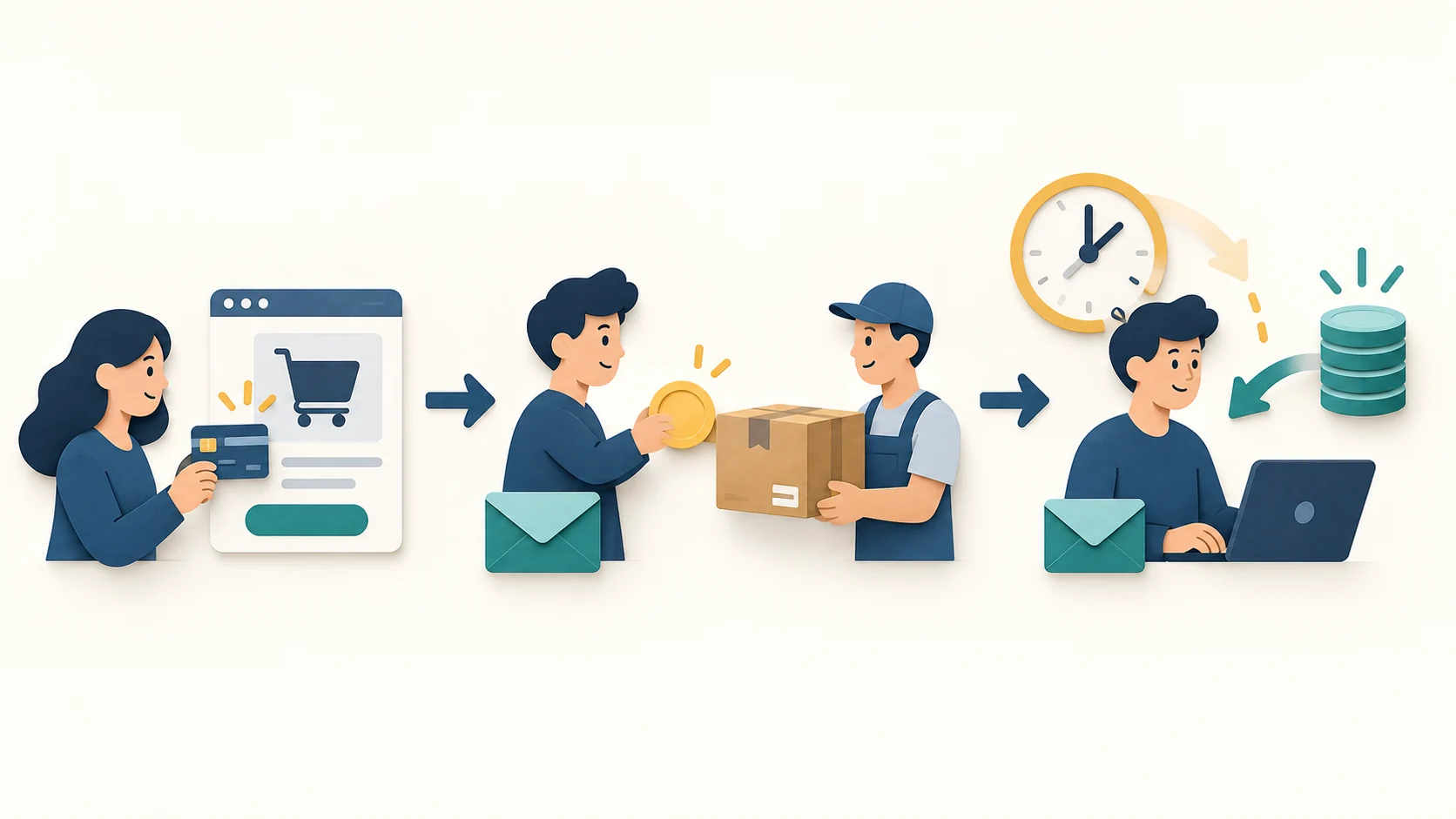
Stripe’s payout guide distinguishes the time funds become available, the payout schedule and any extra bank processing time. The timing depends on the account. Refunds can also arrive next month for products sold this month, while app subscriptions renew even during a quiet week.
Before paying yourself, look at more than the balance on today’s screen:
- Which customer payouts have actually reached the bank?
- Which supplier orders, shipping bills and other invoices still need payment?
- What refunds or returns may need cash?
- Which subscriptions or other bills are due soon?
- How much will the next batch of orders need before its customer money arrives?
Cash you leave for those payments is a reserve. It keeps the shop able to send the next order; it is not automatically a second expense in the profit calculation. Shopify’s cash-flow guide explains why accounting profit and the timing of received and paid money can differ.
Check what can leave the bank today
Suppose the business bank has $1,200 available. A further $200 customer payout is pending, so leave it out until it arrives. The figures below are invented and assume the listed obligations are separate, not duplicate reserves.
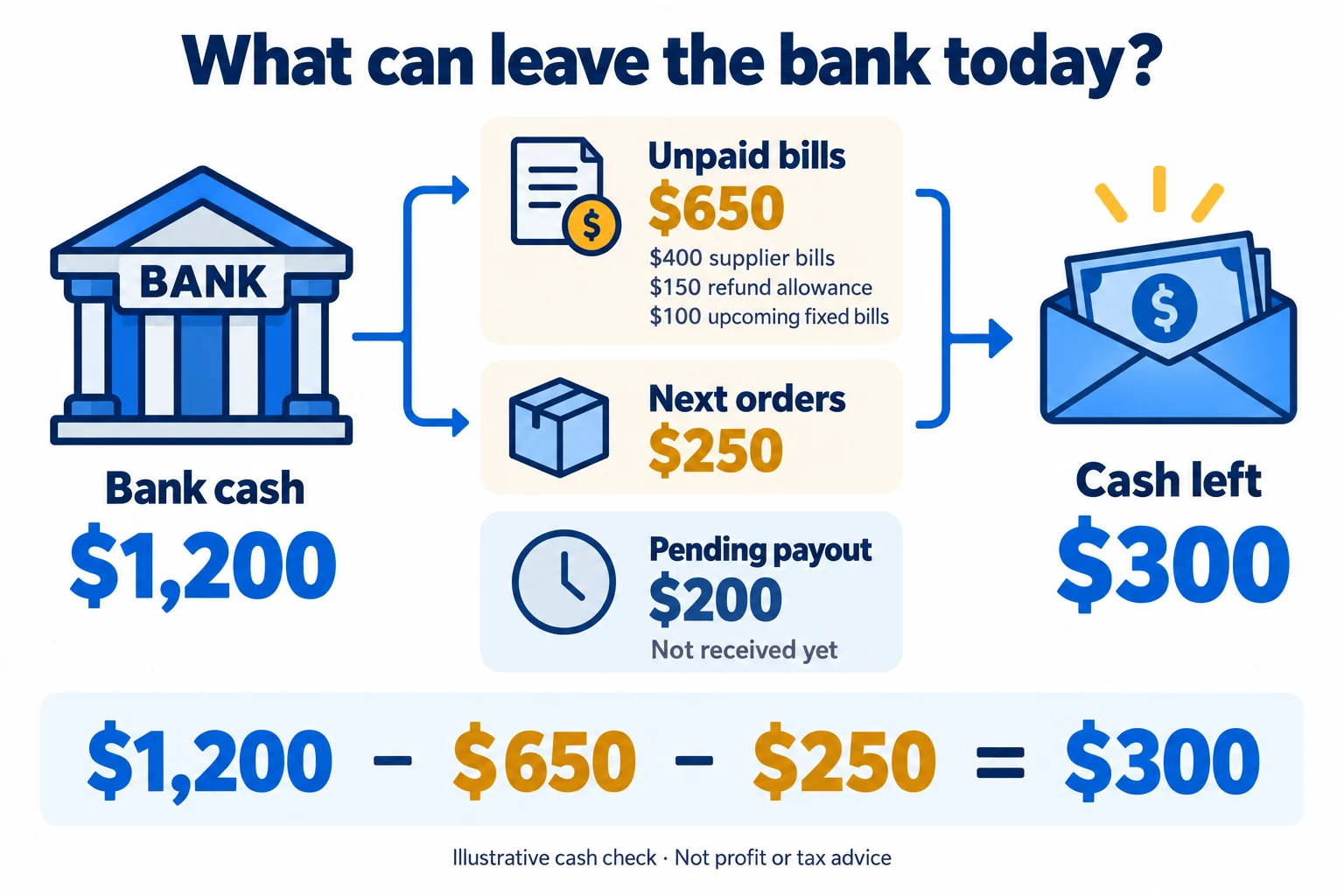
Unpaid obligations
$400 supplier bills + $150 expected refunds + $100 upcoming fixed bills = $650. These need cash even if the sales report looks healthy.
Next orders
Keep another $250 for supplier purchases before the next customer payout. This is working cash, not a second expense in the profit calculation.
Cash left today
$1,200 − $650 − $250 = $300. The bank-based ceiling is $300 under these assumptions, not the $1,200 balance or the $1,400 including pending funds.
Owner payment decision
Check the chosen pay method and tax obligations with your accountant before transferring money. A different bill or existing reserve changes the cash ceiling; this illustration does not authorize a withdrawal.
Compare this cash note with the month’s profit calculation. The two can differ because a profitable order is still awaiting payout, or an earlier sale now needs a refund. The payout schedule does not speed up settlement.
Owner pay is another separate step. You might take a draw, receive a salary or use another payment method, depending on your business. QuickBooks’ equity guidance describes money withdrawn by owners separately from new sales. Shopify’s owner-pay explanation also distinguishes paying yourself, reinvesting and keeping cash.
Ask your accountant which pay method and tax treatment apply to your business. The examples here are before tax and explain the money calculation; they do not choose a legal or tax structure for you.
Build your own monthly income record
Choose one month and one reporting currency. Keep the order report, supplier invoices, payment fees, marketing bills and subscription invoices together. Here is a practical record layout; use your own amounts instead of copying the earlier hypothetical month.
Sales and refunds
Record customer payments and actual refunds for the stated period. If the export already reports sales after refunds, do not subtract the same refunds again. Note later adjustments separately.
Order costs
Match goods, freight, order fees and replacement costs to the relevant orders. Record actual supplier credits separately; a requested credit is not money recovered.
Business profit
Subtract those costs, recorded acquisition spending and fixed bills. Replace any planning allowance with the actual case total, instead of keeping both as expenses.
Bank and owner cash
Separately reconcile received payouts, unpaid bills and the cash needed for coming orders. Keep an owner transfer out of sales; it does not create revenue or prove another profitable month.
For a new shop, fill missing lines with clearly marked estimates. After orders finish, replace them with receipts and review the same period again. A complete record is more useful than borrowing another seller’s “beginner income” band.
06
Work backward from the income you want
Suppose you want $2,000 available to pay yourself each month. You expect $600 of fixed business bills and want to keep another $400 in cash for coming obligations. If each order reliably leaves $8 after its own costs, the calculation is:
($2,000 owner amount + $600 fixed bills + $400 cash retained) ÷ $8 per order = 375 orders.
At $50 per order, that is 375 × $50 = $18,750 in sales. It remains an illustrative target before tax, assuming every modeled payment has arrived and every modeled order cost is paid, with no unexpected bills.
The calculation tells you what would be needed; it does not tell you that 375 people will buy. Shopify’s break-even guide makes the same distinction between a cost calculation and a prediction of demand.
For your shop, start with the actual dollars left per order. Then ask whether you can repeatedly attract and serve the required number of customers at that cost. If the contribution falls from $8 to $5, the same owner goal needs far more orders. That can be a reason to improve the product offer, supplier costs or marketing before trying to increase volume.
Compare finished months, including weak ones
Use several completed months to judge whether the result is repeatable. Three months showing $600 profit can still leave different owner cash if one has unpaid supplier bills. A one-off promotion that produces $2,000 profit should not be treated as the normal monthly result until comparable periods support it.
07
Read an earnings claim by asking what it includes
When someone shares an income screenshot, first ask what the number means. Is it gross orders, sales after refunds, business profit or money paid to the owner? Then ask for the period and the missing bills: products, shipping, advertising, payment fees, apps, returns and any pay for the owner’s work.
A well-documented case can show what one shop earned in one period. It cannot tell you how likely a beginner is to repeat it. Changing the definition of “income” from month to month also makes an improving chart misleading.
If you are still planning a shop, build low and high cases from the product you can actually source. Include a zero-sales or loss month, real delivery costs, your best current estimate of marketing, return costs and fixed bills. Treat the result as something to test and improve, rather than a salary already earned.
If supplier and freight costs are missing from your income calculation, AIDrop’s sourcing service can help assess China-side product options, samples and quality checks. We can also discuss agreed packing and order preparation.
Send product links, exact versions, buyer countries and expected order volume, plus the unclear quote or packing detail. We can help examine those cost lines; we do not promise an income.
08
Frequently asked questions
How much can a beginner make dropshipping per month?
There is no reliable beginner average in the sources reviewed here. You can lose money while testing, make no sales or earn a profit. Use your actual product, delivery and marketing costs to model different order counts instead of adopting a published salary band.
Is $10,000 in dropshipping sales $10,000 of income?
No. It is customer revenue. Products, shipping, fees, ads, refunds and monthly bills still come out before business profit. Cash needs and your business’s pay method then affect what you can take out.
Can dropshipping replace a full-time salary?
It can for some operators, but one strong month is not a repeatable wage. Work backward from the owner amount you need, the money left per order, fixed bills, cash needs and hours worked. Several completed periods provide a better basis than a launch screenshot.
Does the owner always take all the profit?
No. Money may stay in the shop for supplier payments, refunds, new products and other commitments. Profit, available cash and owner pay are related, but they are different numbers.
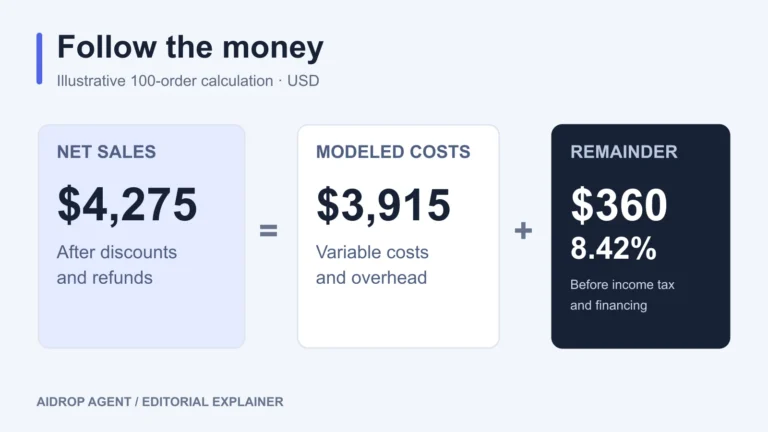
Dropshipping Profit Margin: Calculate What You Keep
Calculate dropshipping gross, contribution, and net margins. See how discounts, refunds, and ad costs change profit in

How to Price Dropshipping Products From Landed Cost and Risk
Calculate a retail price from the delivered cost of one variant, selling fees and required contribution, then
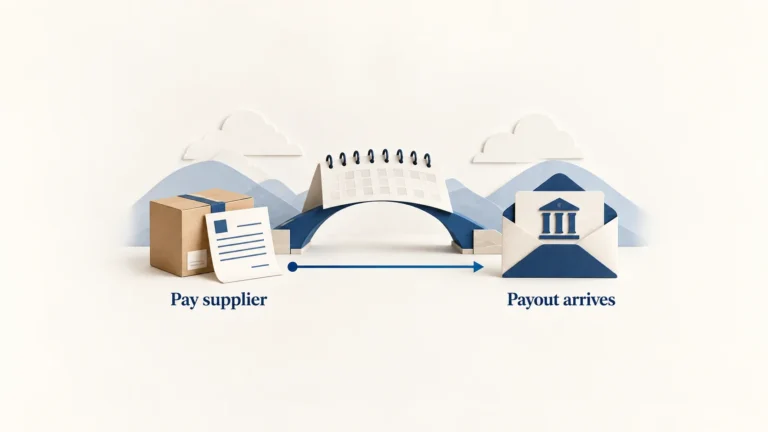
Dropshipping Cash Flow: Supplier Payments, Payouts and Refund Buffers
Plan dropshipping cash flow by date. Separate pending payments from usable cash, fund supplier bills, and test
