
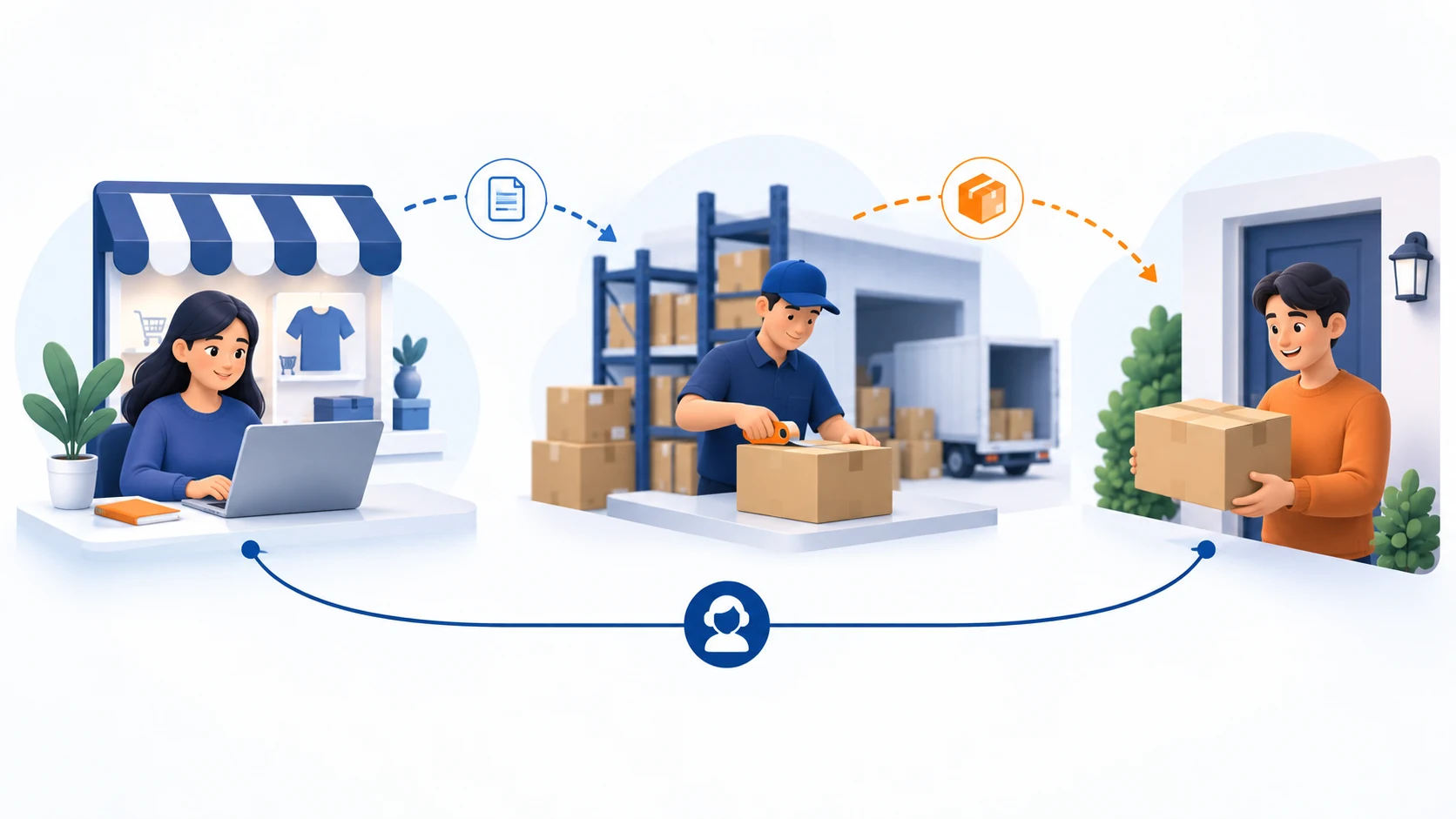
A dropshipper is usually a retailer who sells products while a supplier ships orders directly to customers. The retailer chooses what to sell, sets the customer-facing offer and handles the sale. The supplier holds or produces the goods and performs the agreed fulfillment work.
Imagine buying a desk organizer from an online store. A separate warehouse sends the parcel, but you return to the store if the organizer is damaged or never arrives. That store is the dropshipper in the everyday ecommerce sense. Its job continues after the order reaches the warehouse.
This distinction explains both the appeal and the difficulty of the work: you can sell without running your own packing operation, but you still have a retail business to manage.
01
What the word dropshipper describes
In beginner ecommerce guides, “dropshipper” generally means the merchant using dropshipping to fulfill sales. Shopify’s explanation of the model describes an arrangement where the seller does not store or ship the products itself. The fulfillment partner can be a manufacturer, warehouse or another supplier.
There is a second usage worth recognizing. In trade language, the same word can describe the wholesaler or distributor that sends the goods. Dictionary.com’s definition uses that supplier-side meaning. If a directory advertises “dropshippers,” it may be listing businesses that supply stores, rather than stores that sell to shoppers.
When discussing an agreement, use the party’s actual role: retailer, supplier, fulfillment provider or sourcing agent. “We are both dropshippers” leaves too much unanswered about who accepts the customer’s payment, buys the goods and resolves a failed delivery.
The rest of this article uses the retailer meaning. For the wider model, including sourcing, store setup and shipping, see our guide to what dropshipping is.
02
Retailer, supplier, agent and affiliate: different jobs
The retailer creates the offer the customer buys. That includes the selection of products, selling price, description, delivery expectations and service. The supplier provides the item and ships it under the agreed arrangement. A good supplier can make the store easier to run, but it cannot decide whether the store’s offer fits its customers.
Other businesses can sit between those two parties. Their names matter less than their assigned work:
| Role | Main contribution | What that role alone does not establish |
|---|---|---|
| Dropshipping retailer | Sells to the customer and manages the customer relationship | Ownership of a factory or warehouse |
| Product supplier | Provides the agreed product; may also pack and ship it | Responsibility for every promise made on the retailer’s website |
| Sourcing or fulfillment agent | Coordinates specified tasks such as supplier search, inspection, packaging or dispatch | A guarantee that every task is included in one fee |
| Software provider | Transfers product, order or tracking information | Physical possession or inspection of the goods |
| Affiliate publisher | Refers a shopper to another seller in exchange for eligible commission | Being the retailer accepting that shopper’s order |
A business can perform several roles. A manufacturer might ship directly to shoppers; an agent might operate a warehouse; a retailer might both stock popular items and dropship slower sellers. Establish the arrangement for the specific product instead of treating a company label as a complete explanation.
Dropshipping can also be a form of reselling. A retailer can buy and resell a product without storing it personally. The useful distinction is how goods are supplied and fulfilled, rather than a rule that “resellers hold inventory and dropshippers never resell.”
03
Follow one customer order
Consider a hypothetical store selling a desk organizer for $40. The store has approved a sample, listed the correct dimensions and chosen a delivery service that supports its advertised estimate. Its supplier charges $14 for the item and $6 to ship that order.
When a customer buys, the store receives an order record and a payment status. It then sends the supplier the exact product variant, quantity and delivery details, and pays under their agreement. An app can carry those records between systems, but an imported order still needs to be accepted for fulfillment.
The supplier confirms availability, prepares the parcel and hands it to the carrier. The store receives tracking information and keeps the customer informed. Amazon’s explanation of dropshipping describes the same basic separation between taking the retail order and using a third party to fulfill it.
The difference becomes more visible when something fails. Suppose the supplier discovers that the chosen color is unavailable. The retailer needs to decide whether to offer a suitable alternative, explain a delay or refund the order. Quietly shipping another color would change what the customer bought.
If the parcel arrives damaged, the store needs photographs or other relevant details, an agreed remedy and a route for recovering eligible costs from the supplier. The customer’s request and the supplier claim are related tasks, but they are not necessarily resolved on the same timetable. A practical dropshipping returns process separates those responsibilities.
04
Where the money comes from—and when it is available
A retailer earns money by selling an offer for more than the costs of acquiring, fulfilling and supporting its orders. Buying an item for $14 and selling it for $40 does not create $26 of profit: the rest of the work has costs too.
Here is an illustrative version of the organizer order. The figures are invented to explain the calculation, not a supplier quote or a typical margin.
| Item | Amount |
|---|---|
| Customer revenue, excluding taxes collected for authorities | $40 |
| Product | −$14 |
| Outbound shipping | −$6 |
| Payment and selling fees | −$2 |
| Customer acquisition | −$8 |
| Modeled allowance for refunds and remedies | −$2 |
| Contribution before fixed overhead and income tax | $8 |
The $2 remedy allowance represents an average planning cost across orders. Actual results depend on what customers return, what can be recovered and what the supplier reimburses. Store subscriptions, staff time, other overhead and taxes can reduce the amount remaining further. Our dropshipping profit margin guide explains these different levels of margin in more detail.
There is another constraint even when the order looks profitable: the supplier may need payment before the customer’s payment reaches your bank.
Shopify’s payout guidance separates payment settlement, payout scheduling and bank processing. Timing varies; holds or reserves can also affect availability. A paid order in the store therefore does not automatically mean spendable cash in the business account.
In this example, product and shipping cost $20. If 20 orders require that payment before the related payouts arrive, the store needs $400 just to fund those fulfillment charges. Advertising, refunds and other payments would need their own provision. That is why “no bulk inventory purchase” is a useful benefit, while “no money needed” is an unreliable description.
05
The decisions that remain with the store
The supplier can report facts about a product. The retailer decides which claims to publish and needs a sound basis for them. A copied product description that says “waterproof,” “safe for children” or “genuine leather” becomes part of the store’s offer; importing it through an app does not verify it.
The same applies to delivery. A supplier’s fastest quoted route may exclude processing, particular destinations or busy periods. The store needs to describe an estimate that fits the item and service being sold, then respond when the expected shipment cannot happen.
For covered US orders, the FTC’s merchandise shipping rule requires a reasonable basis for the advertised shipment time. When no shipment time is stated, the usual rule is a reasonable basis to ship within 30 days. If the seller cannot meet the applicable time, delay-consent and refund requirements apply. This is a shipment rule, not a universal promise that every parcel must arrive within 30 days.
The store also chooses its price and customer policy. A supplier may reimburse only a documented defect, while the retailer offers a broader return policy or has additional consumer obligations in its selling market. The gap belongs in the operating plan before the sale, along with a return address and a person responsible for answering the customer.
These duties explain why two stores selling the same supplied item can produce different results. One may explain fit accurately, set a realistic delivery expectation and answer a problem promptly. Another may attract more clicks with promises it cannot fulfill, then lose money on refunds and complaints.
06
What makes someone a capable dropshipper
Starting with a manageable offer makes the work easier to understand. Choose a specific customer need and a product you can explain in enough detail to answer a buyer’s questions. A catalog containing thousands of imported listings gives you more pages, but also more prices, stock records and claims to maintain.
For the organizer, useful preparation would include measuring an actual sample, checking which desk items fit, looking at the packaging and placing a test order to a representative destination. The sample answers product questions. The test order shows how that shipment behaves. Neither proves that every future order will be identical, but both give the retailer a firmer basis for its offer.
Before accepting sales, put the practical answers in writing:
- Which exact item and variant will the supplier fulfill, and how will a stock problem be reported?
- What must the store pay, when is payment due, and what services are excluded?
- What happens when the parcel is delayed, damaged or returned, and who funds the immediate customer remedy?
With those answers, the retailer can make a considered choice about price and delivery. Without them, an attractive product page may simply conceal an unfinished supplier arrangement.
Dropshipping is most useful when avoiding an initial stock commitment or outsourcing fulfillment helps you serve a particular market. The tradeoff is less direct control over the goods and the shipment. As demand becomes clearer, the same business may decide to hold selected inventory, improve packaging or use a different fulfillment arrangement.
07
Questions about becoming a dropshipper
Do you need your own warehouse?
No. In a dropshipping arrangement, a supplier or fulfillment partner handles the physical goods and dispatch. You still need access to reliable product, stock and order information, and a workable process for returns.
Can a manufacturer be the dropshipping supplier?
Yes, if it accepts the relevant individual orders and can ship them to your customers. Some manufacturers sell only in bulk or require production minimums, so being a manufacturer does not by itself mean it offers dropshipping.
Is a dropshipper the same as an affiliate?
Usually not. An affiliate sends a shopper to another business to make a purchase. A dropshipping retailer takes the retail order itself and uses a supplier to fulfill it. A business can use affiliate marketing alongside retail sales, but those transactions have different responsibilities.
Is dropshipping passive income?
It removes some physical work, such as personally storing and packing each order. Product selection, pricing, customer acquisition, payment management and resolving exceptions still require attention. Automation can move records and trigger routine actions; someone must remain responsible when the order cannot proceed as expected.