
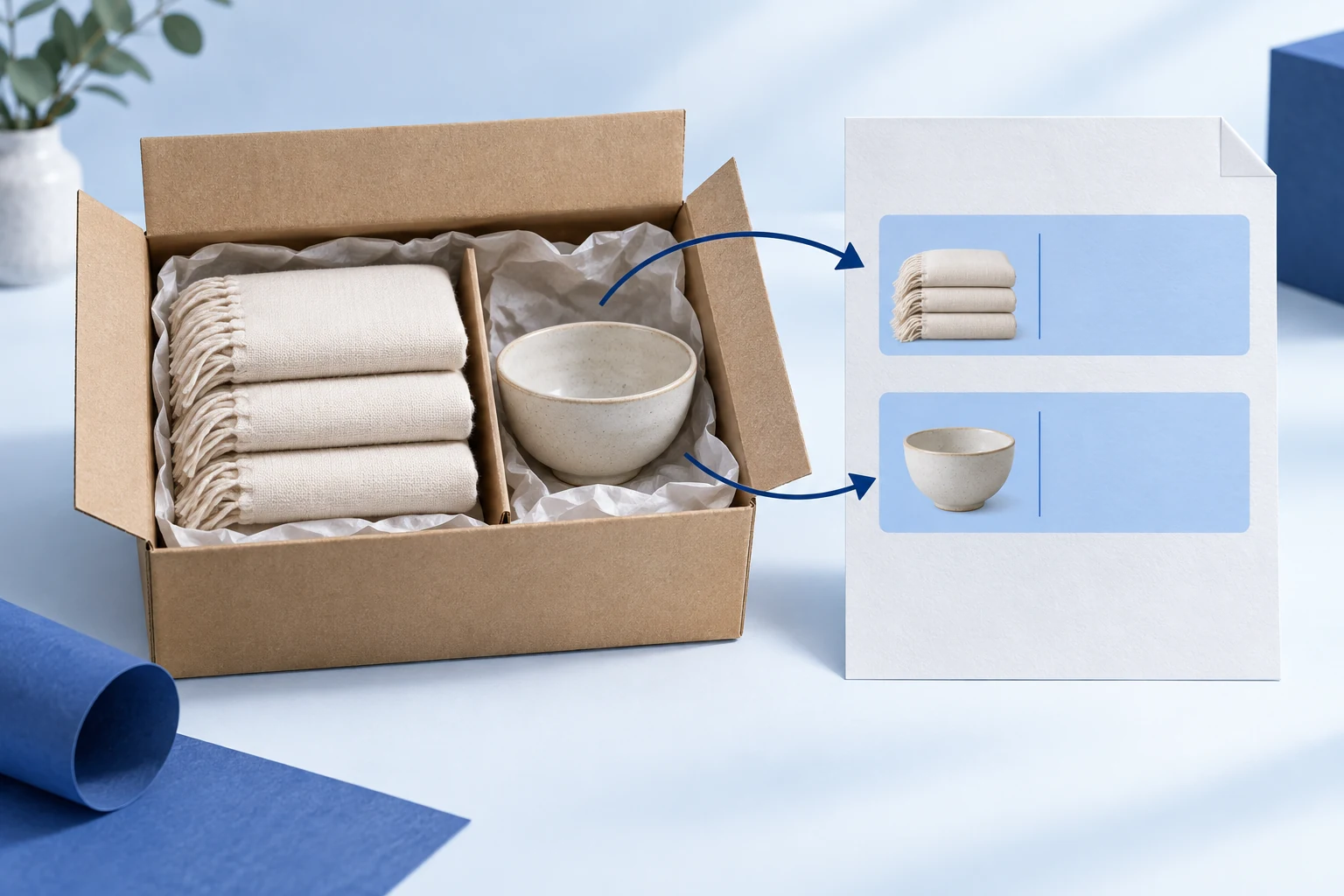
The EU’s temporary €3 customs duty has applied since 1 July 2026 to qualifying low-value imports. For a dropshipping seller, the immediate question is how many chargeable items a shipment contains. One customer order can produce more than one €3 charge.
The Council approved the measure in February, with an initial period running to 1 July 2028. Its announcement describes a charge for each distinct item category identified by tariff subheading, rather than a blanket €3 for every parcel. Council adoption announcement.
Effective: 1 July 2026. Checked: 16 September 2026. This article covers the temporary duty and its effect on quotations, rather than every charge that may arise on an EU import.
01
Which orders need a new cost check?
Start with consumer orders imported into the EU with a consignment’s intrinsic value not exceeding €150. The Commission’s June announcement confirms the threshold is inclusive: €150 itself is within the stated limit. The former low-value customs-duty exemption has ended. Commission notice of 16 June.
Do not use an old shipping invoice as proof that the current route is duty-free. Ask the carrier how it now declares your orders and where the charge appears in its invoice. That question matters even if the warehouse, destination and parcel weight have not changed.
The scope also requires more care than the early “IOSS only” headlines suggest. The amended rules cover relevant non-IOSS distance sales too. Preferential treatment can differ where IOSS is not used; goods above the threshold need a separate assessment. Current delegated regulation.
For the broader division of seller, agent and carrier responsibilities, use our guide to dropshipping customs duties. This change adds a specific charge to that operating process.
02
Count declaration items before changing a bundle price
A physical piece and a customs item are not interchangeable. Commission guidance defines an item using tariff classification, description and origin where the declaration requires it. It explains that the temporary duty is applied per declaration line, regardless of the quantity on that line. Commission customs guidance, pages 11–14.
The following is illustrative arithmetic for eligible consignments, assuming the stated declaration lines are correct. It is not a product-classification ruling or an AIDrop quotation.
| Shipment assumption | Chargeable declaration lines | Temporary duty |
|---|---|---|
| Three identical products correctly declared together | 1 | €3 |
| A mixed bundle requiring two separate lines | 2 | €6 |
| Two separately dispatched consignments, each with one line | 1 in each consignment | €6 total |
This changes the economics of inexpensive bundles. On a hypothetical €25 order, €3 equals 12% of that amount; €6 equals 24%. Those percentages describe the duty’s size relative to the order amount, not the store’s profit margin.
Before changing a bundle offer, send its actual product list to the party preparing the declaration. Ask for the expected line count and the classification basis. A storefront label such as “accessory kit” does not establish that its contents can be declared as one item.
03
Keep duty, VAT and service charges separate
The €3 duty does not replace VAT. The Commission’s VAT addendum explains that treatment differs by procedure. With IOSS, VAT is collected on the sale, and no import VAT is due on this duty at importation. Under special arrangements or the standard import procedure, the duty forms part of the import-VAT taxable amount. Commission VAT addendum.
That distinction is a reason to check the actual procedure before adding VAT to a spreadsheet. A universal “€3 plus VAT” formula would misrepresent some orders.
The announced Union handling fee is another measure. The Commission’s June notice described November 2026 as its earliest application. It should not be folded into this July duty or assigned an assumed rate in a current quote. A carrier’s own clearance or administration charge also needs its own line and explanation.
When two carriers quote different totals, ask both to separate freight, this duty, VAT treatment and their service fees. Comparing two headline shipping prices cannot show whether one already includes a charge the other will invoice later.
04
What to request with your next EU shipping quote
Send one representative single-product order and one mixed bundle. Include the destination, products, quantities, declared values and intended parcel split. Then ask for these details:
- Declaration basis: the number of chargeable lines and the procedure used.
- Included charges: whether the quoted freight amount includes the temporary duty or bills it separately.
- Payment responsibility: who pays the carrier or declarant, and whether the customer could receive a collection request.
- Reconciliation: which invoice or shipment reference lets you match the charge to an order.
A useful response should let you reproduce the total. If the carrier only replies “tax included,” ask which tax and which shipment assumptions that answer covers. Preserve the written response alongside the quotation so the next invoice can be compared against it.
For a route sold as DDP, ask the same questions. The delivery label alone does not give your finance team the item count, duty amount or billing reference needed to audit the shipment.
05
Review the order total before promising a delivered price
Use the cost calculator to organize the available shipping and fulfillment estimate. Keep confirmed customs charges alongside it until the relevant quotation explicitly includes them; an operational subtotal should not be presented as the full delivered cost.
Check a small sample of current EU orders against carrier invoices before applying a new surcharge across your catalog. Compare a single-item shipment, a mixed bundle and a split shipment. If the charges differ from your estimate, resolve the declaration or billing difference before adjusting the customer price.
The useful result is a price you can explain: the transport charge, the applicable duty, the VAT treatment and any separate service fee. That makes an EU order easier to quote and a later carrier invoice easier to challenge.