
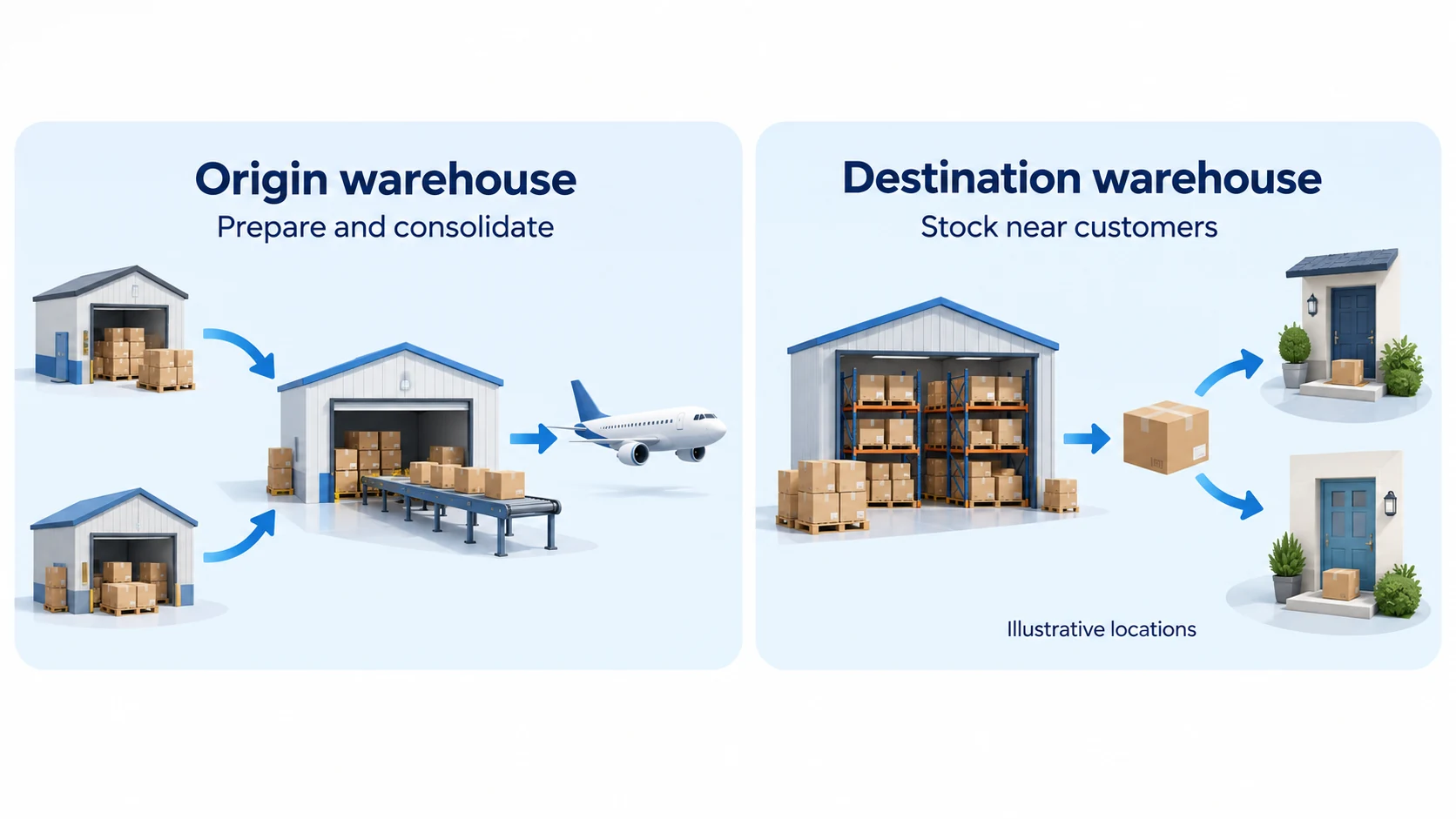
A dropshipping warehouse holds and dispatches goods for customer orders. It may belong to the supplier, be operated by an agent, or be an independent fulfillment facility holding inventory you own. Choose it according to the problem it must solve: an origin warehouse can consolidate and check products before export; a destination warehouse can put released stock closer to customers.
A warehouse address does not establish stock ownership, availability or delivery speed. Those depend on the product, the agreement, receiving status and the route used for the actual order. A supplier advertising several overseas warehouses may hold your chosen variant in only one of them, or in none of them today.
The inventory management guide covers the records behind those decisions. This article focuses on where to place goods, what that placement changes and how to verify that it supports the promise on your store.
01
Separate the warehouse from the business arrangement
Start with three questions:
- Who owns the units?
- Who may sell them?
- Who can authorize their release?
Different answers can apply inside the same building. Shared supplier stock, a reserved supplier allocation and goods purchased by your store are different commercial arrangements.
If the supplier owns a shared pool, the warehouse may serve many merchants. A quantity shown to your store may also be offered elsewhere. If you pay for reserved stock, establish how the reservation is recorded, when it expires and whether another order can consume it.
If you own the goods, agree how the operator identifies them and records receipts, commitments, holds and shipments. Ownership does not mean you must operate a building yourself. An independent warehouse can hold merchant-owned inventory while you manage the catalogue and purchasing remotely.
Direct fulfillment can still involve a warehouse
Supplier-direct dropshipping often dispatches from a supplier’s existing stockroom or warehouse. The relevant difference is whether you rely on that supplier’s available goods after a customer order or pre-position an agreed inventory allocation before the order arrives.
Avoid treating “warehouse” as a synonym for inventory investment. You can use a supplier warehouse without buying a batch in advance. Conversely, you can own a batch stored by another company. Record the commercial arrangement separately from the physical address.
Renting space is a different operating choice
A warehouse-space quote may give you premises while leaving staffing, inventory software, picking, packing and carrier collection for you to arrange. A managed fulfillment quote can include those activities, but only within its stated scope. For example, Cubework’s dropshipping offering advertises flexible warehouse space and business facilities. Read the service schedule before treating a space provider as the team that will fulfill your orders.
When comparing self-managed space with outsourced operations, include labor coverage, equipment, software and the work needed when your usual operator is absent. The lower rent figure alone cannot establish the lower cost of running customer orders.
02
Origin and destination warehouses solve different delays
An origin warehouse sits near the sourcing side of the operation. It can receive goods from several suppliers, check an agreed specification, consolidate items or prepare the required packaging before international dispatch. Whether those services are included must be confirmed with the operator.
A destination warehouse receives replenishment before serving local customer orders. Once the relevant units are received and released, the customer’s parcel can start its journey within that market. The earlier inbound movement still exists; it has moved into the stock-replenishment process.
An illustrative pair of scenes shows the distinction: an origin facility brings cartons from two suppliers together before export, while a destination facility holds already-received units for nearby customer orders. The first arrangement addresses preparation and consolidation; the second addresses where an available parcel begins its delivery journey.
When origin stock is useful
Consider it when products come from several sources, packaging needs to be standardized or supplier dispatch varies enough to disrupt orders. A controlled point before export can give you a place to resolve a quantity or product issue before sending the parcel farther away.
It does not automatically shorten the international parcel leg. Include transport, service availability and destination delivery in the customer estimate. A parcel waiting for a missing component at the origin warehouse has not gained speed merely by leaving the factory.
When destination stock is useful
Consider it for products with repeat demand in a defined market when the current international order-by-order journey prevents the service you want to offer. The benefit depends on keeping the right variant available locally and using a suitable dispatch and carrier service.
The trade-off is earlier commitment. You must replenish before local stock runs out and handle units that sell more slowly than expected. One fast-moving product can justify destination stock while another remains better suited to supplier-direct fulfillment.
03
Choose a location using your orders
Map actual delivery destinations by product or product family. Review:
- Where demand repeats.
- Which services reach those addresses.
- How much the package costs to deliver.
Country-level totals can hide remote-area charges, expensive regions and a cluster of customers far from the proposed facility.
Use the packed product, not the supplier’s product-only dimensions, when requesting route comparisons. Check whether one location can combine common basket items. Savings on an individual parcel may disappear if the arrangement creates more separate shipments.
Start with the promise you are trying to improve
Write down the present failure in concrete terms: procurement delays, inconsistent packaging, unavailable variants, long parcel transit or difficult returns. Then ask whether the proposed location changes that step. A second warehouse cannot correct a wrong product specification or an order feed that routinely sends the wrong SKU.
Request a sample route and processing plan for the destinations you serve. Establish the cutoff time, working calendar, eligible order conditions and physical handoff event. Separate a warehouse dispatch commitment from a carrier delivery estimate.
There is no universally best warehouse country. The decision follows your customer distribution, product restrictions, replenishment options and costs. Do not replace that analysis with a map showing many facility pins.
04
More locations can create shortages inside a large total
Distributing stock can shorten some deliveries, but it divides the inventory available to each region. You must decide how to allocate variants, when to transfer stock and whether another facility can serve an order without breaking its promise.
Suppose a hypothetical store has 120 units of one product. It sends 60 to Location A and 60 to Location B. During the planning period, demand is 90 units in A’s market and 30 in B’s. The total stock equals total demand, yet A is short by 30 while B retains 30. These are illustrative quantities, not a demand forecast.
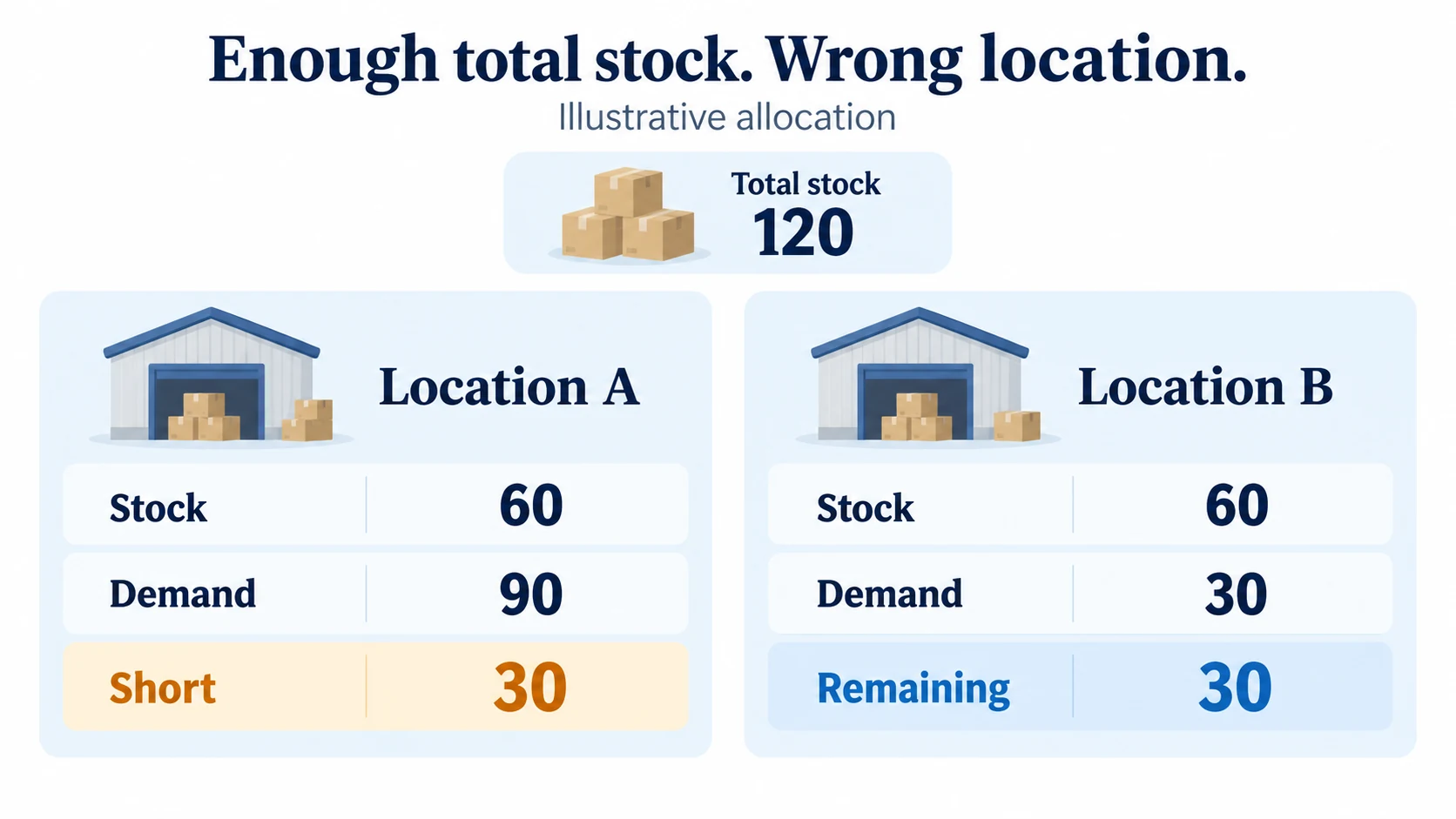
Moving B’s remaining units may cost money and take time. Sending those customer orders from B may also change the service. The business needs an approved transfer or cross-region route; a combined “120 in stock” number does not solve the allocation problem.
Keep the first allocation reversible
Use a limited product set and review location-level sales, stock age and upcoming replenishment. Avoid spreading an uncertain variant across several facilities just to advertise wider coverage. A single well-supported location can be easier to manage while demand is still being established.
Choose a review point before the next replenishment purchase. If one location is accumulating stock, reduce its allocation or consider a transfer while the product still has value. Include transfer preparation and freight in the decision, rather than treating movement between your own stocks as free.
05
Make receiving a release decision
Agree what the operator checks when cartons arrive:
- SKU identity and quantities.
- Visible damage and barcode readability.
- Any product-specific requirements.
Decide which discrepancies create a hold and who may approve release. A count alone cannot establish that the contents meet the agreed quality standard.
Retain the inbound reference, expected contents, received quantity and exception evidence. If the supplier declares 100 units and the facility counts 96, resolve the difference in the inventory record. Do not publish the supplier’s declared quantity simply because the delivery was signed for.
Shopify’s inventory-state documentation distinguishes physical on-hand stock from available, committed and unavailable quantities. It also excludes incoming stock from available inventory until receipt and the relevant state change. Match the platform’s state to the actual warehouse process.
In an illustrative receipt of 100 units, 70 have been accepted and released, 20 are held for a packaging check, and 10 are damaged. Before any customer commitments, only the 70 released units should support ordinary in-stock sales. All 100 may be physically present, but physical presence is a different fact from release for sale.
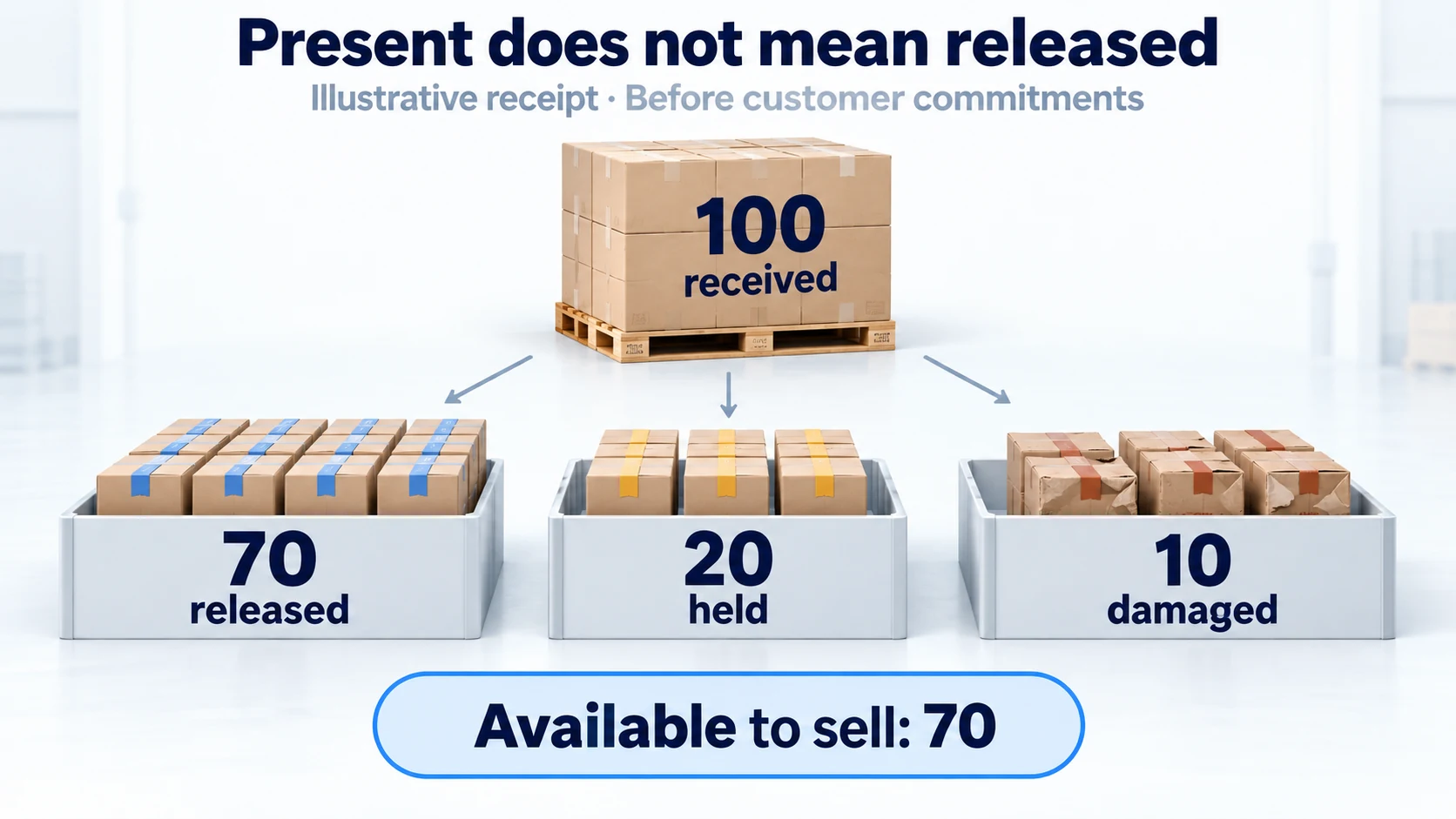
If product inspection is part of the arrangement, define its scope separately from routine receiving. The quality-control article explains why an approved specification and a release decision matter. A warehouse should not silently substitute its standard carton count for a more detailed check you expected.
06
Connect each order to an eligible location
Represent stock where it is actually held and available for the relevant service. Keep supplier stock and merchant-owned destination stock distinguishable. Avoid importing one shared quantity into several locations as though each held a separate batch.
Shopify’s location model supports separate inventory records and fulfillment configuration, including app-managed locations. That does not establish how a particular supplier integration reports stock. Check its documentation and test what happens when one location changes quantity.
Test baskets, not just individual products
A single-item order may route correctly while a basket containing two products splits across facilities. Test common combinations, quantities greater than one, missing variants and destinations outside the preferred warehouse’s service area.
Shopify’s routing rules include minimizing split fulfillments and ranking locations. Rule sequence and available stock influence the result. Confirm the actual order assignment and the resulting customer shipping information in your own setup.
If local inventory runs out, do not quietly keep the same delivery message while sourcing from overseas. Decide whether to change the offer, stop sales or use another route with an appropriate promise. The support team needs to see the route actually chosen, not just the warehouse normally preferred.
07
Treat returns as a separate warehouse service
A local dispatch warehouse may accept returns, but confirm the address, authorization method and handling scope. Determine which actions are included:
- Counting items only or inspecting their condition.
- Photographing defects and repacking goods.
- Returning units to sellable stock.
Create a disposition rule for damaged, opened, incomplete and wrong items. A return arriving at the building is not automatically a sellable unit. Keep it out of availability until the agreed check is complete and the decision is recorded.
Ask how unrecognized returns are handled. Customers may omit the return reference or send multiple order items together. The operator needs a way to identify the parcel and report uncertainty without assigning it to the wrong customer’s record.
Separate warehouse handling from the customer remedy. A supplier credit, a warehouse receipt and a customer refund have different owners and completion events. Include the costs of inspection, storage, disposal and onward shipping when deciding whether local returns handling is worthwhile.
08
Verify the facility and the service before committing stock
Build a shortlist within the delivery area your orders support. Ask existing logistics partners for facilities that handle your product, and use a warehouse directory to identify additional candidates. A directory such as Which Warehouse covers UK warehousing; a listing is a discovery route, not proof that the operator meets your specification. Filter candidates by managed-service scope, product acceptance and carrier coverage before requesting a quote.
Ask for the operating business identity, the exact receiving address and the party that will contract with you. Clarify whether the provider runs the facility or subcontracts the work. If several businesses are involved, identify who is accountable for instructions, charges and claims.
A current walkthrough can help explain the layout, but pictures alone cannot verify your inventory or the promised service. Request evidence tied to a controlled receipt or permitted test order: the goods identified, their recorded status, the dispatched contents and the corresponding stock change.
Use a small practical test
- Agree the SKU, quantity, packaging and exception instructions.
- Send a limited receipt and reconcile what the operator reports.
- Release a test order only against accepted inventory.
- Check packing, physical dispatch, shipment updates and the bill.
- Review a cancellation or return process relevant to the service.
If an event cannot be demonstrated, record the gap and resolve it before moving more stock. For example, a quantity mismatch needs a recount or receipt investigation; repeated order duplication needs an integration fix. More warehouse photos do not answer either issue.
The fulfillment workflow provides the wider sequence for these handoffs. Apply the same order identity from the store through the warehouse and shipment records so exceptions remain traceable.
09
Budget for slow stock and a possible move
Include product funding, replenishment freight, storage and any fixed commitments when choosing the quantity. Check how costs change if sales slow or a packaging revision leaves older units behind. A facility’s low monthly storage quote does not make an unwanted batch economical.
Agree the process for transferring or removing inventory. Establish notice, preparation charges, collection requirements, stock reconciliation and treatment of open returns. Know how you will export product and inventory records if the relationship ends.
Review the arrangement by product and location. The useful questions are whether the stock is in the right place, whether eligible orders receive the intended service and whether the remaining quantity still matches demand. Expand only where those answers support another commitment.
The operations hub connects warehouse decisions with the other parts of the order process. A useful warehouse choice gives a specific step better control; the rest of the system still needs to work with it.
10
Frequently asked questions
Do I need my own warehouse to dropship?
No. Supplier-direct fulfillment can use the supplier’s facilities. If you later hold inventory, an external operator can store and dispatch it. Owning goods and operating a building are separate choices.
Does an overseas warehouse mean my product ships locally?
Only if the relevant variant is available there, the order routes there and the service covers the destination. Verify those conditions for the product rather than relying on a provider’s general warehouse list.
Is stock at an origin warehouse ready for immediate delivery?
It may be ready for dispatch after the required checks and order preparation, but the international parcel journey remains. Use the actual service and destination to describe delivery, and distinguish ready-to-dispatch goods from stock still awaiting release.
Can I use both origin and destination warehouses?
Yes, when each has a defined job. Origin preparation can supply destination replenishment, while the destination facility serves customer orders. Keep quantities, ownership, transfers and availability separate so the same units are not counted twice during movement.