
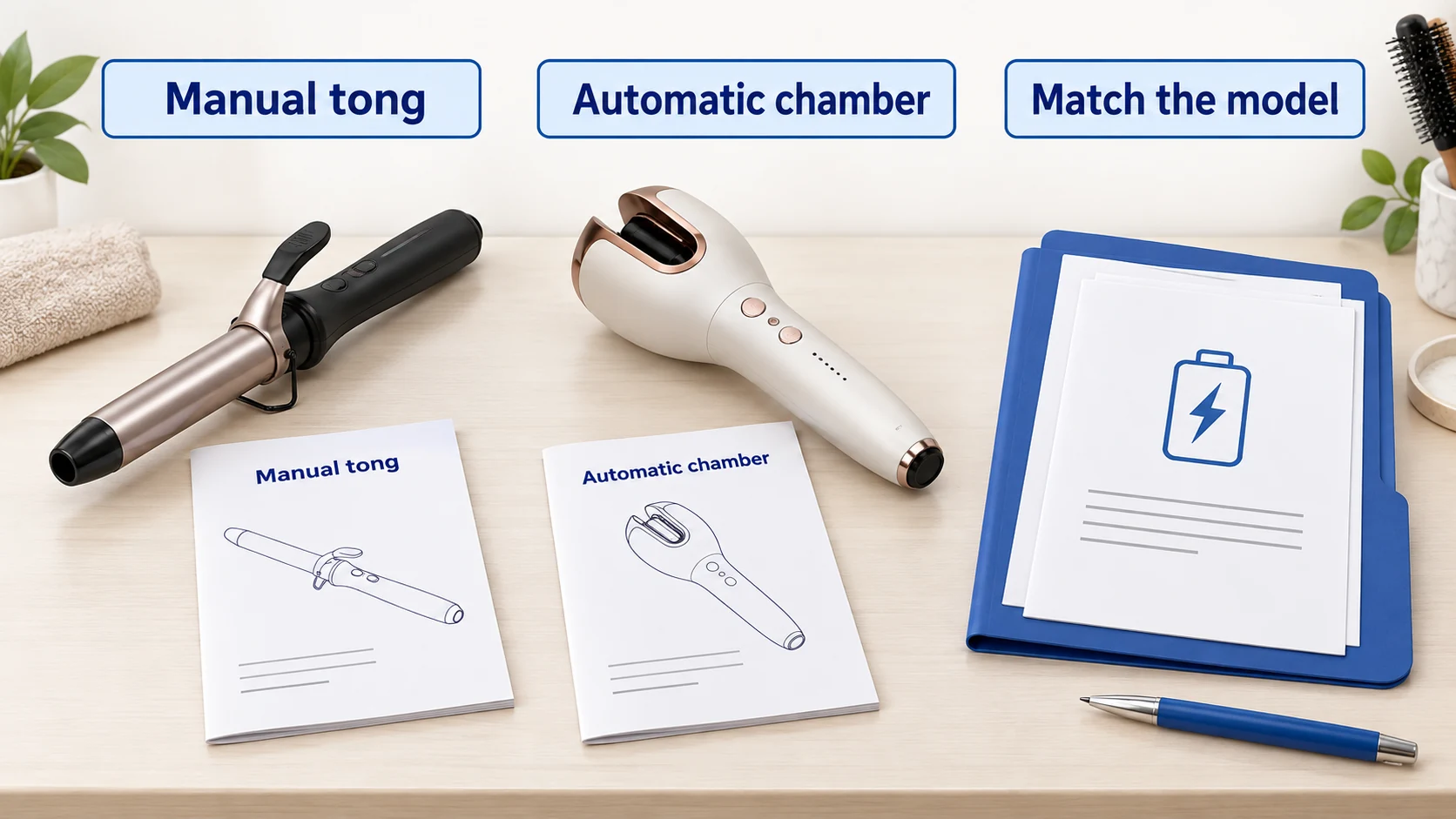
Cordless hair curler dropshipping is possible through catalogs or manufacturers that agree to individual-order fulfillment. It needs more verification than an ordinary beauty accessory: the exact device, battery documents, instructions, destination requirements and fault-return route must be clear. A curl demonstration cannot establish safe operation or shipping eligibility.
Start with a named model, not a collection of similar product photographs. Automatic curl chambers and manual tong barrels can look related while needing different instructions and demonstrations. A substitute device may change more than the color.
Sources were checked on October 13, 2026. This is a document-based guide and proposed order-verification process. We have not tested these devices, obtained their certifications or approved a shipping route.
01
Find an exact device and a supplier who will fulfill it
Doba’s curler category is a catalog route to investigate. A manufacturer such as Ryaca offers named rechargeable devices, but a wholesale page does not establish individual-order dropshipping. Ask for that agreement.
Get the exact model, manufacturer, variant and selling market before discussing a launch. Ask whether one unit can be supplied to the buyer address, whether resale is authorized where relevant, what is included and how a fault is handled.
| Needed answer | Why it comes first |
|---|---|
| Exact model and manufacturer | Documents and instructions must match the goods |
| Supported destination | Product and carrier requirements depend on the market and route |
| Individual-order service | Bulk production is not automatically consumer fulfillment |
| Included charging equipment | The buyer may otherwise receive an incomplete or unsuitable setup |
| Fault and return arrangement | A battery device may need more than an ordinary returns label |
For branded goods, establish legitimate supply and resale conditions. A brand’s instruction manual is useful for understanding its own product; it is not permission to sell that brand through an unrelated supplier.
The beauty-products guide covers broader assortment choices. A heated electrical tool has a different evidence and delivery job from a brush or cosmetic bag.
02
Decide whether the customer wants an automatic or manual curler
An automatic chamber takes a section of hair into a controlled curling mechanism. A manual tong or barrel asks the user to position the hair differently. Show the buyer the actual operation they are purchasing.
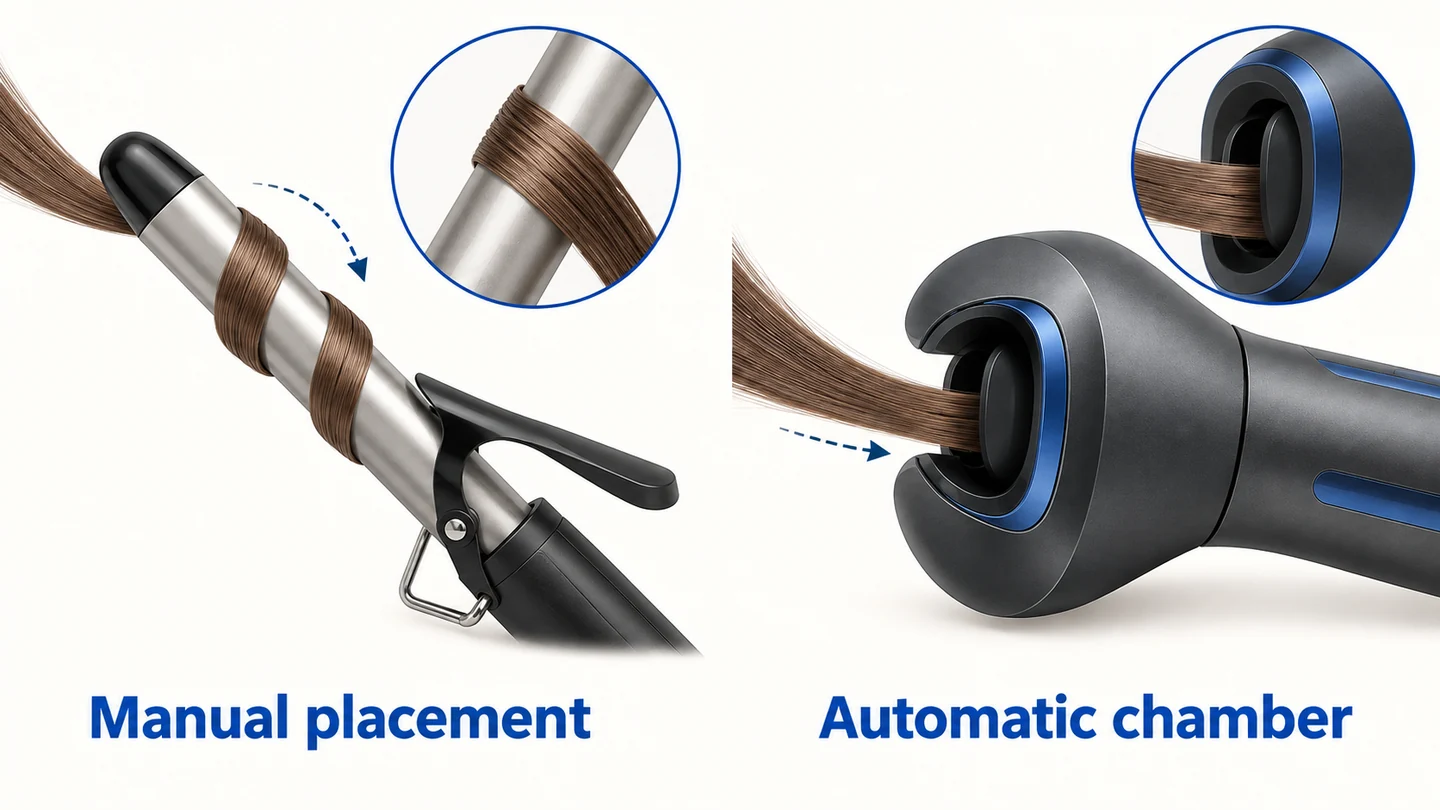
For example, Ryaca’s BY-211 page describes a 25mm ceramic-coated cordless tong. Conair’s Unbound instructions describe an automatic chamber with direction and timer controls. They are distinct configurations.
Do not use an automatic-curler video to advertise a manual device because their silhouettes look similar. Nor should a “cordless” title imply that a device can be used while plugged in; read the selected model’s instructions.
Pick the configuration and then get the correct demonstration, manual and product record. If the supplier proposes a replacement model, review the operation again before accepting it.
03
Separate charging, heating and curling behavior
Being charged, ready to heat and ready for a particular section of hair are different states. The selected model’s manual should make them clear.
| Stage | What the instructions need to explain |
|---|---|
| Charge | Required equipment, charging process and supported indication |
| Heat | Setting selection, ready signal and relevant conditions |
| Curl | Model-specific section and operating method |
| Stop or recover | Shutdown, idle behavior and response to a problem |
Conair’s example covers temperature/direction/timer selection and the ready signal. It says operating time varies with settings and use; idle auto-off does not necessarily mean the battery is dead. Those instructions belong to that model.
Ask for the conditions behind any advertised runtime. Do not copy another model’s values or invent one temperature for all hair types. Obtain a usable manual before selling.
Keep the demonstrated model and manual together. A video with different buttons or charging equipment cannot establish what this customer receives.
04
Match battery documents to the model and route
A lithium battery changes the shipping question. Identify whether it is installed in the device, supplied separately or accompanied by a spare. Then give that configuration to the qualified carrier or forwarder.
PHMSA’s test-summary guidance explains lithium-battery design tests under UN38.3 and the test-summary requirement. A document labeled UN38.3 is a relevant shipping evidence item; it is not a complete electrical-safety certification for the finished curler.
Request the battery manufacturer, model or identifier, relevant rating and matching test summary. Check that the document describes the battery in the device you intend to ship. A summary for an unrelated pack does not establish the selected configuration.
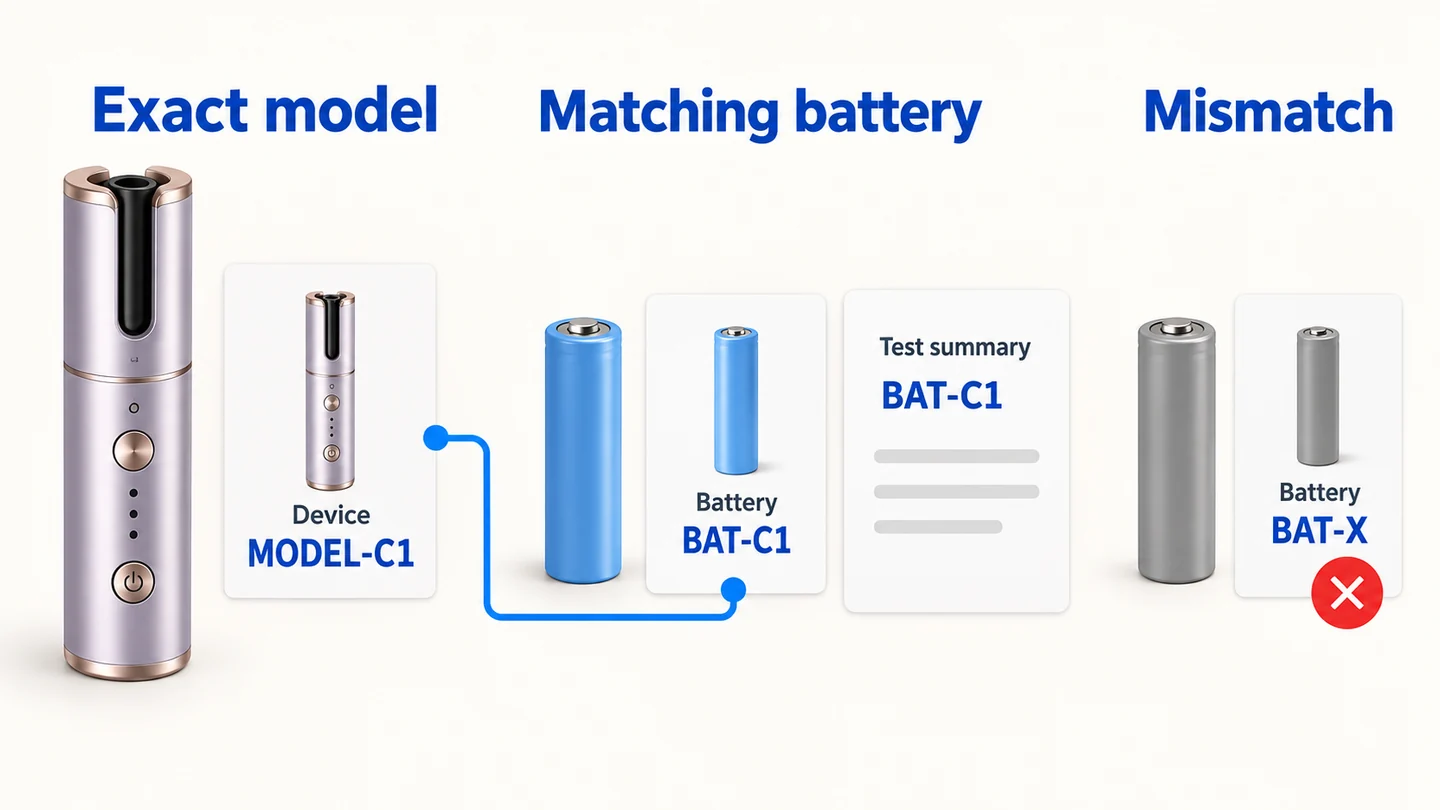
Ask the carrier to confirm the eligible service, packing, markings and any state-of-charge or other applicable conditions for the actual origin and destination. A battery installed in equipment is not automatically ordinary unrestricted freight. The lithium-battery shipping guide covers those broader route decisions.
If the supplier cannot identify the battery or the carrier will not accept the configuration, hold the offer. A cheap freight number without eligibility is not a usable shipping quote.
05
Check the charger, manual and customer remedy
Confirm what the buyer receives: device, cable, wall adapter, instructions and any accessories. The Ryaca page, for example, lists charging equipment as not included. That matters more to the buyer than a photograph showing a cable nearby.
For the chosen model, collect:
- Model and label information, including the documented input requirements.
- Charging-equipment inclusion and compatibility information.
- The actual instructions and cautions in a usable language.
- Product evidence relevant to the intended selling market.
- The fault-reporting, warranty and approved return arrangements.
Do not treat CE, FCC or another symbol in a marketplace image as complete proof. Obtain the applicable evidence and qualified assessment where required. These requirements differ; the guide does not give a universal approval checklist for every market.
Agree how a customer should report a fault and where the item can be returned. A damaged or abnormal battery device may need specialist handling. Do not tell a customer to mail it through an ordinary service before the approved route and instructions are confirmed.
06
Run a controlled first order without inventing a safety test
Once the documents and eligible route are clear, use an ordinary controlled order to check what arrives and whether the records agree. It is an order and configuration check, not a laboratory approval.
For an illustrative record labeled MODEL-C1, the acceptance sheet could contain:
| Record field | Compare against |
|---|---|
| Device model and variant | Supplier specification, invoice and received label |
| Battery identity and rating | Matching manufacturer information and test summary |
| Charger and accessories | Agreed included contents and documented input requirements |
| Manual | The actual buttons, configuration and supported operation |
| Parcel and route | Approved carrier arrangement and packing instructions |
Save the store order ID and accepted supplier order ID. Check the received device, packaging and labels before any use. Only follow normal operation in the exact instructions; do not improvise battery, overheat or destructive tests.
If the model or adapter does not match, stop the launch and ask for a correction. If the device shows abnormal operation or damage, stop use and follow qualified manufacturer/carrier directions. An ordinary function check does not override a document mismatch or establish safety for all uses.
Keep a changed model, battery or included adapter from inheriting the old approval. These components form one product configuration, so the evidence has to follow the change.
07
Price approved shipping and the fault scenario
Use an eligible route and its actual packing quote. An illustrative order receives $49 and spends $18 on the device, $4 on preparation/packing, $10 on freight, $1.70 on payment and $5 on a remedy allowance. It leaves $10.30 before advertising, tax and overhead.
These are invented figures. The allowance is not a guaranteed warranty cost; the freight is not approval or a quote for a battery route.
Calculate a fault separately:
- Price the replacement device and an eligible second shipment.
- Agree who funds each cost and how the buyer receives the replacement.
- Keep the customer response separate from supplier reimbursement; use the warranty guide to plan both.
For an AIDrop inquiry, send exact model, destination, available documents, battery configuration and charging contents. This supports a scope assessment; it does not promise certification or acceptance of every battery shipment. Send your specifications to AIDrop.
08
Questions about dropshipping cordless curlers
Can I copy a famous brand’s runtime onto a similar device?
No. Runtime belongs to the exact model and conditions. Use the selected manufacturer’s supported information and do not transfer instructions or demonstrations between devices.
Is a UN38.3 summary enough to call the curler safe?
No. It concerns battery transport evidence. Finished-product requirements, actual configuration, instructions and other applicable evidence are separate matters.
Can a manufacturer’s wholesale page supply my first one-unit customer order?
Only if that service is agreed. Confirm the quantity, buyer destination, packing, accepted route and fault response before offering dropshipping.
What if I cannot support the electrical and battery requirements?
Hold that product. A non-electrical, heatless accessory may be another assortment option, with its own product and supplier checks. You do not need to force an unsupported device into the store to fill a category.

Beauty Products Dropshipping: Claims, Ingredients and Supplier Records
Choose an explainable beauty range with actual supplier examples, product and label questions, a worked bottle-cost example,

Supplement Dropshipping: Choose a Supplier and Check What You Can Sell
Choose an exact supplement offer and supplier route, match the formula and label, calculate a complete paid

Hair Extension Dropshipping: Choose the Length, Texture and Order Route
Compare actual hair vendor routes, fill a precise bundle or wig request, budget app access and a
