
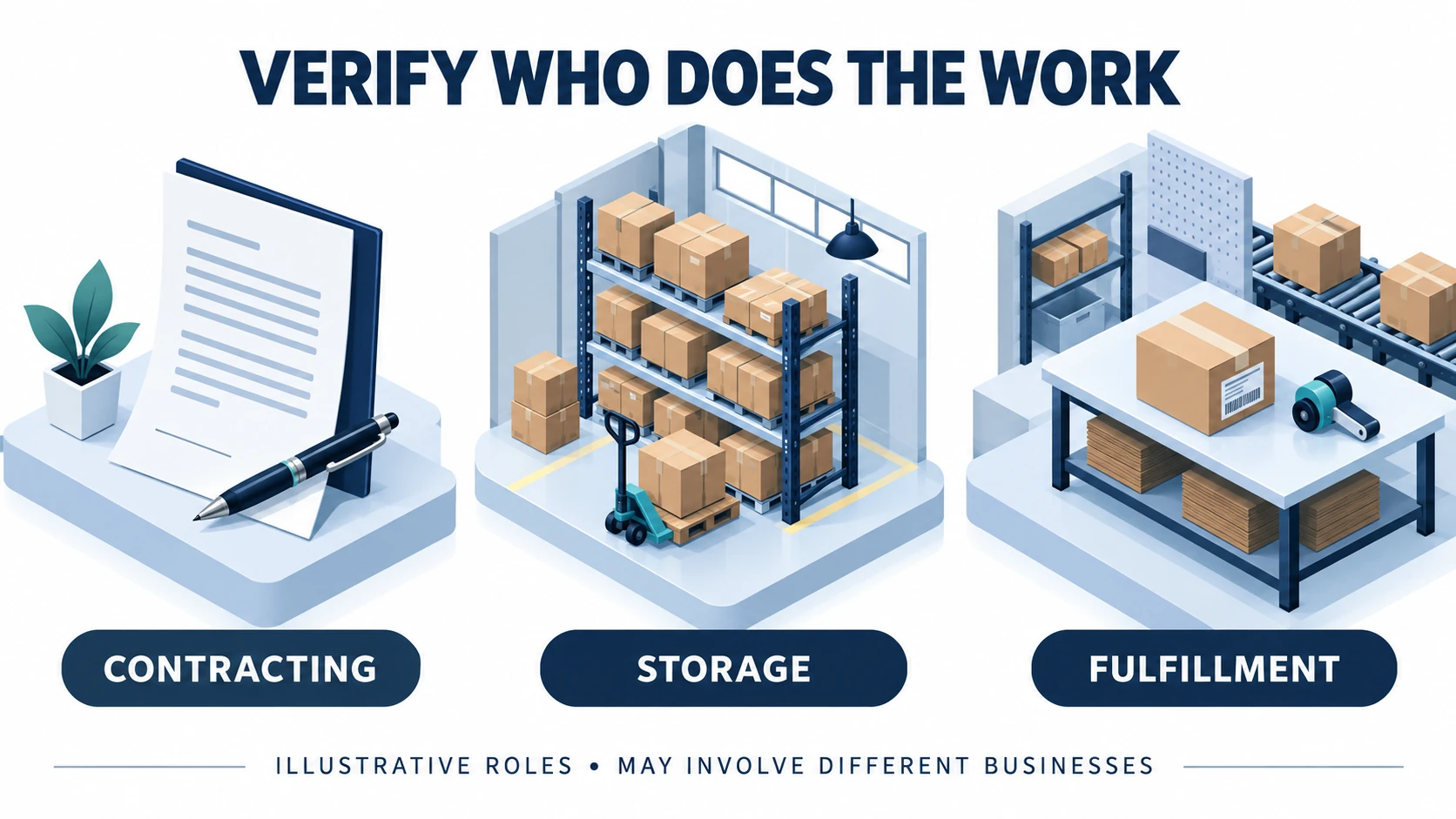
Find China dropshipping agents through fulfillment platforms, specialist operators, supplier introductions and relevant trade networks. Before paying for a trial, establish who will contract with you, purchase the product, hold inventory, check orders and arrange delivery. Those responsibilities may sit with different businesses.
Choose an agent for the work your orders need. A sourcing contact, a warehouse operator and a software platform can all be useful, but they do not provide the same service. Ask for evidence tied to your exact product and route rather than relying on a general promise of fast fulfillment.
01
Identify the service you actually need
An agent can help coordinate buying and fulfillment in China, but the label is broad. Start by describing the point where your current arrangement stops working.
Sourcing and purchasing: You need help identifying suppliers, obtaining samples, comparing quotations or arranging a purchase. Confirm whether the agent introduces you to the supplier or resells the goods under its own agreement.
Storage and order fulfillment: You already have a product source and need receiving, stock records, picking, packing and dispatch. Check whether the candidate operates the facility or arranges these services through another operator.
Platform-based coordination: You want a catalog, ordering interface or store connection with associated supplier and fulfillment services. Identify which company performs the physical work behind the software.
A merchant who has a supplier but needs individual parcels shipped may need fulfillment rather than another sourcing layer. A merchant who has only a product photograph needs more work before any warehouse can process orders reliably. The agent, supplier and 3PL comparison separates these roles.
Write the requirement in operational terms: the product and variants, expected order range, destinations, packaging, system used and the problem to solve. Avoid presenting forecast volume as committed demand. The broader guide to choosing a dropshipping agent covers the general selection decision; the checks here focus on a China-based arrangement.
02
Find candidates without mistaking a directory for verification
You can investigate platforms such as CJdropshipping and operators such as HyperSKU as starting points. Their public pages describe their own services. Inclusion here is not an independent audit, endorsement or claim that either fits every product and destination.
Supplier introductions can identify someone familiar with the category. Ask why the supplier recommends that agent and whether the two businesses have a commercial relationship. A referral can save search time while still requiring separate checks.
Trade events, industry contacts and established logistics providers can also produce candidates. Ask for relevant operating experience rather than a generic client list. An agent handling your product type may understand its packaging and variant risks, but request evidence instead of assuming competence from location alone.
Online communities can reveal names and common questions. Treat unsolicited recommendations cautiously as leads: respondents may work for the service they recommend. Move any promising candidate into the same verification process rather than using the number of recommendations as your decision rule.
Give a small shortlist the same brief. Comparable inputs make the responses useful. If one candidate quotes an unbranded single item and another quotes a packed set with an insert, their headline prices do not describe the same order.
03
Verify the contracting business and the facility separately
Ask for the registered Chinese business name, registration identifier, contracting name and invoice details. Compare the information across the quotation, agreement and payment instructions. A trading name on a website may differ from the registered name, so ask for the relationship in writing.
China’s National Enterprise Credit Information Publicity System is a starting point for checking registration information. Use the exact Chinese name or identifier and obtain help if you cannot interpret or access the record. A saved license image alone is not a substitute for checking the available registration record.
Registration does not establish fulfillment quality. It does not prove that the company owns the advertised warehouse, holds your stock or has inspected the product. No specific agent’s registration or facility has been audited for this article.
Ask who receives payment and why. If the payee differs from the contracting business, require a documented explanation of the relationship and payment authority. Do not let a last-minute change in bank details pass as a routine administrative update; verify it through an established contact channel before sending funds.
For the operating location, request the address and the name of the entity running it. Ask whether storage is owned, leased or subcontracted. Any of these arrangements may work; what matters is knowing who has custody and who is accountable to you.
A current walkthrough can help connect an address with the described process. Ask to see the relevant receiving, storage, packing and dispatch areas and how your stock would be identified. Generic warehouse photographs cannot establish these details. Keep customer names and other merchants’ sensitive information out of requested evidence.
For a larger commitment, consider an appropriately scoped independent inspection or professional due diligence. Define the questions to answer before ordering the check. A facility visit, a company search and a product inspection each establish different things.
04
Compare the cost of the same completed order
Request a written quote with enough detail to reproduce the total for your intended order. Include the product version, quantity, destination, packed dimensions, service and validity period.
Ask how the following are charged:
- Product purchase and any purchasing fee or markup.
- Domestic transport from the supplier to the operating warehouse.
- Receiving, inspection and handling.
- Packaging, inserts, labeling and assembly.
- Storage, minimum commitments and aged inventory.
- Outbound shipping and relevant surcharges.
- Repacking, failed delivery, return handling and disposal.
- Payment, currency conversion and balance withdrawal where applicable.
Not every provider will price every item separately. An all-in quote can still be usable if it states exactly what is included and when additional charges apply. Compare the complete scope instead of assuming that a separately listed service fee is always worse than a markup inside the product price.
CJ’s published service-fee page distinguishes different service and warehouse arrangements. That is a useful reminder to obtain the applicable quote rather than treating “free sourcing” or another headline as a zero-cost total. The current terms for your own arrangement control the purchase.
Consider two hypothetical quotations for the same packed item and destination. Quote A lists $5 for the product and $7 for the included handling and delivery, totaling $12. Quote B lists $4.50 for the product and $6 for delivery, plus $1.50 for handling and $0.75 for packaging, totaling $12.75.
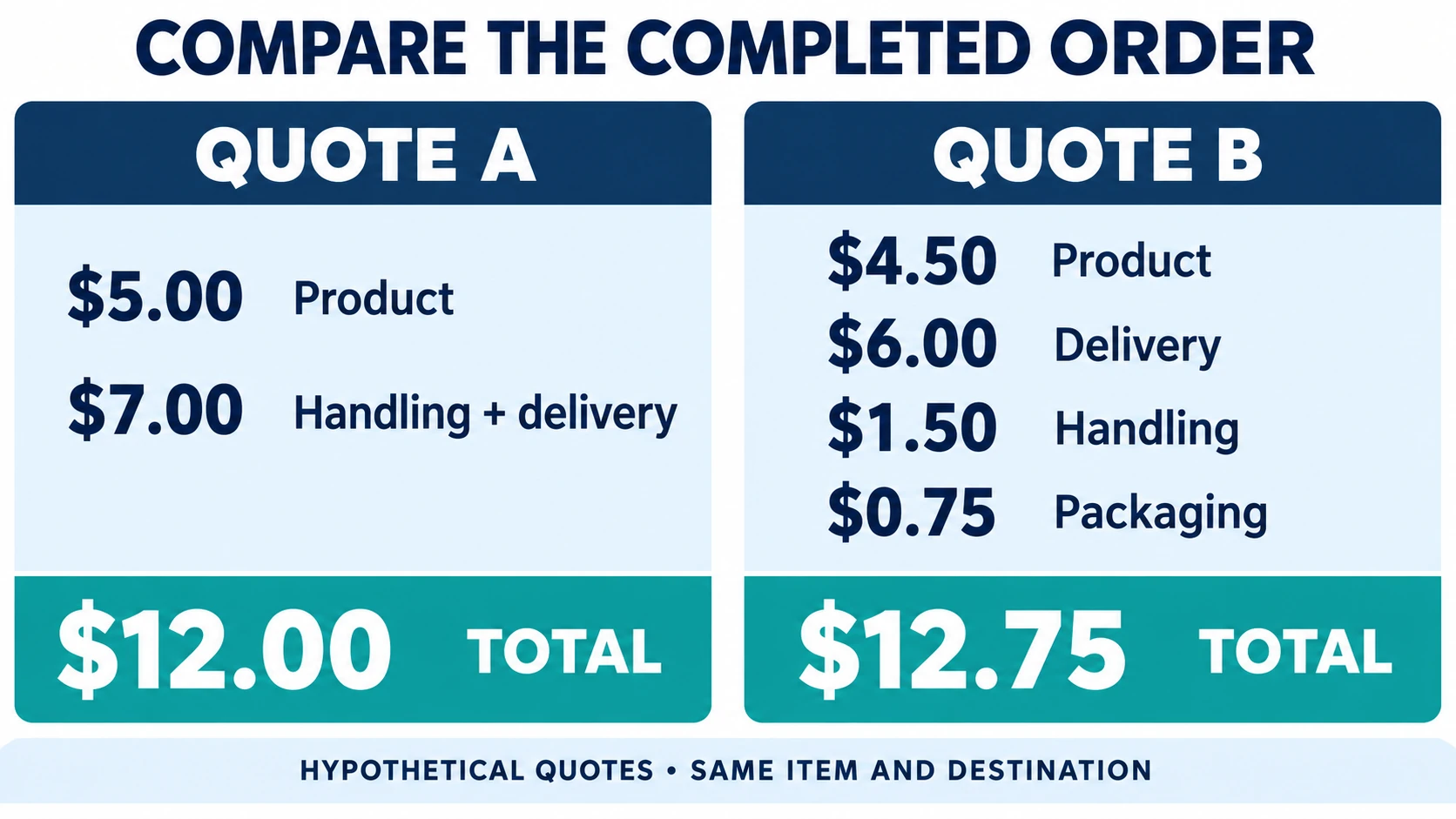
The lower product price in Quote B does not make it the cheaper completed order. This example is illustrative; it says nothing about either provider’s reliability. After matching cost, still compare the product, service, exclusions and responsibility for failed orders.
Ask how price changes are approved. Currency, packed weight or service changes can alter the total. Agree whether the agent must pause an order above a stated cost limit and who can authorize the difference.
05
Turn sample approval into a usable product reference
Specify the product before evaluating the agent’s handling of it. Identify the variant, dimensions, materials, included items and packaging. For a set, list every component. A photograph alone can leave too much room for a different version to be supplied.
Order a sample through the proposed arrangement where practical. Inspect the features that matter to the actual use, then record the accepted version with dated images and a specification. The sample approval guide explains this record. A cosmetic check does not establish electrical safety, material compliance or durability under untested conditions.
Ask the agent to describe the inspection scope. Does the service check quantity and visible damage, dimensions, function or another agreed characteristic? Which units are examined? What record is produced, and what happens to a failed item?
A quality-check claim needs a defined check and response. A count of inspection points does not prove that the points address your product’s risks. A supplier’s sample approval does not prove that every later unit matches it.
Agree how substitutions and changes are handled. A different material, zipper, color or component can affect what the customer receives. Require approval for changes that matter to the listing or use; identify who can give that approval and how the decision is recorded.
If a check fails, establish whether the item is held, replaced, reworked or returned to the supplier, and who pays. Do not leave failed units in available stock while waiting for a decision. The inventory record should make their status visible.
06
Keep inventory ownership and system access clear
An agent may ask you to buy stock in advance or maintain a balance for purchases. Understand what the payment buys. A cash balance, goods ordered from a supplier and stock physically received at a warehouse are different states.
Ask when ownership transfers, how your units are identified and whether inventory is allocated exclusively to you or shared. Define how receiving shortages and damaged goods are recorded. A dashboard quantity is useful only when the underlying stock movement can be explained.
Request records for received units, available units, reserved orders, held goods and dispatched units. Agree how discrepancies are investigated and how often balances are reconciled. If an item appears available but cannot be found during picking, the response should address both the affected order and the stock record.
Store integration also needs a clear boundary. Confirm which information is sent, which statuses return and what happens when the connection fails. An imported order is not necessarily accepted for fulfillment, and a generated tracking number is not necessarily a carrier handoff.
Use an access method suitable for the task and avoid sharing your primary store password. Ask how customer order information is accessed, retained and removed when the relationship ends. Confirm the arrangement fits the obligations that apply to your business and customers.
07
Test the route and the response to a problem
A shipping estimate should name the origin, service, destination coverage and the event that starts the clock. Supplier procurement, warehouse processing, carrier transport and customs handling can contribute different delays.
Ask for relevant recent route evidence with sensitive information removed. Look for the dates and event definitions behind any claimed delivery range. Do not generalize from the fastest parcel or from a destination different from your main market.
Use a trial that represents the actual product and packing arrangement. Record the order request, acceptance, packing, carrier handoff and delivery. Include a destination relevant to the intended offer where feasible. A small trial can reveal defects; it cannot establish a statistically reliable failure rate.
For USPS tracking, “Shipping Label Created, USPS Awaiting Item” means a label exists but USPS has not yet received the parcel. A shipping partner may have a separate preceding leg. USPS tracking guidance explains these event distinctions.
Ask the agent how it investigates a parcel that remains at that stage. You need a named contact, the evidence they can obtain and the point at which they escalate. Another screenshot of the same status does not resolve whether the parcel moved. The tracking and missing-update guide helps separate the events to investigate.
Test communication with realistic questions before expanding the arrangement. Ask how an address correction, out-of-stock variant or failed quality check would be handled. Do not manufacture a live customer problem; review the procedure and use your own trial where an actual issue occurs.
08
Agree on claims and an exit before committing stock
Put the operational terms in writing. Identify the contracting parties, product reference, services, charges, approval limits and responsibilities for exceptions. For a substantial commitment, have qualified advice review the agreement and the relevant jurisdiction rather than relying on a generic template.
Clarify the process for a wrong item, damage, missing parcel or failed delivery. Ask what evidence is required, when a claim must be submitted, what remedy may apply and which party communicates with the carrier or supplier. A merchant’s refund to a customer and a supplier’s reimbursement to the merchant are separate events.
Define what happens when you leave. Include the release of remaining stock, collection arrangements, packing or transfer fees, outstanding balances, data exports and removal of access. Ask how held or disputed goods are treated. An attractive starting quote can be less useful if you cannot recover your inventory on clear terms.
Make the first commitment proportionate to the evidence. Resolve material identity, product or payment questions before a trial. After a satisfactory trial, increase volume only when the stock, costs and service responsibilities remain clear.
09
Frequently asked questions
Is a private agent better than a platform?
Neither is automatically better. A private arrangement may offer more direct coordination, while a platform may provide a convenient ordering interface. Evaluate the actual contracting, stock, inspection, shipping and recovery arrangements rather than the label.
Can I work with an agent without buying inventory upfront?
Some arrangements allow purchasing after an order, while others require a balance, minimum volume or advance stock. Ask for the terms for your exact item. Packaging or customized products can create separate commitments even when the basic item is purchased per order.
Does a warehouse address prove that the agent owns the warehouse?
No. It may be a partner facility, leased space or another operating arrangement. Ask who runs it, who holds your goods and who is responsible under your agreement. Ownership alone would not establish service quality either.
What should I send when requesting a quote?
Send the product reference and variants, intended destinations, expected order range, packaging requirements, system used and the work you want the agent to perform. Ask for inclusions, exclusions and exception charges so responses can be compared.
When should I reject a candidate?
Pause or reject the arrangement when a material identity or payment discrepancy remains unresolved, the supplied product differs without approval, or the provider cannot explain who holds and releases your stock. A missing public price is a reason to request a clear quote, not by itself proof that a business is unreliable.