
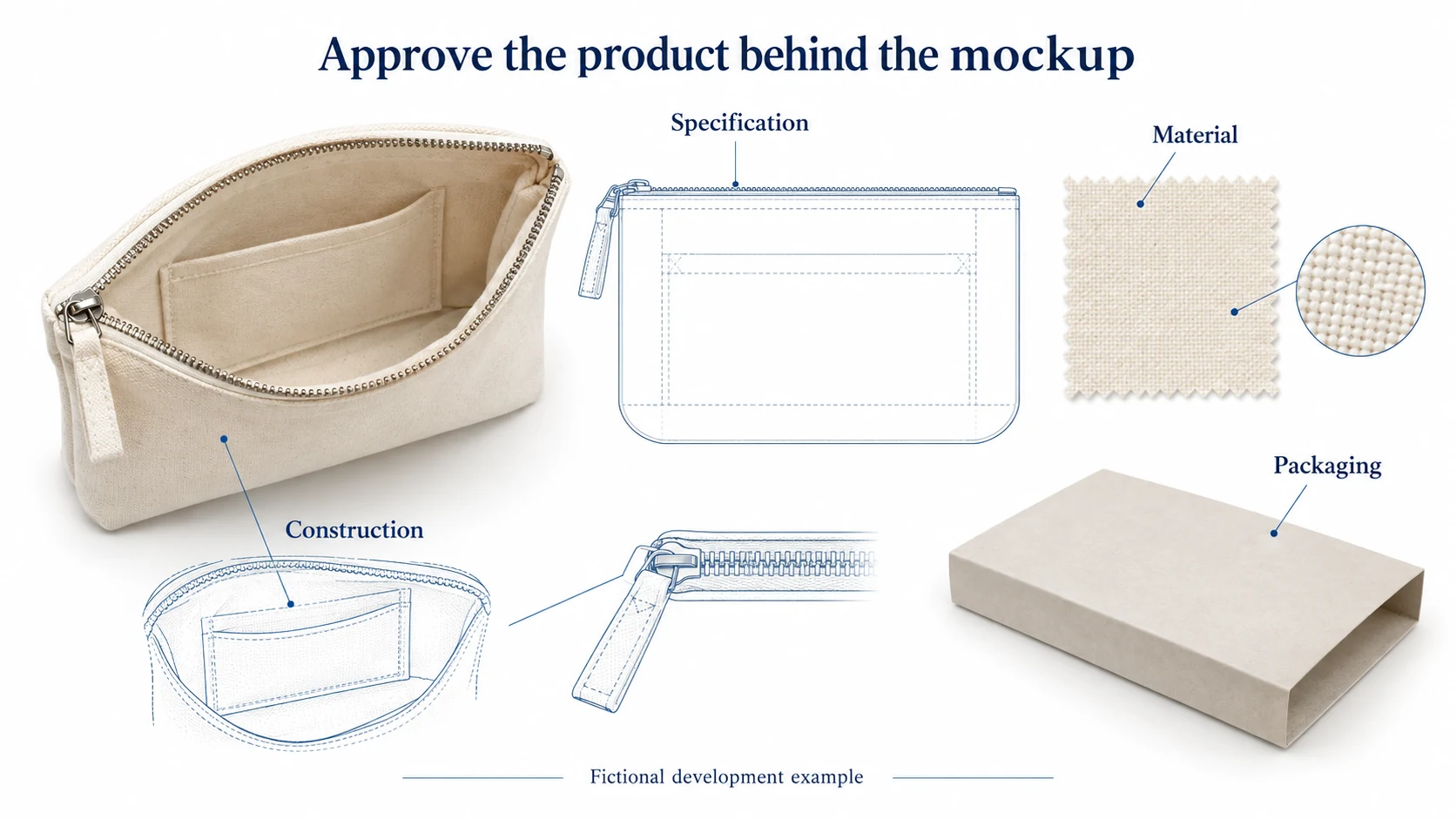
Custom product dropshipping can mean adding artwork, personalizing each order or developing a changed physical product. The first two often work with catalog blanks made on demand. Changes to materials, dimensions, components or formulas usually need development, samples and a separate production agreement before individual orders can be fulfilled.
Start by describing the change, not by asking whether a supplier “does custom.” A name printed on a pouch and a redesigned pouch compartment require different files, equipment, checks and commitments. Both can end with the supplier shipping a parcel to your customer, but the work before that shipment is different.
If you are still deciding how much branding or product control you need, our private label dropshipping guide explains the wider business model. This article focuses on making the intended change reproducible, from supplier brief to customer order.
01
Decide what the customer is actually customizing
There are three common starting points. In a branded catalog offer, you create one design and sell it repeatedly. In a personalized offer, each buyer supplies information such as a name or photograph. In a developed product, the underlying item changes before customers choose or personalize it.
| Your idea | Likely production route | What needs approval |
|---|---|---|
| Put original artwork on a standard shirt | Print on demand using a supported blank | Garment, artwork, print method, placement and finished sample |
| Engrave a different name on each item | Per-order personalization | Allowed characters, layout, proof process and accurate order data |
| Add a brand sleeve to a catalog organizer | Packaging or labeling service | Sleeve fit, artwork, packing instructions and stock availability |
| Change the organizer’s pocket depth | Modified product specification and sample | Dimensions, materials, construction and manufacturing repeatability |
| Develop a new bottle formula or molded part | Specialist development and production | Technical specification, applicable tests, tooling or formula terms and batch approval |
Printful’s custom-product service is a concrete example of the catalog route: select a base product, add the supported design and have orders made and shipped on demand. Prodigi similarly turns digital designs into printed products, including art and other catalog merchandise. Neither description means that a merchant can redesign any physical component using the ordinary product editor.
Some apparel suppliers offer changes beyond a flat print. For example, Apliiq’s pricing documentation includes supported custom pockets and hood liners as separately priced additions. The relevant question is whether your chosen base product supports the specific alteration—not whether the platform uses the word custom.
A new shape, material or formula can require a manufacturer and a later fulfillment arrangement. The manufacturer may produce a batch to your specification, while a warehouse handles individual orders. You can outsource both tasks and still own the inventory between them.
02
Write a brief that a supplier can quote
Begin with the customer’s problem. “Make a premium organizer” is too open to interpretation. “A compact charger must fit in the main pocket without forcing the zipper” gives the supplier a purpose, but it still needs measurable requirements.
The following is a fictional development brief, not a tested product or a recommendation that these dimensions will suit every charger. It shows the level of specificity needed for a quotation.
| Brief field | Example requirement |
|---|---|
| Working reference | Cotton organizer, development version V1 |
| Intended use | Store the specified charger and two coiled cables inside a travel bag |
| Base construction | Supplier’s existing cotton zip pouch, with material composition declared in the quote |
| Finished external size | Target 220 × 150 mm, supplier to propose achievable tolerances before approval |
| Internal pocket | Target clear opening 100 mm wide and usable depth 80 mm; confirm against the physical charger sample |
| Main change | Increase the internal pocket depth; retain the approved outer shape and zipper arrangement |
| Brand application | One printed logo on the front, using supplied artwork and approved placement reference |
| Optional customer personalization | One name on the reverse, using an agreed typeface and printable area |
| Packaging | One pouch per protective bag, with required product information and no unapproved inserts |
| Quote scope | Development sample, revisions, production MOQ, per-unit price, personalization, packing and customer dispatch quoted separately |
Attach a drawing with named measurements and a photograph or physical reference for the object that must fit. “Width” could mean the pouch’s outer seam-to-seam width or the usable pocket opening. Identify which one you mean before comparing quotes.
Ask the supplier to flag requirements it cannot hold consistently. A proposed tolerance is a negotiation point, not a number to invent because it looks technical. If the process cannot reliably make the pocket small enough for your design and large enough for the charger, revise the design before production.
Keep nonnegotiable requirements separate from preferences. Fit, required labeling and an essential closure may be mandatory. A decorative thread color may be flexible. This lets the supplier offer a workable alternative without quietly changing the feature the customer needs.
03
Approve the production version, not only an attractive prototype
A prototype answers whether the idea can work. A production sample should show the intended materials, construction, artwork and packaging. A hand-adjusted sample made differently from the planned run may look convincing without demonstrating repeatability.
For the organizer, check the actual charger fit, pocket opening, zipper movement and the stress points created when the pouch is filled. Record what you checked and what you did not. A successful fit test says nothing by itself about every regulatory requirement, wash durability or the consistency of an entire batch.
Photograph the approved sample with relevant measurements and retain the specification revision. If the pocket needs another change, call the new version V2 and state whether V1 is rejected or approved for a different use. Avoid a folder of files called “final,” “final-new” and “final-approved” with no clear production reference.
A mockup approves appearance; it does not prove the physical product. Printed colors, fabric texture, seam placement and the usable space inside a product can differ from a flat rendering. Use artwork proofs for artwork questions and a physical sample for physical questions.
For regulated products, establish the applicable documentation and testing before approving a commercial run. A new formula or component can change the product’s requirements. Do not carry over a supplier’s old report simply because the packaging or product name is similar. The quality-control guide explains how to connect inspection scope to the failure you need to detect.
Also resolve rights to the new work. Commissioning drawings does not automatically clarify who owns them, whether you can send them to another factory or whether the supplier can reuse the design. Put file access, tooling ownership where relevant and any exclusivity into the development agreement.
04
Price the change and the finished order separately
Customization can create value, but it adds work. Include sample revisions, development, artwork preparation, setup, additional production steps and the cost of mistakes. If a name is printed incorrectly, the base item may still be physically sound but unsellable to another customer.
For a one-off design on a catalog product, the main extra cost may be decoration. For a changed product, you may need to buy a batch before receiving customer orders. Packaging can have its own minimum. Ask for these quantities separately rather than accepting one unexplained “custom MOQ.”
Here is an illustrative personalized-organizer calculation in USD. Assume a $32 selling price and the following costs per order:
| Variable cost | Assumed amount |
|---|---|
| Product and standard brand print | $8.00 |
| Customer-name personalization | $2.00 |
| Packing and delivery | $6.00 |
| Payment fees and expected remake allowance | $2.00 |
| Total variable cost | $18.00 |
| Contribution before acquisition and fixed costs | $14.00 |
At 50 completed sales, that produces $700 before acquisition and fixed costs. If development and samples cost $300 and the campaign costs $100, $300 remains before other overhead and tax. This is arithmetic from stated assumptions, not a margin benchmark or an earnings forecast.
Now suppose ten orders need an extra $16 remake and delivery, beyond the allowance already budgeted. That consumes $160 of the remaining $300. A personalization process that repeatedly loses accents or uses the wrong layout can erase much of the apparent advantage.
If production requires a prepaid batch, model the cash purchase separately from the cost allocated to sold units. A profitable first 50 sales may coexist with money tied up in the remaining stock. Use the MOQ planning guide to compare the commitment across colors, sizes and packaging.
05
Make every customer choice survive the order handoff
A customer-facing text box is only the beginning. The entered name, selected layout and correct product variant must reach the system that creates the production file. A supplier receiving only “blue pouch” cannot infer the missing name.
Shopify’s customization guidance distinguishes fixed variants from more advanced text or upload inputs and calls for testing those details through checkout and fulfillment. A customization app may provide the storefront controls, but you still need to verify what the production partner receives.
Consider this fictional order:
| Production field | Value to preserve |
|---|---|
| Store order | EX-1042 |
| Product version | Organizer V2, natural cotton |
| Customer text | Léa |
| Layout | Reverse-center, approved layout P3 |
| File reference | EX-1042-P3-approved.png |
| Approval state | Approved for production; no later customer edit applied |
The accent in “Léa” is part of the request. Test supported characters, punctuation, very short and maximum-length names, line wrapping and the font’s available glyphs. Reject or resolve an unsupported entry before payment or production, according to your defined workflow. Silently replacing a character gives the customer a different product.

For image uploads, define accepted formats, adequate resolution for the actual print area, cropping and who checks image rights. A low-resolution thumbnail can look acceptable in a small storefront preview and fail at print size. Follow the provider’s product-specific template rather than applying a universal file specification to every item.
Decide whether customers approve a proof. If they do, record the approved version and when production begins. If they do not, show a clear preview or input confirmation and explain the limitations. A customer may expect the screen preview to show exact placement unless you explain otherwise.
Freeze the production file at release. If a customer changes the spelling afterward, first determine whether production can still stop. Replacing a file in your store does not recall a file already downloaded by the supplier. Likewise, search for the existing order reference before retrying a failed submission; a slow response should not create two personalized products.
06
Set delivery and returns around what actually happens
The delivery promise needs to include proof approval where required, the production queue, customization and carrier transit. “Ships in three days” and “delivered in three days” are different promises. A supplier’s transit estimate usually does not include days spent waiting for the buyer to approve artwork.
For US orders covered by the FTC’s merchandise order rule, the seller needs a reasonable basis for its advertised shipping time and must handle delays under the rule’s consent or refund requirements. Outsourcing production does not remove that responsibility.
Write a returns policy that distinguishes a buyer’s change of mind from your error, a manufacturing defect or a product that differs from the approved order. Do not use “custom items are nonrefundable” as a blanket answer to all four situations. Applicable consumer rights depend on the market and the transaction; supplier reimbursement terms do not define all your obligations to the buyer.
Record which version was ordered, which text was approved, which file was released and what the customer received. These records make an error understandable. If the buyer approved “Lea” but later wanted “Léa,” that is a different case from production dropping an accent present in the approved file.
07
Launch with enough variation to test the process
You do not need dozens of options to learn whether the offer works. Begin with a manageable set whose combinations you can verify. Two pouch colors, one approved typeface and a defined text area may be easier to support than several fonts, placements and finishes offered before any sample is reviewed.
Follow a real authorized order from the storefront to the production partner and then to the delivered parcel. Confirm the charge, file, product version, packaging and tracking. This is a test to perform on your chosen setup, not a claim that any particular integration has already passed it.
When customers report a problem, classify the cause before changing suppliers. A missing name can be an order-data problem; a wrong print position can be a template problem; a pocket that is too small can be a specification or production problem. Each needs a different correction.
Use the first completed orders to refine the offer. If buyers value the name but rarely use an expensive optional finish, remove unnecessary complexity. If a repeated fit issue remains, return to the physical design. The point of customization is to supply the product the customer chose, reliably enough that the extra choice is worth offering.
08
Frequently asked questions
Can I design a completely new product and dropship it?
Yes, if a manufacturer can develop and produce it and a supplier or fulfillment partner agrees to handle individual orders. That may require engineering, tooling, testing and prepaid inventory. A standard POD catalog does not include unlimited product development.
Does custom dropshipping always require an MOQ?
No. Supported prints or personalization on catalog blanks can be made one at a time. Physical product changes, special materials and packaging may require minimum purchases. Ask separately about each part of the project.
Is print on demand the same as private label?
They can overlap. Print on demand describes when a product is decorated or made; private labeling concerns the brand and supply arrangement. A catalog shirt with original artwork can be produced on demand without giving the merchant exclusive rights to the shirt’s underlying construction.
Can I automate personalized orders immediately?
Only after checking the data and release rules. Confirm that the correct variant, customer input, approved file and order reference reach production, and that errors or unsupported inputs are held for review. Automation should reproduce an approved process rather than hide missing information.