
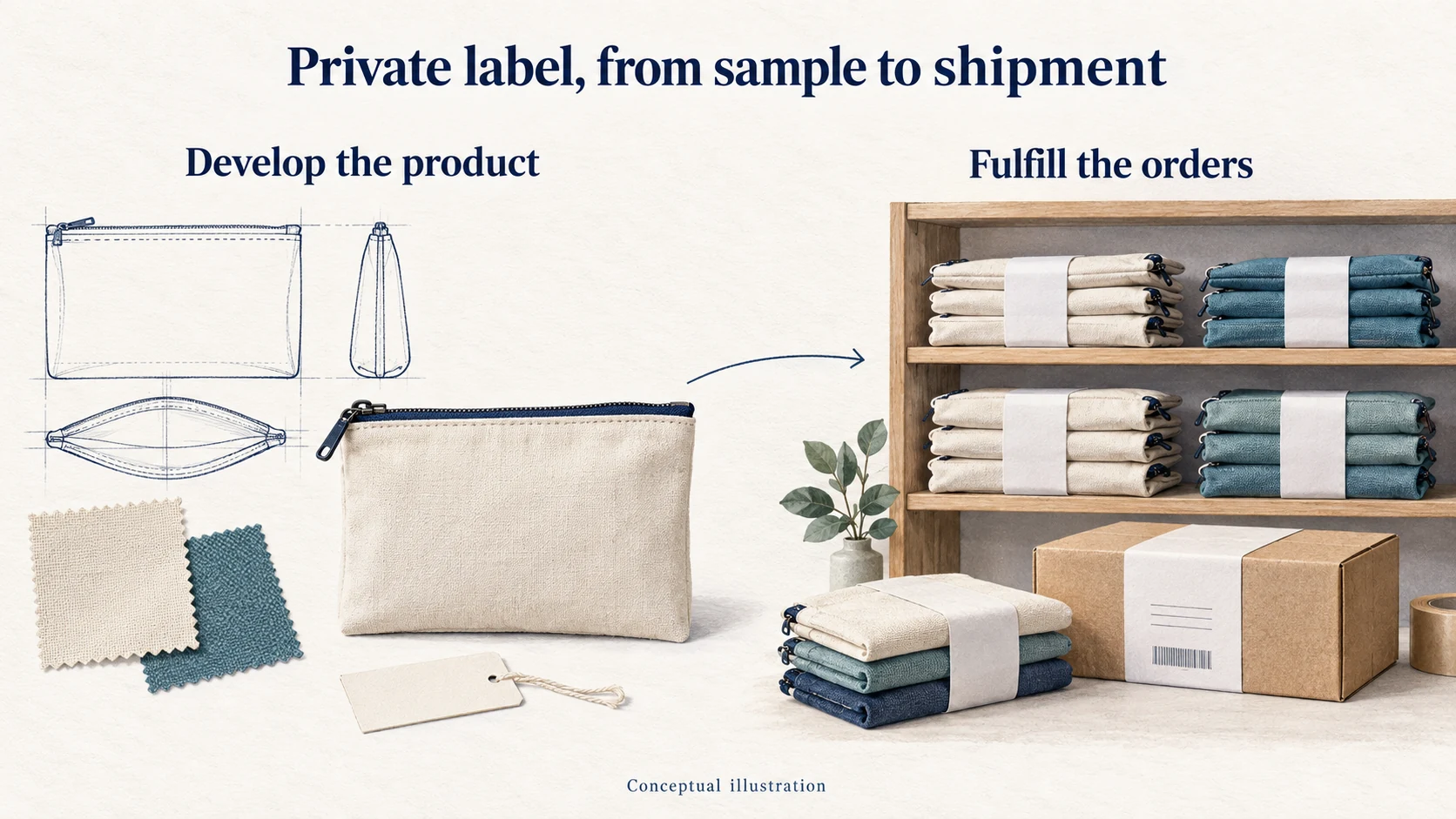
Private label dropshipping combines selling products under your own brand with a supplier or fulfillment partner shipping customer orders. Depending on the arrangement, you may brand an existing item or commission a version with different materials, dimensions or features. You can avoid handling parcels yourself while still paying for product stock, packaging and development before the first sale.
The important questions are therefore practical: what will change, who owns and pays for it, what proves the product is ready, and how will the next order be fulfilled? A logo answers only a small part of that.
01
What the model includes
Private labeling describes the product and brand arrangement. Dropshipping describes how customer orders are fulfilled. They can work together, but the combination does not automatically eliminate inventory investment or give you exclusive rights to a factory’s design.
Suppliers use the terminology differently. One may call a printed neck label “private label”; another may reserve the term for a custom garment. Read the proposed work rather than choosing on the service name alone.
| Arrangement | What changes | Main commitment to understand |
|---|---|---|
| Standard-product dropshipping | You sell an existing supplier item | Availability, order handling and the customer promise |
| White-label or light branding | An existing product receives your label, print or packaging | Branding materials, application cost and permission to relabel |
| Custom private-label production | The supplier makes an agreed version for your brand | Specifications, samples, production quantity and inventory funding |
| Print on demand | Decoration or production happens after the order | Available blanks, print methods, branding options and production time |
| More extensive OEM or ODM development | Work may involve your design or adaptation of a manufacturer’s design | Actual design rights, tooling, engineering and development obligations |
The table describes common arrangements, not a universal legal classification. In particular, ownership and exclusivity must be established separately. A product made in your chosen color can still use a design the manufacturer supplies to others.
Private-label work can improve fit, presentation and consistency, and make the offer less interchangeable. It also creates more things to fund and control: artwork versions, labeling, stock, quality checks and replenishment. A higher selling price does not guarantee a higher profit after those costs.
02
Start with the improvement customers need
Choose a product you understand well enough to describe the improvement. Perhaps buyers need a wider opening, a stronger closure, clearer sizing or packaging that stops damage. A complaint repeated across competing products can suggest a useful requirement, but verify that your proposed change addresses it and is feasible to manufacture.
For example, a cotton accessory pouch could use a different compartment layout and a measured opening width. Those changes are more concrete than “make it premium.” They also tell a factory what to sample and an inspector what to measure.
Some products make a first project much harder. Children’s goods, electrical products, cosmetics, supplements and food can involve substantial category-specific safety, testing, labeling or claims requirements. A low factory price does not reduce that work. Select a category whose requirements and potential harm you can assess before committing to development.
Use product research to establish the customer problem, competing offer and plausible price. For an existing store, examine delivered orders, repeat purchases where relevant and return reasons. There is no universal sales count at which private labeling becomes sensible. A durable accessory may not be frequently repurchased, yet still justify a differentiated version; a repeatedly purchased product with unresolved defects may not.
The project should have a reason to exist beyond hiding a familiar supplier listing. Write that reason in one sentence, then identify the product change, evidence and cost that follow from it.
03
Find production and fulfillment capabilities separately
A manufacturer can make an excellent product and still be unable to process individual customer orders. A fulfillment warehouse can dispatch orders accurately and have no role in developing the product. An agent may coordinate both, but its actual scope needs to be clear.
Ask prospective partners for an explanation of how your item moves from development to customer delivery. Identify the contracting business, production site or subcontracting arrangement, inspection responsibility, storage location and order-fulfillment party. Understand who answers when production is late or stock arrives short.
Your existing supplier can be a starting point if it can make the proposed change. Sourcing marketplaces and category-specific manufacturers can widen the shortlist. A provider offering on-demand decoration may be more suitable when your differentiation is artwork rather than a new product structure.
Apliiq, for example, documents apparel decoration and private-label services. Its dropship pricing guidance separates the base product, decoration, a $1 fulfillment fee per item, shipping and optional services; its stated pay-as-you-go private label or neck print price is $2.50 after the initial allowance. These are that provider’s documented terms, checked September 21, 2026—not a general private-label quote. They illustrate why “no bulk product order” still does not mean “branding is free.”
For custom manufacture, compare quotations for the same specification and destination. A lower price for a thinner material or a different logo method is a different offer. Supplier reviews and badges can inform screening, but they do not establish that your product, quantity and required documentation have been approved.
04
Write a brief that produces comparable quotes
Send a reference item or drawing with a written explanation of what should stay the same and what should change. State the intended customer, use and sales markets before asking for a price. The supplier needs to understand both the physical object and the conditions under which it will be sold.
For the hypothetical cotton pouch used throughout this guide, the initial brief might specify the finished dimensions, a proposed tolerance, fabric composition and weight, opening size, zipper type, interior arrangement and artwork position. The factory must confirm whether those requirements can be met; the example is not a validated product specification.
Include the following commercial and production information:
- The exact product version, materials, components, colors and sizes being quoted.
- Artwork files, logo method and dimensions, packaging format and required label copy.
- The expected first quantity and a conservative range for subsequent orders.
- Sample cost, revision allowance and the point at which a production schedule begins.
- The proposed inspection scope, acceptance criteria and remedy for nonconforming goods.
- Product, setup, packaging, inbound transport, storage and customer-order handling charges.
- Sales destinations, delivery terms and the party responsible for import and product compliance work.
Ask the supplier to mark any exceptions. “Can do” is less useful than “the requested fabric is unavailable; this substitute changes the weight and price.” Keep that exception out of the approved specification until you have evaluated it.
Use a version number and date for the final brief. An old image in a chat should not override a revised drawing. The same current files should reach production, inspection and the team preparing your store’s product page.
05
Unpack the minimum order quantity
There may be several minimum order quantities, or MOQs: one for the base product, another for a custom color, and separate runs for labels or packaging. A quote saying “MOQ 100” is incomplete unless it says what those 100 units can contain.
If a supplier requires 100 pouches per color and you choose three colors, the product commitment is 300 pouches. If the printed sleeve minimum is 500, you are also buying packaging for 200 future units. A fourth color can create another product commitment even if the total design remains unchanged.
Ask whether sizes or colors can be mixed, whether the same MOQ applies to reorders, and what happens to unused materials. Confirm storage charges, ownership, count records and the process for recovering your remaining stock if you leave the supplier.
You can sometimes reduce exposure by keeping a stock material, choosing fewer variants, using a standard package with an insert, or paying a setup charge for a smaller run. These are options to quote, not concessions every factory must offer. A higher unit price can be the better first order when it leaves less money tied up in an unproven version.
A packaging minimum is still inventory risk. It can become unusable if the product size, legal copy or brand name changes. “No product MOQ” should prompt a separate question about labels, sleeves, boxes and other prepaid materials.
06
Budget cash before calculating margin
The following illustrative pouch project uses invented numbers to show the calculation. It is not an AIDrop quote, a supplier estimate or a recommendation for a particular product.
Assume the first order is 300 pouches, with 100 in each of three colors. The sleeve supplier requires 500 printed sleeves. The agreed product price includes the selected product customization, while sleeves are charged separately.
| Initial payment or commitment | Calculation | Amount |
|---|---|---|
| Product batch | 300 × $6.50 | $1,950 |
| Printed sleeves | 500 × $0.40 | $200 |
| Sample, artwork and setup budget | Assumed fixed amount | $600 |
| Inbound transport to fulfillment stock | Assumed batch amount | $150 |
| Batch inspection | Assumed batch amount | $180 |
| Total initial outlay | Before sales and ongoing order costs | $3,080 |
The first 300 orders consume $120 of sleeves, leaving $80 of sleeves if none are damaged or obsolete. Costs assigned to the first 300 units, including the $600 setup, total $3,000. That is not the same as saying the project only needed $3,000 in cash: the extra sleeves had to be paid for too.
Next, model a fulfilled order at a selling price of $24. For illustration, the consumed product costs $6.50, sleeve $0.40, allocated inbound transport $0.50, allocated inspection $0.60, pick and pack $1.20, customer shipping $4.50, payment fees $0.90 and expected exception allowance $0.50. Together these are $15.10 per order, leaving $8.90 before advertising, fixed setup and overhead.
If customer acquisition costs $5 per order, the remaining contribution is $3.90. Recovering the $600 setup from that contribution alone takes $600 ÷ $3.90, rounded up to 154 orders. That narrow calculation is not a complete business break-even forecast: it excludes overhead and income tax, assumes the costs and selling price hold, and does not guarantee the remaining stock sells.
Avoid counting the same cost twice. When you deduct $6.50 for each sold unit, that represents consumption of the product batch already purchased. Do not also deduct the full $1,950 batch purchase again from the same contribution calculation. A cash-flow schedule and a profit calculation answer different questions.
The launch budget may also need testing, compliance work, photography, storage, import duties or taxes, software and a reserve for corrections. They are excluded from these illustrative amounts because the product and route are not real. Add the actual quoted and applicable items before making a commitment. The unit economics guide provides the broader cost structure.
Finally, plan when money leaves. A deposit, production balance and inbound freight may be due before the first customer payout. Replenishment can require another deposit while much of the first batch remains unsold. Model a slower-sales scenario and keep funds available for refunds and operating costs instead of spending the entire budget on a lower unit-price tier.
07
Agree on brand, design and tooling rights
Check the proposed brand name before printing a packaging run. For the US, the USPTO’s clearance guidance explains that relevant searches include similar marks and common-law use, not only an exact match in a federal database. An available domain does not establish that the name is safe to use.
Distinguish the assets you supply from those the factory already owns. Your logo, commissioned artwork, product drawings, the manufacturer’s existing design and any new tooling may have different rights attached. Obtain appropriate permissions for artwork and designs you did not create.
For customer-funded tooling, agree on ownership, identification, storage, maintenance, permitted use and whether it can be transferred to another factory. Paying an invoice described as “mold fee” does not by itself explain those rights or make transfer technically practical.
If exclusivity matters, define the product, territory, channel, duration and any purchase commitments involved. “Exclusive design” in a message is too vague to settle whether a supplier can sell a closely related version. Manufacturing and IP agreements need appropriate legal review for the parties and jurisdictions involved.
Commercial terms also need payment milestones, cancellation consequences, remedies, dispute arrangements and controls on subcontracting or substitutions. Set these before the batch exists, when both sides can price the agreed responsibilities.
08
Approve a sample that production can repeat
A reference sample helps you choose a direction. A pre-production sample should represent the materials, construction, decoration and packaging you intend to order. Confirm whether it uses the planned production process or whether some elements were made differently for the sample.
Review the sample against the written brief. For the pouch, measure the opening and finished dimensions, inspect seams and closures, confirm the layout, and review the label and sleeve. Record what was checked, the result and any approved deviation. A photograph can establish some visual details, but cannot replace every physical, functional or laboratory check.
Keep an approved reference tied to a versioned specification. Retain the final artwork and packaging files, approval date and supplier acknowledgment. Where useful, keep matching reference samples with the business and the inspection party.
A pilot run can show whether the intended process reproduces the approved result at a smaller scale, if the supplier offers a suitable arrangement. It should have its own acceptance and commercial terms. One attractive sample does not prove that an entire production run will match it.
If a material, color, component or print process changes, evaluate what needs to be reapproved or retested. Do not let a cheaper replacement become the new product through an informal conversation that never reaches the listing or inspector.
09
Check product labels and destination requirements
Brand presentation sits alongside mandatory product information. The exact requirements depend on the product, intended use and market. Determine them before artwork approval so you do not have to relabel a finished batch.
For many textile products sold in the US, FTC rules address fiber content, origin and business identification. The FTC’s textile labeling guide explains that replacing a label must preserve required information and identifies recordkeeping obligations for retailers that substitute labels. A decorative brand label is not a reason to remove required origin or fiber information.
For US general-use consumer products subject to applicable CPSC rules, the responsible US manufacturer or importer must issue a General Certificate of Conformity supported by the appropriate testing. The CPSC’s guidance explains the scope and distinguishes general-use products from children’s products. Do not assume every item needs the same certificate or that a generic factory report covers the version you ordered.
Importers must also check the CPSC’s eFiling requirements. From July 8, 2026, most regulated consumer-product imports require electronic filing of certificate data with CBP. Confirm whether the product and entry fall within that requirement and how the importer and broker will submit the data; obtaining a certificate alone does not complete that process.
Other destinations and categories have their own requirements. Build a product-specific list covering required tests, labels, warnings, traceability, responsible parties and claims. Confirm that the reports identify the correct product, materials and applicable standards, and that the issuing laboratory and documents can be verified where necessary.
Visual QC, a supplier badge and a sample approval each answer different questions. None should be described as blanket regulatory certification. A material change can affect compliance as well as appearance, so the review process needs to cover both.
10
Inspect the production batch before release
Define what the inspection will examine, how units will be selected and what findings lead to a hold. Agree on measurable criteria and examples of unacceptable defects. A damaged seam, incorrect label and missing item may require different corrective actions.
For the pouch project, the check might cover quantity by color, dimensions, closure function, seam condition, artwork placement, labeling and pack contents. The actual test method and acceptance criteria should reflect the product and its risks. A sampling plan assesses a defined sample; it does not prove every unit is defect-free.
Separate production acceptance from warehouse receiving. A production inspection can pass, yet cartons can arrive damaged or with a count discrepancy. Reconcile accepted quantities when stock arrives and keep held goods unavailable for customer orders.
If the batch fails, document the finding against the approved requirement and agree on sorting, rework, replacement or another remedy under the contract. Recheck corrected goods before release. “The factory says it is fixed” should not silently replace the acceptance process.
The quality-control guide explains how to connect the reference, inspection evidence and release decision. Keep the reports tied to the purchase order and production lot so later complaints can be investigated.
11
Connect stock, packaging and customer orders
Give each sellable variant a clear SKU, and map it to the correct product version, label and packaging. A color name in the store should not rely on a warehouse worker interpreting a photograph. If a kit has multiple components, define its complete contents and what happens when one component runs out.
Maintain usable quantities for products and packaging separately. Having 80 pouches and no approved sleeves may prevent you from fulfilling the branded offer. Decide in advance whether an alternative package is acceptable, whether the listing must change or whether orders must be held. Do not substitute silently.

Clarify who owns stored goods and who is responsible for loss, damage, counting and release. Understand storage fees, aging rules, stock withdrawal and any disposal or transfer terms. The goods being outside your premises does not mean they are outside your financial exposure.
Use actual packed dimensions and weight when quoting delivery. A larger presentation box can change billable shipping weight, and an extra branded layer may not provide useful protection. The packaging guide helps balance protection, presentation and parcel size.
Before launching, place a controlled end-to-end order through the real workflow. Check the ordered variant, packing instructions, customer-facing documents, tracking and support process. Production lead time and customer dispatch time are different clocks; publish the latter only when saleable stock or a supported made-to-order process is ready.
12
Use returns and reorders to improve the next batch
Your customer policy and supplier recovery agreement are separate. Work out who receives a return, how it is assessed and whether an acceptable unit can re-enter stock. A supplier refusing to take back a branded item does not automatically remove the customer’s rights or your store’s published obligations.
Record the reason and the relevant lot when a problem appears. Several opening-size complaints could indicate a misleading listing, a dimensional issue in one batch or customers using a larger object than the product was designed for. Those explanations call for different fixes. The returns guide covers the customer-to-supplier handoff.
Reorder from usable inventory and realistic lead time. In a simple hypothetical calculation, demand is four units per day, the complete replenishment lead time is 45 days and the business chooses a 40-unit buffer. The reorder point is 4 × 45 + 40 = 220 units.
Apply that point to inventory position: usable on-hand stock plus relevant confirmed incoming stock, minus outstanding commitments. Do not count quarantined goods as usable. The 40-unit buffer is an assumption, not a statistically calculated recommendation; actual variability and service targets may require a different approach.
At eight units per day, 220 units no longer covers the same lead time. Revisit the calculation when advertising, seasonality or supplier timing changes. Also review demand by variant: a total of 220 across three colors may conceal a stockout in the popular color and excess in another.
Before increasing the next order, compare the expected unit-price saving with the additional cash, storage and unsold-stock exposure. Keep the specification controlled across reorders, and require approval for substitutions. Growth should make the process more predictable, not remove the checks that made the first batch acceptable.
13
Choose a launch you can learn from
Proceed when you can explain the customer benefit, fund the commitment, identify the responsible parties, approve the product and support delivery and returns. If a major part remains uncertain, reduce the scope or resolve it before placing the full order.
That may mean one color, a stock material or simpler packaging for the first run. The aim is to learn whether customers value the actual product and whether the operation can repeat it—not to pay for every possible brand feature at once.
If you are preparing a project for AIDrop, the private-label and packaging service page provides the relevant inquiry route. Bring the reference product, desired changes, destination, quantity and current demand evidence so the scope can be discussed concretely. The product and supplier guides cover the related sourcing decisions.
14
Frequently asked questions
Can I do private label dropshipping without buying inventory?
Some on-demand branding arrangements charge per sold item, but others require prepaid products, labels or packaging. Confirm each commitment separately. A partner storing your goods means you avoid physical handling; it does not necessarily mean you avoid owning or funding them.
What is a normal private-label MOQ?
There is no single useful number across products and customization levels. Ask for the minimum by product, color, size, material and packaging component, plus the reorder terms. Compare a simpler configuration if the total exposure is too high.
Does private label make the product exclusive?
Not automatically. The base design, custom elements, brand assets and tooling may have different ownership arrangements. Define any exclusivity in an appropriate agreement rather than relying on the service label.
Is it more profitable than standard dropshipping?
It can support differentiation or better purchasing terms, but it also adds development, stock and quality costs. Compare contribution after fulfillment, acquisition and exceptions, and account for fixed work and unsold inventory. A higher retail price alone does not answer the question.
How much money should I start with?
Build a budget from the actual product and terms: samples, development, minimum batches, packaging, testing, transport, storage, launch costs and correction reserves. Include the timing of the next production payment. A generic startup figure is less useful than knowing which obligations become payable before revenue arrives.