
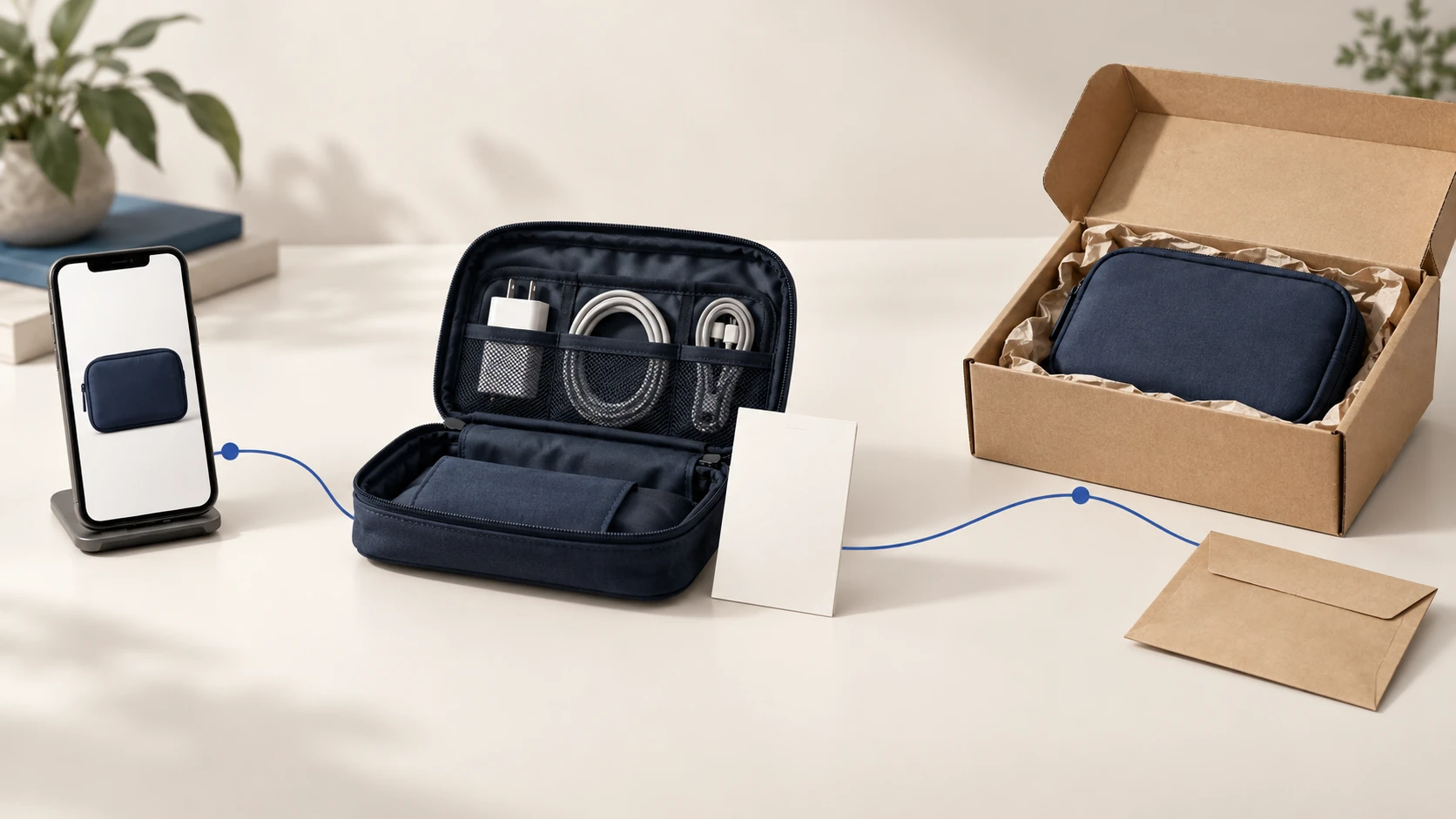
Dropshipping marketing connects a customer need to an offer, brings suitable visitors to that offer, helps them buy with accurate information and earns their next order. A workable plan covers acquisition, conversion, retention and measurement. The channels you choose must fit both the customer and the amount each order can contribute after its costs.
For a new store, that usually means starting with a clear offer, one primary acquisition channel and a small follow-up program. Add channels when you have enough evidence and capacity to manage them. A growing list of campaigns is not useful if the store cannot explain the product or deliver what the advertising promises.
Dropshipping changes who stores and dispatches the goods; it does not remove the store’s responsibility for the buying experience. If the model is new to you, the dropshipping overview explains how the supplier, seller and customer fit together.
01
Start with a customer and a reason to choose your store
Describe a specific buying situation. “People who like travel” is too broad to guide an offer. “Travelers who carry a large charger and several cables in a small cabin bag” gives you something to demonstrate, measure and compare.
Build the offer around that situation. It might be a pouch with clearly shown capacity, a useful combination of sizes, or better information about which items fit. Those are more credible starting points than claiming to be the best store or competing only on a discount.
Write a short offer statement containing the customer, the use, the included product and the important limit. For example: a cable pouch for travelers who want one place for a charger and accessories, with the internal dimensions and actual contents shown. This is an illustrative positioning exercise, not a description of an AIDrop product.
Then make the page and campaign agree. A video showing three organizers should not lead to a default variant containing one unless that distinction is unmistakable. A delivery promise must reflect the product, destination and service being offered.
Before launching, answer these customer questions:
- What exactly am I buying, and which variant is shown?
- Will it fit my intended use?
- What is the total price, including known delivery charges?
- When should it arrive, and how will I receive updates?
- What happens if it is unsuitable, damaged or different from the description?
You do not need an elaborate brand story to answer these well. You need accurate product information, usable photographs and a store that keeps its promises.
02
Choose channels by the buying situation
Some customers already know the product they want. Others recognize a problem only after seeing a demonstration. Match the channel to that situation instead of copying another store’s media mix.
| Channel | Useful when | What must be ready | What to watch |
|---|---|---|---|
| Paid search or Shopping | Buyers search for a specific product or solution | Accurate product data, relevant landing page and viable order economics | Cost of acquiring an order and the terms that actually convert |
| Paid social | A demonstration can introduce the product to suitable people | Clear creative, an honest offer and working measurement | Attention that fails to become relevant visits or orders |
| Organic video | You can repeatedly show useful product details | Samples, a sustainable production routine and a matching page | Time spent versus qualified traffic and customer questions |
| SEO and free product listings | Customers research fit, use or alternatives | Helpful pages, accessible product information and eligible listings | Visibility develops unevenly and is not guaranteed |
| Creators and affiliates | An identifiable audience trusts a relevant publisher | Product fit, agreed terms, disclosure and permission to reuse content | Total partner cost, attribution and audience relevance |
| Email and customer referrals | People already know the store or have bought successfully | Appropriate permission, useful messages and reliable service | Complaints, opt-outs and discounts that erode contribution |
Paid search can help you reach people expressing demand, but common product terms may attract intense competition. Paid social can introduce an unfamiliar product, but a click may reflect curiosity rather than an intention to buy. Neither is inherently the best channel for every store.
For a small test, keep the offer stable enough to learn from it. If you change the product, price, audience and landing page together, you will have difficulty explaining the result. Test a clear hypothesis such as whether a capacity demonstration brings better-qualified visitors than a general lifestyle clip.
Organic channels still need resources. Allocate time for production and maintenance rather than treating them as an unlimited free supplement. Google’s free-listings guidance is explicit that eligibility does not guarantee exposure; accurate catalog information is necessary, but it does not create a forecast of traffic.
For creator campaigns, agree on deliverables and usage rights before supplying products or paying fees. The FTC’s endorsement guidance explains U.S. disclosure expectations for material connections, including relevant gifts and payments. A creator’s apparent enthusiasm is not a substitute for a clear relationship disclosure.
03
Set an acquisition budget the order can support
Work backward from order contribution. Begin with revenue after discounts. Account for refunds and replacement costs once, using actual adjustments or an explicit planning allowance. Deduct the product, fulfillment, delivery, payment and other variable costs without counting the same expense twice. Be consistent about taxes and which costs are included. Do not call the remainder net profit while fixed overhead is still unpaid.
Consider an entirely hypothetical first order:
| Planning input | Amount |
|---|---|
| Customer revenue used in this example | $40 |
| Product cost | $11 |
| Delivery | $7 |
| Packing and handling | $2 |
| Payment costs | $1 |
| Expected refunds or replacements allowance | $3 |
| Contribution before acquisition and fixed overhead | $16 |
Under these assumptions, spending $16 to acquire the order consumes all its contribution before fixed overhead and taxes. If you want to retain $6 at that stage, your planning ceiling for acquisition is $10. These figures illustrate the calculation; they are not supplier rates, an AIDrop quote or a recommended industry benchmark.
Contribution before acquisition − desired remaining contribution = acquisition-cost ceiling. Recalculate when shipping, discounts, returns or the product mix changes.
The same example also explains why revenue return on ad spend can mislead. At $16 of ad spend, $40 of attributed revenue produces a 2.5× ROAS. That is the illustrated break-even point before fixed overhead, assuming the ad cost is the entire acquisition cost. At a $10 ad cost, ROAS is 4× and the modeled order retains $6 before overhead and taxes.
Creative fees, samples, affiliate commissions and agency costs may sit outside the ad-platform spend figure. Include them when evaluating customer acquisition. If only part of the $10 allowance remains available for media after those costs, the required media ROAS will be higher.
Do not justify a loss on the first order with an unproven lifetime-value estimate. Repeat purchases can change the economics, but the evidence should come from actual customer cohorts and their costs. The profit-margin guide provides more detail on separating these layers.
04
Make the product page finish the conversation
The page should answer the question that brought the visitor there. Someone clicking a size demonstration should immediately find the dimensions and variant shown. Someone clicking a bundle offer should see the exact pieces and price.
Use photographs that explain the product, including scale and details that affect use. A close view of a zip, closure or compartment can be more useful than another decorative image. Show limitations where they matter; hiding them tends to move the problem into customer support or returns.
Keep delivery and return information easy to find before payment. Separate processing time from transit where that distinction matters, and avoid presenting a best-case journey as a universal promise. Confirm that the destination being targeted can actually be served on the stated terms.
Check the purchase on a phone. Select a variant, add it to the cart, inspect the total and follow checkout far enough to identify payment or shipping problems. A technically completed test should not be described publicly as a real customer order or product endorsement.
Use legitimate reviews and evidence. Do not invent testimonials, customer photographs, scarcity notices or purchase counters. If a new store has no reviews, accurate information and useful demonstrations are a better foundation than fabricated social proof.
When improving conversion, change the part that the evidence points to. Repeated size questions suggest missing information. Abandoned checkouts after shipping appears suggest a total-price or delivery issue. Neither automatically calls for a larger discount.
05
Plan retention around the product people bought
Retention starts with the first delivery. Send useful order information, make support reachable and resolve the issue when something goes wrong. An unresolved replacement request should take priority over a promotional sequence.
After a successful purchase, choose the next message based on the product’s use. A durable organizer may justify care instructions or a relevant companion item. A consumable may have a repeat-purchase cycle, but the timing should reflect the actual item and customer behavior rather than an arbitrary weekly promotion.
Segment customers where it improves relevance. Someone who bought a small pouch may be interested in an explanation of a larger size; someone who already bought the complete set may not be. Avoid asking people to buy the same non-consumable again without a reason.
Keep commercial-email requirements tied to the recipient’s market. The FTC’s CAN-SPAM business guide covers U.S. obligations such as accurate sender information and opt-out handling. Other jurisdictions may require additional consent. Maintain the permissions and suppression lists your program needs.
Referral incentives and loyalty discounts should be costed like other acquisition or retention expenses. A reward can increase orders while reducing the contribution left from each one. Measure whether it brings appropriate new customers or simply discounts purchases that would have happened anyway.
06
Measure the whole order, not just the ad click
Record channel, campaign, landing page, spend, orders and the costs or adjustments those orders generate. Use consistent definitions for new customers, repeat customers, attributed revenue and refunds. Otherwise two reports can appear to disagree while measuring different things.
For links you control, Google’s campaign URL guidance explains the use of source, medium and campaign parameters. Keep the naming consistent and use a content parameter when distinguishing creatives. Check that your analytics and store setup respect applicable privacy and consent requirements.
Analytics is an incomplete view of how people decide. A customer can see a video, return through search and buy on another device. Consent choices, attribution windows and platform reporting methods can affect the numbers. Reconcile campaign reports with store orders and refunds rather than adding every platform’s claimed revenue together.
Use the funnel to decide what to investigate:
- Little relevant traffic: examine targeting, search terms, distribution and the creative’s subject.
- Visits without product engagement: check whether the page matches the promise and loads usefully on mobile.
- Carts without purchases: inspect the total price, delivery terms, payment options and checkout errors.
- Purchases with weak contribution: revisit discounts, acquisition costs and the actual order mix.
- Orders followed by complaints or refunds: inspect product information and fulfillment before increasing demand.
Small numbers need restraint. A handful of orders cannot establish a durable winning audience or a reliable lifetime value. Record what the result suggests and what evidence would justify increasing the budget.
07
Build your first marketing plan in three stages
Prepare the offer. Choose the customer and product, obtain the information and samples needed to describe it accurately, calculate the acquisition ceiling and test the purchase path. Decide which countries and variants the campaign will cover.
Run a bounded channel test. Choose one primary channel, a limited set of creative or search hypotheses and a budget or time allowance you can afford. Define what you will measure before launching. Keep enough consistency to understand the result, while correcting any factual or customer-experience problem immediately.
Review completed orders before expanding. Compare acquisition cost with realized contribution, read customer questions and check delivery outcomes. Improve the offer or page where necessary. Add a second channel when it serves a clear role and you have the capacity to manage it.
A simple written plan should identify the audience, offer, primary channel, follow-up method, cost ceiling and review date. It should also name who handles stock changes and customer problems. The commercial planning hub connects these decisions with the wider operation.
The useful result is a marketing system that can explain why customers buy and what those orders leave behind. More traffic helps only when the offer, page and delivery experience can support it.