
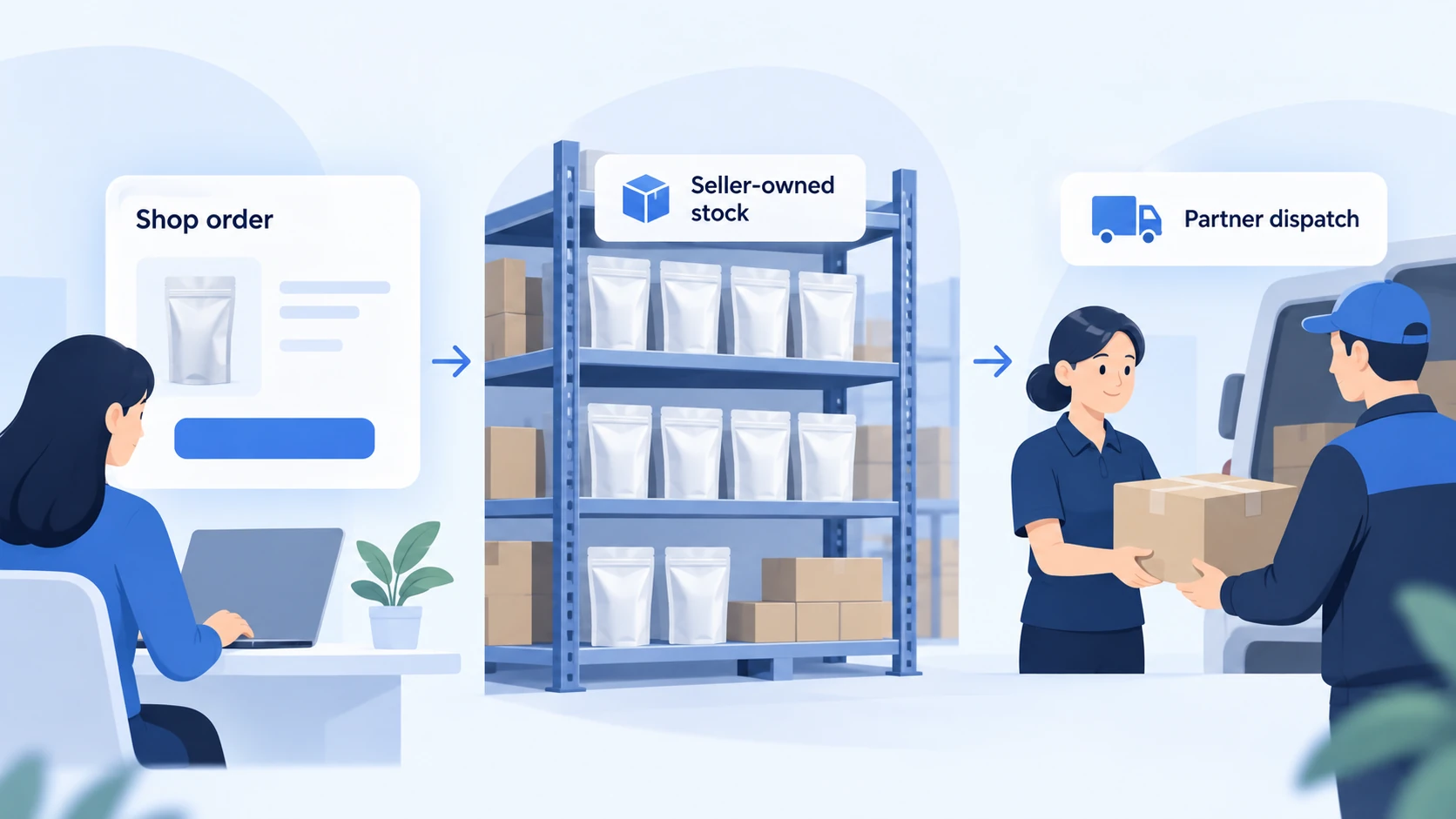
TikTok Shop dropshipping means selling through TikTok’s in-app shop while a supplier or fulfillment partner sends the goods to your customer. You manage the offer, product content and customer relationship. Another business performs the agreed storage, packing and dispatch work.
For a US shop, that description needs an important qualification: outsourcing fulfillment does not remove inventory ownership. TikTok’s US third-party fulfillment and packaging requirements permit third-party fulfillment when the seller maintains ownership of the inventory. They also prohibit buying from another online retailer and having that retailer ship directly to the TikTok Shop customer.
This guide covers US local sellers and domestic fulfillment. A cross-border seller program or another country’s Shop has its own conditions. Before investing in stock, establish which account, product and shipping arrangement you can actually use.
01
How the business works
A shopper watches a product demonstration, opens its product link and buys through TikTok Shop. The order reaches your shop and, where configured, your supplier or warehouse system. The fulfillment partner picks the correct unit, packages it and dispatches it through the service assigned to that order. You follow the delivery and handle the customer’s questions.
That arrangement can keep a packing operation out of your home or office. It still leaves you with commercial responsibilities: paying for inventory and services, setting an accurate selling price, funding customer acquisition and resolving problems after delivery.
People also use “TikTok dropshipping” to describe videos that send customers to a separate online store. These are different sales paths:
| Sales path | Where the customer buys | Your main operating task |
|---|---|---|
| Your own TikTok Shop | TikTok’s in-app checkout | Manage the shop, stock, fulfillment and customer service |
| TikTok traffic to your website | Your website’s checkout | Run the external store and its complete order process |
| Affiliate creator promotion | Another seller’s TikTok Shop | Promote eligible products under the creator arrangement |
An affiliate creator does not become the supplier-fulfilled merchant merely by linking a product. The seller and creator programs have separate requirements. TikTok’s creator eligibility policy distinguishes affiliate, marketing and official shop accounts; follower rules should not be borrowed from one role to describe another.
For other store models, the platform section of the dropshipping hub puts the sales channel alongside the underlying order operation.
02
What makes it worth considering
TikTok Shop gives a product demonstration a short route to checkout. A shopper can see a storage pouch opened, understand what fits inside and view the exact item without searching for a separate website. That is useful when the product’s value becomes clearer in use than in a catalog thumbnail.
Supplier fulfillment can also let you concentrate on a narrow product range, content and support instead of running a warehouse. An existing manufacturer or distributor relationship may provide product knowledge and replenishment options that would take time to build yourself.
The drawbacks follow from the same setup. A successful video can create more orders than available stock can support. A provider’s app may import orders while the warehouse is unable to use the required label. Customer acquisition and returns can consume the difference between purchase price and selling price.
The model is more suitable when you can obtain the same product consistently, demonstrate it honestly and finance the inventory arrangement. It is less attractive when the offer depends on a retailer’s temporary discount, uncertain warehouse availability or a delivery promise nobody has agreed to meet.
03
Settle the inventory and shipping arrangement first
Ask the supplier what you are purchasing and when ownership passes to you. Keep the agreement, purchase records and warehouse allocation consistent. A screen showing a large shared catalog does not establish that stock belongs to your business or is available for your orders.
There is also a practical distinction between owning stock and physically holding it. You can own units stored at a supplier or fulfillment warehouse. The supplier can then dispatch those units when the corresponding customer order arrives. The amount and timing of that inventory commitment are commercial terms to negotiate, not something a “dropshipping” label settles.
TikTok’s US logistics guidance describes three shipping arrangements. Availability and responsibilities vary:
| Arrangement | Who performs the physical work | What to establish with a partner |
|---|---|---|
| TikTok Shipping | Your warehouse or fulfillment partner packs and hands over the parcel | The partner can use the platform’s assigned label, origin and carrier process |
| Seller Shipping | Your operation uses a supported logistics provider | Your shop is eligible and tracking reaches TikTok correctly |
| Fulfilled by TikTok | TikTok’s fulfillment network stores and dispatches accepted inventory | Inbound stock, product eligibility, preparation and current fees |
Seller Shipping may be available only to selected sellers. Do not build your operation around a menu option you have not confirmed in your account. TikTok’s domestic shipping overview also states that TikTok Shipping serves US domestic warehouses, not cross-border warehouses.
An international supplier can still be relevant to sourcing goods for a suitable domestic operation. That does not make direct dispatch from any overseas warehouse compatible with a US local shop. Work out the actual stock location and shipping service before publishing the listing.
04
Choose products you can explain and supply
Start with a customer use case. A product that solves a visible, specific problem is easier to explain than a collection of unrelated items selected only because their videos received views. Study the offer customers can buy: its price, included parts, size, alternatives and delivery terms.
Comments can reveal useful questions. Viewers may ask whether a pouch holds a particular charger, whether a shelf fits a narrow space or whether a tool works on their material. These questions suggest demonstrations and listing details to verify. They do not establish how many people will purchase.
Order a sample of the exact variant you intend to sell. Check the dimensions, finish, function, package contents and instructions. Record what the sample can actually do, including limitations. A short video showing a real fit or use condition is more helpful than repeating a supplier’s broad promise.
Products involving health claims, children, electrical components, batteries or other regulated features need additional category and product checks. Confirm the applicable TikTok requirements and supporting documents before offering them. An attractive wholesale catalog is not evidence of permission to sell every item it contains.
The product research guide explains how to turn demand signals and customer complaints into a product brief. For TikTok Shop, add the exact fulfillment origin and account requirements to that brief.
05
Build the shop around the real operation
Register for the correct US seller type using accurate information. Complete the identity or business checks, tax information and payout setup requested for that type. Keep names, addresses and documents consistent; a supplier cannot solve a mismatch in your seller identity by changing a product listing.
Next, configure the actual pickup warehouse and the address that will receive returns. TikTok’s Seller Center setup guidance treats these as part of the shop setup. Get the provider’s permission and operating instructions before using its address.
Create a small initial catalog. Each listing should identify the item, variants, dimensions or relevant specifications, included accessories and material limitations. Use pictures you have permission to publish. Map every shop variant to the exact supplier SKU and warehouse stock record.
Treat automatic imports as a starting point for checking. An imported title may describe a bundle while the selected SKU contains one unit. A default shipping weight may describe the bare product instead of the packed parcel. Either mismatch can create a cost or customer-service problem after the sale.
06
Calculate what remains from an order
The difference between your selling price and the supplier’s product price is not your profit. Include fulfillment, shipping, platform charges, creator or advertising costs and an allowance for returns or other losses. Add taxes, duties or inbound costs where they belong in your actual arrangement without counting the same cost twice.
TikTok’s category referral-fee table lists many categories at 6%, with exceptions. Confirm your category and account terms. A referral fee is only one line in the calculation.
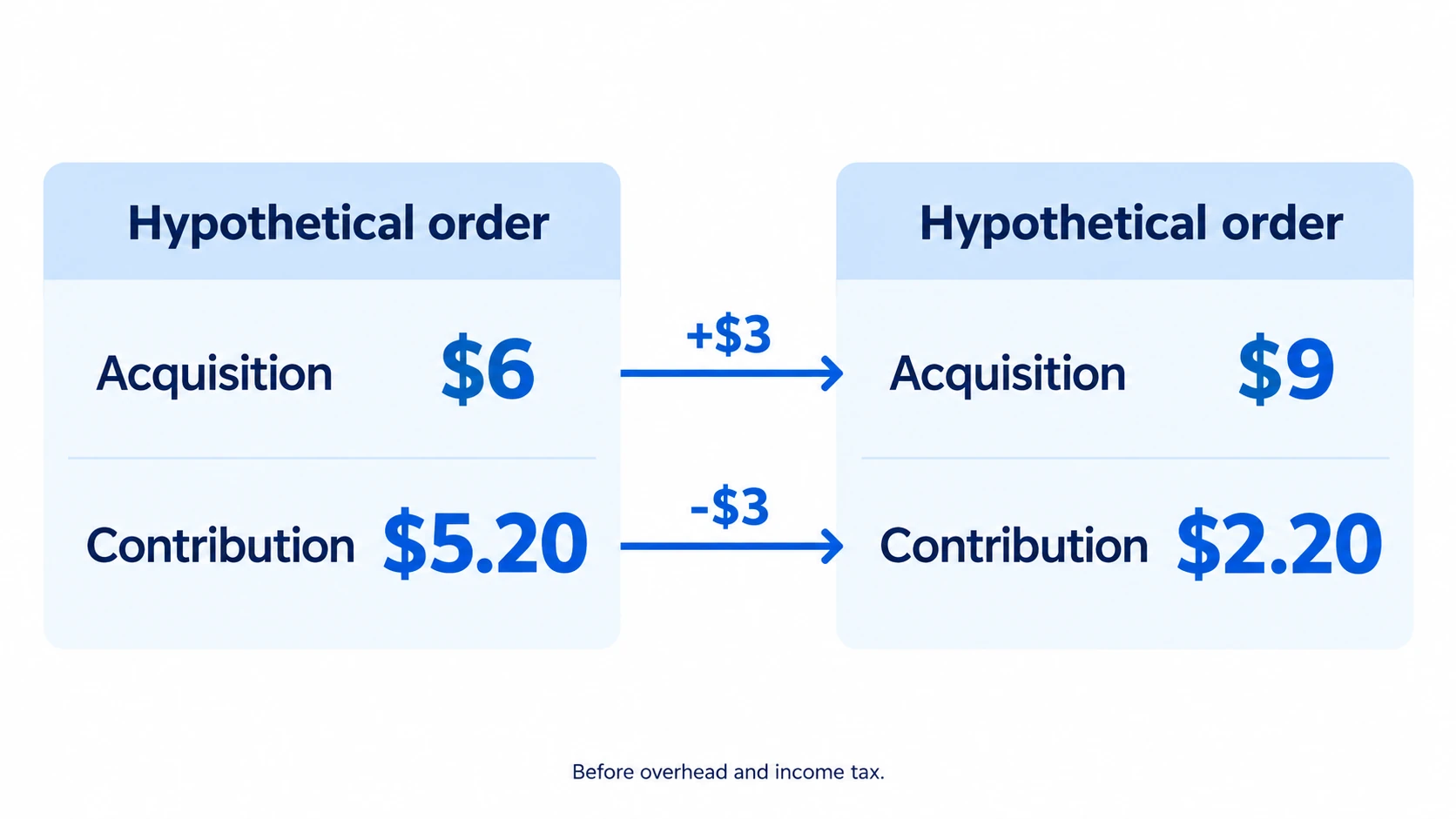
Here is a hypothetical order. These figures are assumptions for comparison, not a TikTok or AIDrop quote:
| Item | Assumed amount |
|---|---|
| Selling revenue, excluding tax | $30.00 |
| Product cost | −$9.00 |
| Packing and outbound shipping | −$6.00 |
| Assumed platform charge | −$1.80 |
| Creator or advertising cost allocated to this order | −$6.00 |
| Allowance for returns and other order losses | −$2.00 |
| Contribution before overhead and income tax | $5.20 |
If acquisition cost rises from $6 to $9, the contribution falls to $2.20. If the creator commission and advertising both apply, include both; the single acquisition line above assumes their combined allocated amount. Seller-funded discounts and sample costs also need a place in your records.
A profitable order can still require cash before its payout arrives. Inventory purchases, inbound freight and creator samples may be paid before a customer orders. Other fulfillment charges can become due while the sale is awaiting settlement. TikTok’s settlement guidance links settlement to delivery and applicable conditions; use the dates shown for your account instead of assuming immediate access to the payment.
Prepare a cash forecast alongside your margin calculation. Include committed inventory, replenishment, operating bills and refunds. More sales can increase the amount you need to fund before they increase the amount you can withdraw.
07
Use content and creators to answer buying questions
A useful product video shows the item clearly, demonstrates one relevant task and gives the viewer enough context to judge the result. Show scale when size matters. Show the parts included when accessories affect use. Avoid a demonstration that depends on an unlisted accessory or a different product version.
Plan several distinct questions around the same product rather than repeating a sales pitch. One video might show setup, another an everyday use, and another a limitation customers often misunderstand. Product questions and return reasons can reveal what to explain next.
If you work with creators, agree on the exact product, sample, compensation and permissions to reuse the material. Give them factual information they can verify. Review product claims and required commercial disclosures before the content is used in your campaigns; paying for a video does not make its claims accurate.
Watch the whole path from view to delivered order. Views without product clicks may indicate weak relevance. Clicks without purchases may suggest an offer or listing problem. Purchases followed by cancellations or returns can indicate an operating problem. These are starting points for investigation, not proof that one metric identifies the cause.
08
Keep the first orders visible
During the initial selling period, review the order list and the provider’s order records together. Confirm the exact variant, accepted quantity, payment or release state, warehouse and shipping method. Investigate an unmatched order before manually creating another one.
A label being created is different from the carrier receiving the parcel. TikTok’s shipping workflow guidance requires the correct assigned warehouse and carrier process. For TikTok Shipping it specifies dispatch within two business days; use the actual order deadlines and applicable handling rules in Seller Center.
Ask the provider who investigates a parcel without a pickup scan, who can stop an unshipped order and who responds when a product becomes unavailable. Customer support needs an accurate status, not simply a tracking number copied from another screen.
When an order has an unclear fulfillment result, check whether a parcel already exists before releasing it again. That small pause can prevent a duplicate shipment while preserving the information needed to resolve the original order.
09
Plan returns before the first complaint
Your customer’s remedy and your recovery from the supplier are separate transactions. A supplier may accept only certain defect claims, while the shop has broader customer obligations. Keep enough funds and authority to resolve the customer request within the required process.
TikTok’s US returns and replacements requirements distinguish returnable products, non-returnable items and different request states. Check the deadline on the request rather than relying on one countdown for everything.
Agree on who receives the return, records its condition and decides whether it can be restocked. Ask what happens to an opened item, a wrong variant, a damaged parcel or a package sent to the wrong return address. Those details determine both the customer’s experience and your real loss.
Keep product photos, packing records and relevant tracking evidence attached to the order. Use them to investigate the request fairly. The returns guide covers how to connect the customer decision with supplier recovery and stock disposition.
10
Expand only what the operation can repeat
Increase exposure when the same product can be supplied accurately, dispatched through the assigned service and supported after delivery. Look at stock by variant, not only total units. A popular size can sell out while the dashboard still shows plenty of another size.
Before a larger campaign, compare sellable stock with expected demand and the time needed to replenish it. Reserve stock for committed orders and decide when to reduce displayed quantity or pause promotion. A replacement product should receive its own approval; a visually similar unit can have different dimensions or performance.
Review profit after returns have begun to arrive. A promising early sales total can change when you include refunds, replacement shipments and creator costs. Use those findings to choose whether to replenish, revise the offer or stop selling the item.
11
Frequently asked questions
Is TikTok Shop dropshipping allowed in the US?
Supplier or third-party fulfillment has documented operating paths, but it is subject to US inventory-ownership and shipping requirements. Retail-to-customer purchase routing is prohibited. A provider advertising a TikTok integration does not establish that your stock arrangement or product is compliant.
Can I start without buying any inventory?
Do not assume that a zero-inventory model fits a US local shop. Establish how you own the goods and how they will be available for fulfillment. The supplier’s payment schedule and stock commitment need to support that arrangement.
Do I need a large following?
Selling and affiliate creation are different roles. Official shop-account binding and affiliate eligibility do not use identical requirements. Check the requirements for the specific seller and creator functions you intend to use.
Is Shopify required?
No. Seller Center provides a route to set up the shop and add products. A separate commerce platform may help an existing business manage its catalog, but it adds a synchronization process that needs checking.
Which product is best for a beginner?
Start with a product you can inspect, explain and supply consistently at a viable total cost. A narrow range with clear specifications is easier to learn from than a large imported catalog. Confirm category permission and supporting documentation before making the selection final.