
Pinterest’s Hobbies Trend Report, released on August 25, 2026, highlights growing interest in hands-on creative activities. Three signals are relevant to a craft-product shortlist: searches for hand embroidery art increased 1,351%, beaded bag charms DIY increased 965%, and mini room craft increased 296%, according to the official report.
The accompanying source notes identify global text-based searches, comparing May 2026 with May 2025. These are search-growth figures, not product-sales growth, and they do not measure September purchases. The report and its embedded methodology were checked on September 17.
For merchants, the useful next step is to investigate what a beginner needs to finish a project. A kit can answer that need, but only if its contents, instructions and delivered price work together. The evaluations below are editorial suggestions, not Pinterest product endorsements or sample tests conducted for this article.
01
What Pinterest measured, and what remains unknown
A DIY query leaves the commercial question open. Someone may want a free tutorial, a replacement component, a complete starter kit or inspiration for materials already at home. Selling a finished charm to someone who wants to make one can miss the purpose of the search even when the product looks relevant.
The reported percentages also do not supply the absolute counts needed to compare market size. A steep increase from a small base can remain smaller than a less dramatic increase elsewhere. There is no basis here for ordering the three product ideas by expected revenue.
Before choosing an offer, investigate the intended destination market and the language customers use. Pinterest’s Trends documentation explains region and date-range selection, and describes search graphs indexed on a zero-to-100 scale. A peak of 100 is not 100 purchases or a comparable absolute audience count across unrelated graphs.
Use the signal to choose a question to test, then use customer and product evidence to decide what to sell. The broader product-research guide explains how to connect an initial idea with a defined customer need.
02
Three craft offers worth testing against the actual contents
Embroidery: can a beginner finish the pictured design?
A starter set might combine a hoop, fabric, thread, needles and instructions. Its usefulness depends on whether those parts support the exact result shown in the listing. A long component list can still omit the thread color needed to finish the border or assume knowledge the intended buyer does not have.
Ask for a sample of the packaged version you would sell. Check the contents against the design, then have someone unfamiliar with the project follow the supplied instructions. Record where they stop, which terms need explanation and whether any unlisted tool is necessary.
Focus the inspection on three outcomes:
- Enough material: the included thread and fabric support the advertised project.
- Usable instructions: the buyer can identify the starting point and understand the required stitches.
- Honest presentation: the photograph distinguishes the finished example from what arrives in the package.
If the instructions depend on a video, check the actual link and language before approving the listing. Do not promise a particular completion time merely because a skilled demonstrator finishes quickly. Any estimate should come from a relevant test with its conditions recorded.
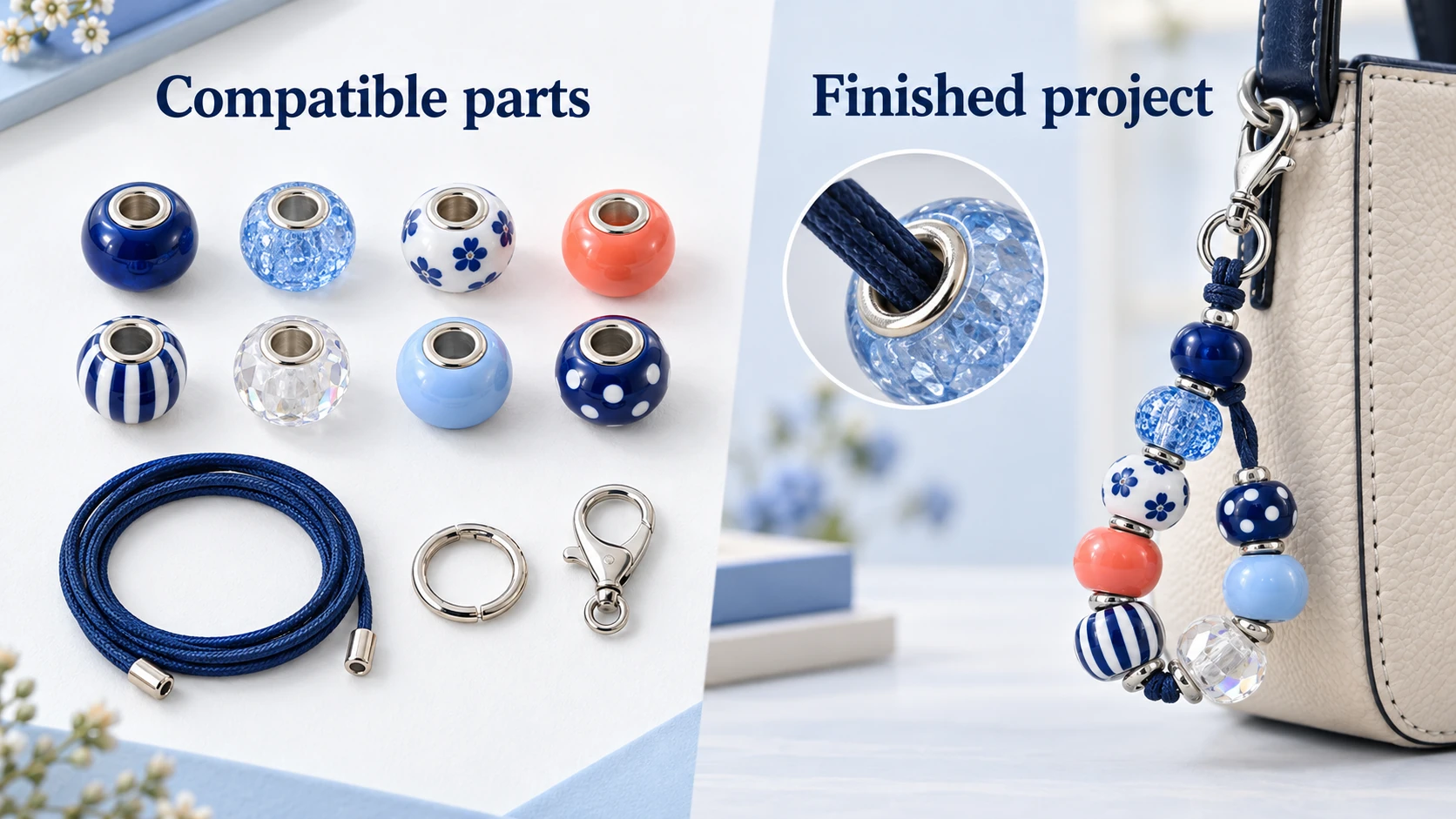
Beaded charms: do the parts fit each other?
For a proposed charm-making kit, inspect the bead openings, cord, connectors and clasp together. A supplier can accurately describe each part while the combined kit still proves difficult to assemble. Decorative appeal does not resolve a cord that will not pass through the selected beads.
Build the configuration shown in the proposed listing using only the declared contents and tools. Check how it attaches to the intended bag, whether the closure holds during ordinary handling, and whether the instructions explain the finishing step. This is a suggested sample check, not a durability certification.
The smallest component can determine whether the whole kit works. Confirm whether the supplier can replace a missing clasp or a mismatched part without sending an entire new kit. That answer belongs in the fulfillment plan before a low purchase price becomes the main reason to select the supplier.
Miniature rooms: are the scale and assembly demands clear?
A miniature-room offer needs dimensions that a buyer can understand. Show the completed size and the size of important components. If the listing uses a scale ratio, verify that the furniture and room parts follow the same intended scale rather than relying on a staged photograph.
Inspect the flat panels and small attachments after the sample parcel arrives. Warped pieces, difficult joins or unclear part numbering can prevent assembly even when every item is present. Check whether glue, cutting tools, paint or lighting components are included; list exclusions before purchase.
For an initial offer, consider a simpler configuration whose assembly and packing you can verify. Extra features are worth adding only when the instructions, supply consistency and customer support can handle them. A seller should be able to explain the finished project without hiding important requirements in a long supplier specification.
03
A complete kit has costs beyond its headline price
Compare suppliers on the same contents and packaged configuration. One quote might include translated instructions and protective packing while another covers loose components only. Resolve that difference before comparing unit prices.
Consider a hypothetical kit sold for $24, with these assumed per-order costs:
- Goods: $7.
- Shipping: $5.
- Payment and other order fees: $1.
- Exception allowance: $2.
- Customer acquisition: $6.
The modeled remainder is $3 before fixed overhead, taxes and other costs not included here. If shipping rises from $5 to $8, that remainder falls to zero. These are illustrative planning inputs, not supplier rates, observed margins or a recommended price.
Measure the packed parcel and request a quote for the actual destination. A protective insert can be necessary even if it changes the billable package size. The shipping-cost guide covers the inputs needed to compare a complete parcel quote.
The exception allowance also needs revision once orders provide evidence. Missing components may lead to a replacement part, another shipment or a refund. Do not assume a small item is inexpensive to support merely because its purchase cost is low.
04
Check the customer and sales channel before listing
Decide who the kit is designed for before commissioning packaging or advertising. In the United States, the CPSC’s children’s-product guidance considers intended use, packaging and promotion, consumer recognition and age guidelines when determining whether a product is primarily intended for children aged 12 or younger. An adult label alone does not settle that classification.
Have the actual contents and presentation assessed for the destination’s applicable requirements. Needles, small components and any included chemicals or electrical parts make the exact kit important; a document for a different assortment does not establish the status of this one. Resolve missing evidence before making age-suitability or safety claims.
The channel matters too. Etsy’s craft-supply guidance distinguishes qualifying creative supplies from ready-to-use commercial products resold as supplies. A kit, a component and a finished decorative object need their own accurate listing treatment. Permission to sell one does not automatically establish permission to sell the others under the same category.
05
Use one small offer to test the commercial question
Choose one defined project and one customer group. Prepare the listing from the approved sample, showing the package contents, completed example, required tools and delivery conditions. Keep the product version fixed during the test so customer responses refer to the item you actually checked.
Evaluate paid orders alongside acquisition cost, requests for help, missing-part reports and refunds. Saves or enthusiastic comments may help explain interest, but they cannot substitute for the economics of completed orders. Keep the first commitment limited enough that a weak result does not leave an unwanted assortment to clear.
If buyers want the project but cannot finish it, investigate instructions or kit completeness before adding more designs. If the item works but the delivered offer does not convert, compare price, delivery and competing offers. Those findings give the next sourcing decision a firmer basis than choosing whichever search percentage was largest.