
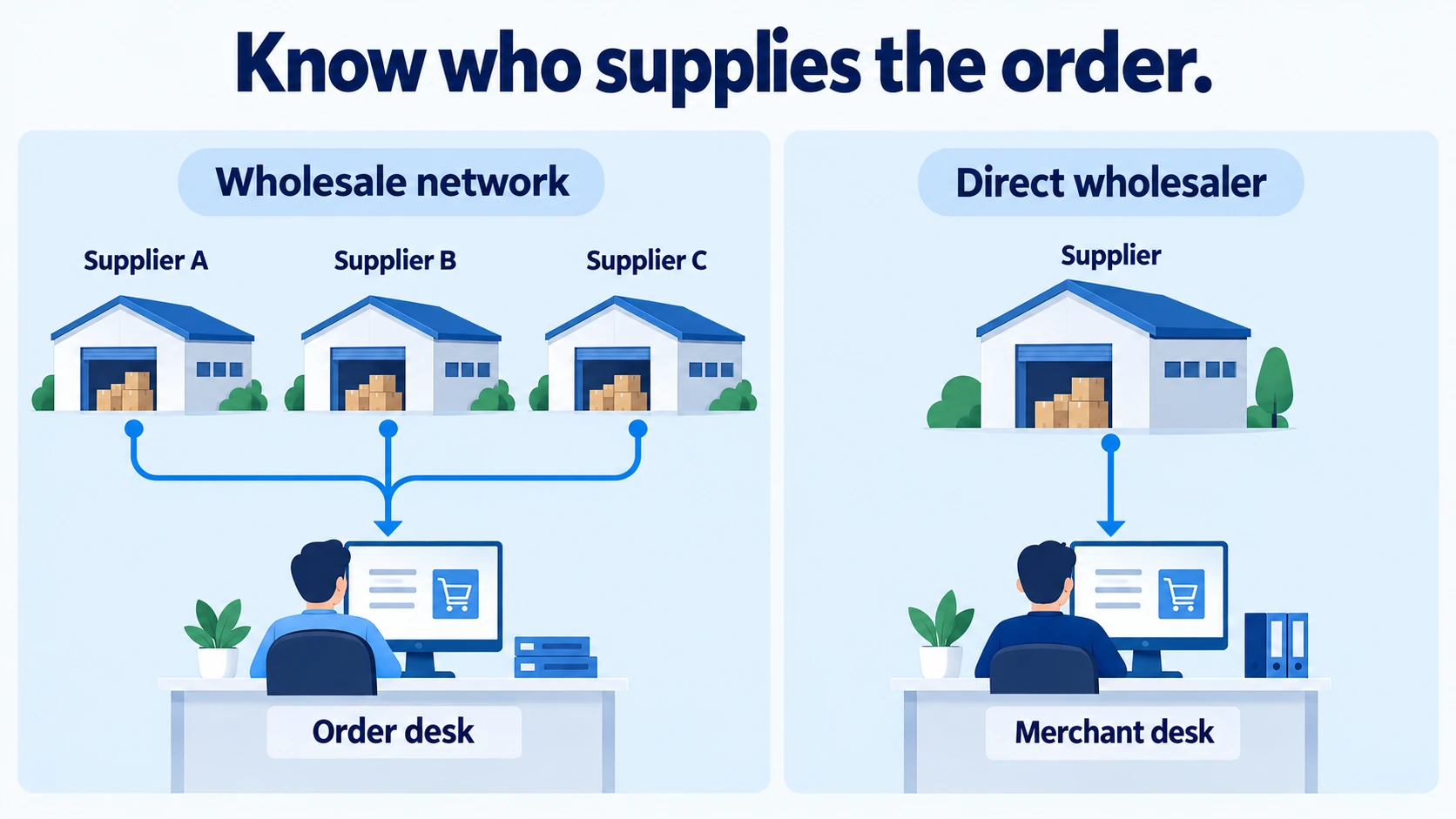
Start an eBay dropshipping supplier search with wholesale networks such as TopDawg or Wholesale2B, or with a direct wholesaler that supports individual-order fulfillment. Compare the source relationship, exact products, dispatch location and return process before choosing the software connection.
The providers below are candidates based on their current public descriptions, reviewed September 17, 2026. They are not independently tested recommendations or a list of suppliers approved for every eBay product. Their advertised features help you decide what to investigate next.
01
Compare the type of relationship first
A wholesale network can help you find products and coordinate orders across participating sources. A direct wholesaler gives you a relationship with the business supplying a defined range. A directory helps you discover businesses; an integration moves data. These roles can overlap, but they are not interchangeable.
Ask who invoices you for the goods, who holds the stock and who resolves a failed order. If three businesses perform those jobs, learn how an issue moves between them. The number of available products does not answer those questions.
For the broader model, the eBay dropshipping guide explains how supplier fulfillment fits the sale and customer responsibilities.
02
TopDawg: investigate the network and selected products
TopDawg’s eBay integration page advertises wholesale product importing, stock and order synchronization, and shipment monitoring. It also describes branded packing slips as a feature of specified plans. Those are provider claims to verify against the plan and products you intend to use.
This is a candidate when you want a network and a connected ordering process. Before paying, investigate a small basket of exact SKUs: their dispatch origins, shipping services, total costs and return destinations.
Ask whether a product’s availability is shared across other merchants and when units become allocated to your order. Also ask who contacts you when a selected supplier cannot fulfill. A central dashboard is most useful when it exposes that exception clearly.
Do not turn an advertised tracking-update speed into a delivery promise. Receiving a tracking number and having a parcel accepted by the carrier are different events. Test the relevant workflow rather than relying on a network-wide headline.
03
Wholesale2B: investigate importing and order handling
Wholesale2B’s eBay plan page presents access to wholesale products, product importing and automated listing management. It is another candidate for a merchant comparing a connected catalog with managing each source directly.
Confirm the current arrangement for your selected products. Ask which business sells the goods to you, how the order is paid and accepted, what stock-update interval applies and who deals with a shortage or return.
Do not assume that every item visible somewhere on a provider’s website has the same source or channel suitability. Inspect the proposed wholesale relationship for the actual SKU. A marketplace integration does not establish the sourcing arrangement on its own.
Request a demonstration using a product you might genuinely sell. Follow its variant, origin, quote and return information through the process. This reveals more about fit than comparing the largest advertised catalog numbers.
04
Direct wholesalers: a narrower catalog can be useful
If you know the product category or brand, approach an appropriate wholesaler or authorized distributor directly. Ask whether it supplies your business and destination, permits the proposed sales channel, and offers individual-order dispatch.
A legitimate wholesaler may sell only cases or pallets. That does not make it unsuitable as a business, but it may not fit your current fulfillment model. Confirm the service before spending time building listings from its catalog.
A direct relationship may offer clearer answers about product versions and stock. It can also require more manual ordering or a separate integration. Compare the complete work you will perform, including how you learn about price changes and unavailable variants.
Use the supplier-finding and verification guide to prepare a consistent brief. Direct does not automatically mean cheaper or better; it means you have a different relationship to evaluate.
05
Apply the source requirement before the feature comparison
Check the proposed arrangement against eBay’s sourcing policy before comparing features.
Ask a candidate to explain the actual supply arrangement in writing. An account on a retail website, a subscription to an importer or a promise to remove retail packaging does not by itself establish a wholesale relationship.
Once that question is resolved, compare convenience features. Product importing, stock updates and automatic tracking can save work, but they should operate on a suitable source rather than obscure one you have not investigated.
06
Send each candidate the same order brief
Prepare a representative order with the exact product, variant, quantity, packed dimensions where known, destination and required service. Request the included work and exclusions alongside the total.
Use comparable fields for each response:
- Product: exact version, pack quantity, purchase price and substitution rules.
- Origin: the dispatch location for that SKU and how changes are reported.
- Handling: order cutoff, working calendar and acceptance process.
- Delivery: service, destination coverage and relevant extra charges.
- Returns: receiving address, authorization, inspection and reimbursement.
- Systems: stock updates, order status, tracking and failed-update response.
This comparison can reveal why a lower product price is not a cheaper completed order. One quote might include packaging and handling while another adds them later. Make the scope equal before deciding which is better value.
Ask how price changes affect open orders and existing listings. Agree on the point at which an order must be paused for your decision instead of being fulfilled at an unexpectedly higher cost.
07
Test the product and the dispatch information
Order a sample through the proposed process and inspect the exact variant. Check the quantity, material, dimensions and included parts, then compare them with the data you would use in the listing. Keep the accepted version identifiable.
An illustrative supplier trial follows one product through three checks: the received unit matches the listing specification, the parcel travels from the stated origin, and the shipment record belongs to that order. A correct product alone does not answer the origin or tracking questions.
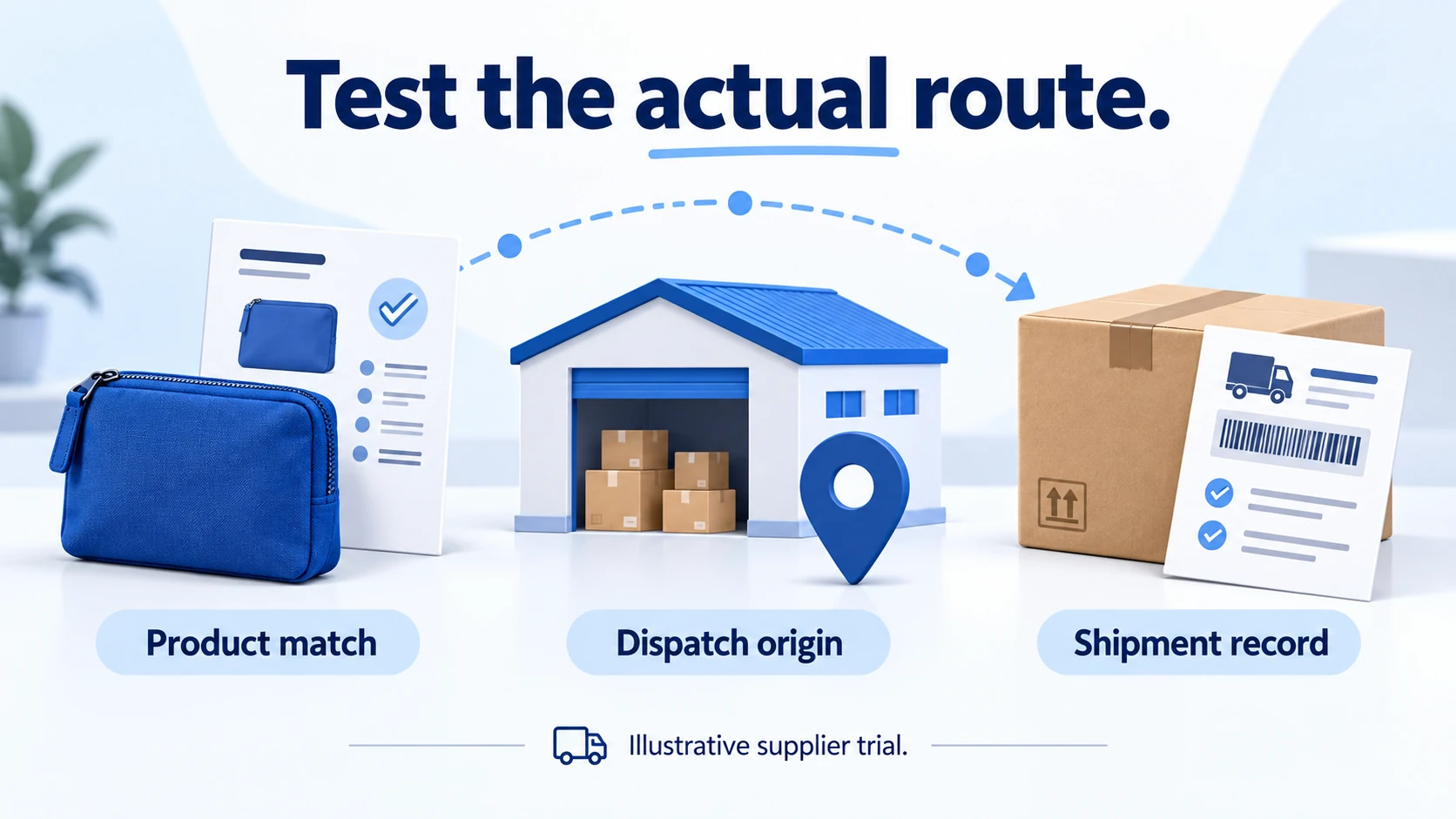
Do not treat a single successful parcel as proof of a reliable delivery average. It can expose a defect or demonstrate what occurred on that occasion. More products, origins or services expand the scope that needs investigation.
If the supplier changes the item, ask whether the change affects your listing. A different accessory, color or package quantity is not a harmless substitution simply because the supplier considers it equivalent.
08
Check stock updates and exception handling
Ask what the available-stock figure means. Is it shared stock, reserved stock or a feed updated periodically? When does an accepted order reduce it? What happens if another merchant buys the last unit before your order reaches the supplier?
Then inspect how the integration handles uncertainty. A failed submission should remain visible until you know whether the supplier accepted it. Retrying without checking can create a duplicate purchase.
Useful questions for a demonstration include:
- Can you find the supplier’s acceptance record for a specific order?
- Can you see an unavailable variant before promising dispatch?
- Can a price increase pause the order for review?
- Can you correct tracking without assigning another parcel’s number?
- Can you export the records needed if you stop using the service?
Choose software and service together. A supplier with clear manual confirmation may be workable at a small volume; a large automated catalog with invisible failures may be much harder to manage.
09
Make the return route part of the buying decision
Confirm where returns go for each relevant product and market. The original shipping warehouse may not accept them. Ask who inspects the returned unit, what evidence is required and how the supplier decides on reimbursement or replacement.
Your buyer response and the supplier’s settlement can occur at different times. Plan enough cash to handle the applicable customer resolution while the commercial claim is investigated.
Compare the likely cost of a failed order alongside the normal quote. A low-priced item with an expensive return route may need a different product, source or service arrangement. Do not assume that a generous-looking policy works operationally until you know who receives the goods.
10
Choose a limited starting scope
Approve specific products, origins and services rather than approving a provider’s entire catalog. Record the unresolved questions and do not expand into a new route merely because the same dashboard displays it.
Ready for a trial: the source relationship is clear, the product and quote match, and the order and return process have owners.
Needs clarification: a missing document, uncertain origin or incomplete return quote prevents a useful decision.
Not suitable for this offer: the product, supply arrangement or delivery service cannot support what you intend to sell.
Review actual orders before increasing commitments. Supplier fit is demonstrated through the work you need performed, not through a badge, catalog count or integration screenshot.
11
Frequently asked questions
Which supplier is best for eBay?
There is no universal choice. Compare the exact category, destination, source agreement and service. TopDawg and Wholesale2B are candidates to investigate; direct wholesalers may fit a narrower product plan better.
Can I use a supplier based overseas?
Evaluate the source and actual dispatch route. Location alone does not establish policy fit or delivery reliability. State the true item location and use a service your customer promise can support.
Does an eBay integration mean the supplier is approved?
No. Integration describes a technical connection. Your supply arrangement, product and order still need to meet the applicable requirements.
Should I choose the largest catalog?
Only if the additional products are useful and qualified. A smaller selection with clear stock, specifications and recovery arrangements is easier to operate than many items you have not examined.