
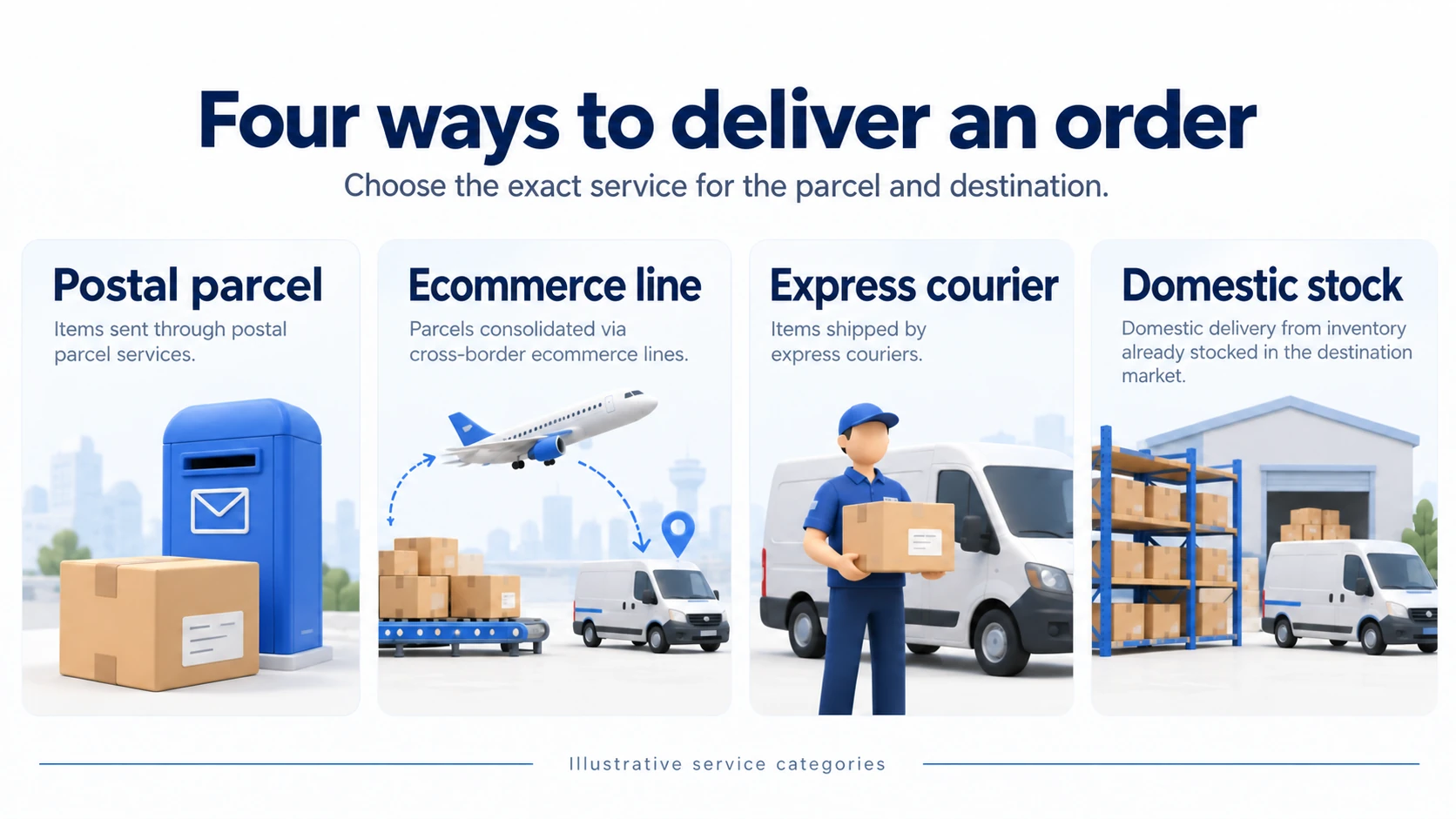
The main dropshipping shipping methods are postal parcel services, cross-border ecommerce lines, express couriers, and domestic delivery from inventory already stocked in the destination market. Choose an exact service for the packed product and delivery address, then compare its charges, timing, tracking and recovery terms.
A carrier name alone is not enough. The same provider can offer several services with different acceptance rules and delivery arrangements. A supplier’s “standard shipping” option also needs a service name and scope before you can turn it into a reliable customer promise.
Start by eliminating services that cannot accept the product or serve the address. Compare the remaining options using the same parcel measurements, dispatch location and delivery requirements. That prevents a low headline rate from winning a comparison it cannot actually fulfill.
01
Compare the four practical options
Each method can suit a different order. None is automatically the cheapest or fastest for every destination.
Postal parcel services
Postal services can be candidates for eligible small parcels where the delivery promise allows the available service window. The parcel may move between the origin postal operator and a destination postal network.
Check the particular postal product, destination coverage, weight limits, tracking events and compensation terms. A familiar label such as ePacket does not establish that the service is currently available for your route and product. Historical country lists and transit tables are poor substitutes for an actual accepted booking.
This option deserves attention when the package is small and the order can tolerate its documented timing and tracking limits. It becomes less attractive if limited shipment visibility creates a level of customer support or loss exposure that the margin cannot absorb.
Cross-border ecommerce lines
An ecommerce line typically arranges a cross-border parcel journey with a local delivery partner at the destination. Compare its origin collection, international transport, customs arrangement and final delivery as parts of one service.
For example, YunExpress describes dedicated B2C lines separately from its bulk-shipping offerings. That establishes the service category; its marketing page does not prove the performance or acceptance of your specific parcel. Ask for the exact service code and written quote.
Find out whether tracking changes to a local carrier number, who can investigate a missing handoff, and which company accepts a claim. These details become important when a parcel moves internationally but the destination carrier has not yet recorded possession.
Express couriers
An express service is worth quoting when urgency, shipment value or the available delivery commitment justifies the cost. Check the actual origin-destination service and the conditions attached to any delivery commitment.
Price the complete parcel. Express billing can be affected by dimensions, fuel or remote-area charges, special handling and other service conditions. An affordable rate for a compact sample does not establish the rate for the final retail packaging.
Also confirm acceptance for the product itself. A faster service does not remove restrictions on batteries, liquids or other controlled goods, and an “express” checkout label does not authorize the supplier to book any similarly named route.
Domestic delivery from stocked inventory
When inventory is already available in the destination market, the customer parcel can use a domestic service. That can remove the international leg from the individual customer’s order, but it introduces inventory and replenishment decisions upstream.
Include inbound transport, receiving, storage, pick-and-pack and unsold-stock exposure when comparing it with direct shipping. A low domestic label price is only the final leg of that model. Confirm that the stock is actually available at the stated location rather than treating an overseas warehouse option as immediate availability.
Bulk air or ocean freight usually belongs in this replenishment comparison. Moving a carton or pallet to a warehouse is a different job from delivering one customer parcel. If a seller offers an end-to-end freight solution, verify that final delivery and the relevant charges are included.
02
Check whether the packed product is accepted
Give the shipping provider a precise description before requesting a price. Include the product’s materials or contents, any battery, liquid or magnet, the packed weight and dimensions, quantity per parcel and destination postcode.
For products with special transport requirements, get acceptance for the exact configuration. A battery inside equipment, a spare battery packed with it and a standalone battery can create different requirements. Do not reduce the description to “electronics” and expect the quote to cover every configuration.
DHL Express explains that some goods need additional documents, packaging, markings or approval in its shipping acceptance guidance. Those are carrier-specific requirements to verify, not permission to use the same treatment on another service.
Before approving a route, obtain answers to these questions:
- Does this service accept the exact product and packaging configuration?
- Does it deliver to the postcode and address type, including any PO box or remote-area restriction?
- What documents and descriptions must accompany the parcel?
- Who supplies those documents and checks them before dispatch?
- What happens if the carrier rejects the parcel after collection?
Resolve acceptance before advertising the delivery option. A quotation without product disclosure can become unusable when the parcel reaches a screening point.
03
Compare quotes for the same parcel
Measure the final packed item rather than the bare product. Packaging changes the space the parcel occupies, and carriers can use that space in billing.
DHL’s published weight and dimensions explanation uses length × width × height in centimeters divided by 5,000, then compares volumetric and actual weight. Use the divisor, rounding and limits of the service you are actually buying; this is not a universal rule for all providers.
Consider two hypothetical parcels that both weigh 0.8 kg on a scale. A compact carton measuring 20 × 15 × 10 cm has a volumetric weight of 0.6 kg with that divisor. A larger 40 × 30 × 20 cm carton has a volumetric weight of 4.8 kg. Under the greater-of rule, before any service rounding, their chargeable weights would be 0.8 kg and 4.8 kg.
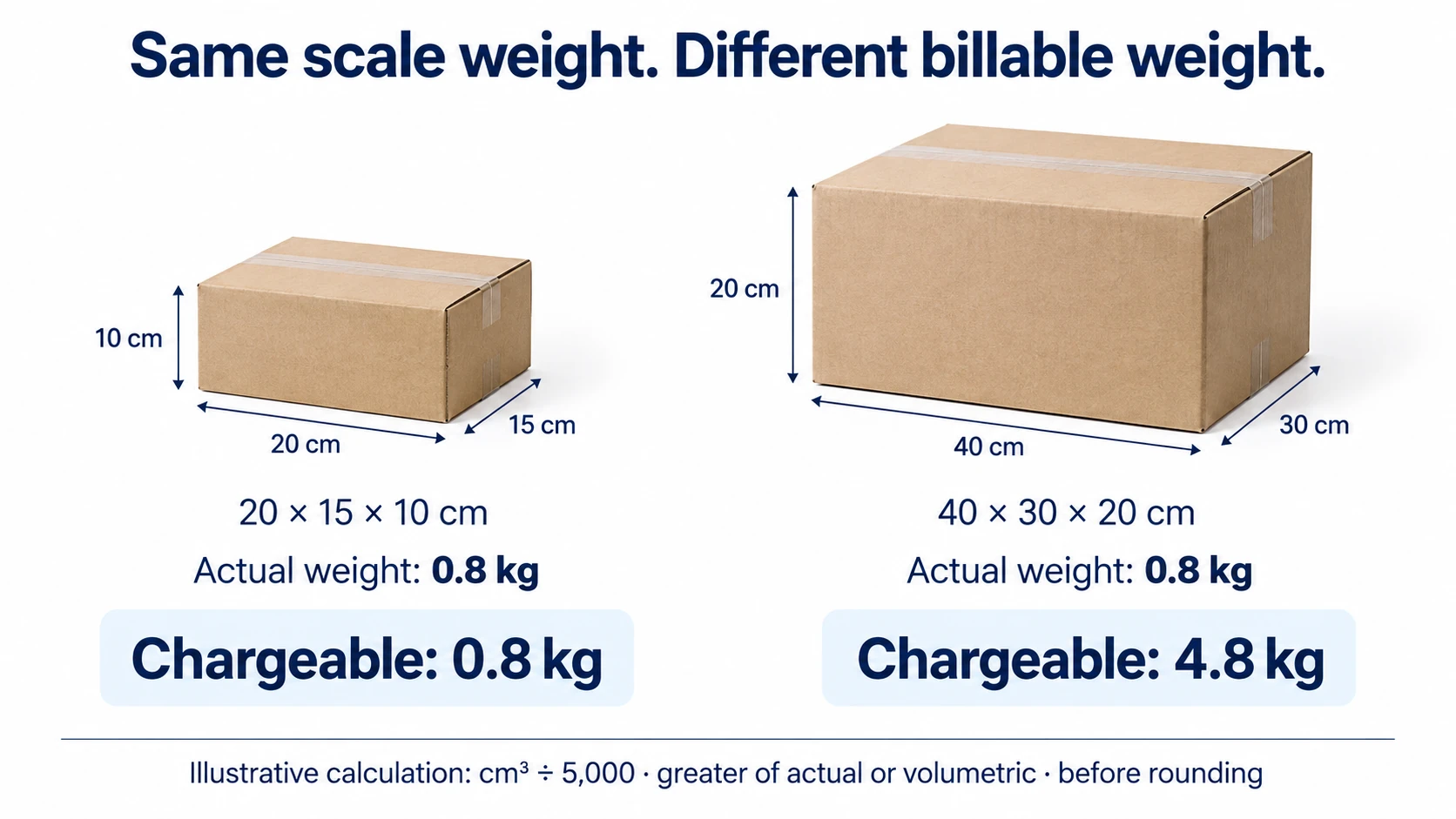
The large carton can therefore change which shipping method is economical even though the scale weight is unchanged. Reduce unnecessary space only while maintaining the protection the product needs. Damaged goods and replacements can cost more than the packaging saving.
Send the same specification to every provider. Ask each to identify:
- Transport charge and billable weight.
- Handling or packaging charges.
- Fuel, remote-area and other applicable surcharges.
- Customs clearance, duty or tax treatment and any exclusions.
- Final delivery and unsuccessful-delivery charges.
- Claim terms, liability limits and any separately purchased cover.
Keep the quote date, service code, currency and validity period. A rate that applied to a different weight band or expired service period should not remain in your product margin calculation.
The dropshipping shipping-cost guide covers the full cost comparison in more detail. At this stage, the practical goal is to compare services that cover the same job, not merely the smallest number on each rate sheet.
04
Turn transit claims into a delivery promise
Ask where the quoted clock starts. A service may describe time from carrier acceptance, while the customer starts waiting when the order is placed. Supplier preparation, collection cutoff and non-working days can sit outside the advertised transit period.
Shopify’s transit-time guidance explicitly separates transit time from order processing time. Make that distinction in your own offer even when the supplier uses the word delivery loosely.
For an illustrative promise calculation, suppose preparation is quoted as two business days and transport as five to eight business days from acceptance. Do not advertise the transport range alone as the customer’s order-to-door expectation. Check how collection cutoffs, holidays and destination delivery days affect the combined estimate before displaying it.
Ask whether the quoted range is an estimate, a measured historical range or a contractual commitment, and what happens when it is missed. Those descriptions support different promises. A supplier’s best recent parcel is not a reliable estimate for the next order.
Use the dropshipping shipping-times guide to build a promise from the complete order journey. Update that promise when processing performance or the service changes; buying a faster international leg may not fix a long supplier preparation delay.
05
Read the tracking handoffs
Tracking should help you explain the parcel’s current position and decide who needs to act. Check whether the service provides a useful origin event, movement through the international leg, a destination handoff and a delivery outcome.
Label information received: The carrier has shipment data. Confirm whether the parcel has actually been handed over before telling the customer it is moving.
International movement recorded: The parcel is progressing through that part of the journey. Check the expected destination handoff rather than assuming the local carrier already has it.
Destination carrier accepted: The local network has recorded receipt. Use its next events and delivery instructions when dealing with the final leg.
UPS’s tracking definitions distinguish label creation from possession and movement. The wording differs by provider, so use that principle to interpret the actual events rather than translating every status into “shipped.”
If two tracking numbers are used, record the connection between them. A customer-facing tracking page should not lose the shipment when the destination carrier takes over. Test the link the customer receives, not only the supplier’s internal tracking screen.
Define an escalation trigger with the provider for missing scans or an overdue handoff. Base it on the service’s expected events and the customer promise. Without that agreement, your support team may repeatedly ask for updates without knowing when to request an investigation or offer a remedy.
06
Set customs and recovery responsibilities
Confirm who prepares customs information, who is named in the import arrangement, who handles clearance questions and who pays the applicable import charges. A shipping label describes transport; it does not answer every customs or tax question.
If a quote uses DDP or another delivery term, ask for the named destination and the precise scope in writing. Do not infer that a short service label covers every tax, registration or product requirement. Have the provider explain any exclusions and the response when customs requests more information.
Describe the goods and value accurately. A provider willing to quote a route is not evidence that an inaccurate declaration is acceptable. Where the product or destination creates a regulatory question, resolve it with the relevant authority or qualified adviser before dispatch.
Recovery terms deserve the same attention as the outbound price. Ask who opens a claim, what evidence is required, when the claim must be filed and what compensation is available. Declared value, carrier liability and insurance are not automatically equivalent.
Also establish the return path. An undeliverable parcel may be returned, held or otherwise handled under the service terms. Find out the address, fees and choices before the first exception. A supplier saying “we handle returns” still leaves unanswered who pays and whether the goods can be recovered economically.
07
Offer shipping choices the supplier can execute
Keep the checkout options tied to an actual fulfillment rule. If customers pay for express, the supplier must know which service to book for that order and which substitutions require your approval.
Start with a manageable set of destinations and services. A standard option plus a genuinely available expedited option can be easier to execute than several vague speed labels. Where a destination is not accepted, disable it until the service is confirmed.
Test mixed carts. Two products from different suppliers may need separate parcels and costs. Shopify documents how rates can combine across profiles and locations; it also notes an ongoing move to shipping options by market. Check the behavior in your current store rather than assuming every admin has the same settings screen.
Free shipping, flat rates and charging the carrier cost are pricing choices for the customer. They are separate from the physical shipping method. Whichever presentation you use, check that the retained order revenue covers the actual service and that split shipments are explained clearly.
08
Test a primary service and a fallback
Before sending a large volume, place a controlled test using the final product, packaging and an address representative of the market you intend to serve. Save the accepted quote, dispatch confirmation, tracking events and delivery condition.
A single successful test checks that one parcel completed the path. It does not establish a reliable on-time percentage. As orders accumulate, review dispatch-to-acceptance delays, delivery outcomes and exceptions by service and destination instead of blending every route into one average.
Choose a fallback for a specific failure: an unavailable service, an excluded postcode or a missed collection opportunity. Recheck product acceptance, cost and timing before switching. The fallback should not silently reduce a delivery option the customer paid for.
Document who approves an extra charge and who updates the customer when no available route can preserve the original promise. That gives the team a practical response when the cheapest or fastest option disappears.
09
Frequently asked questions
Which shipping method is best for dropshipping?
Choose the exact service that accepts the parcel and destination, meets a supportable delivery promise and leaves workable economics. Postal, ecommerce-line, express and domestic delivery each need a like-for-like quote; there is no universal winner.
Is express always the fastest choice?
Compare the complete order-to-door journey. A fast carrier leg can still follow slow supplier preparation. Check the actual service commitment, collection timing and destination conditions.
Is ePacket still an option?
Verify current acceptance for the origin, destination and parcel with the provider offering it. Do not use an old country list or historical transit estimate as confirmation that today’s order can use it.
Why does a lightweight product have expensive shipping?
The packed parcel may be bulky, subject to a different weight band, restricted to certain services or affected by surcharges. Measure the final packaging and ask for the billing calculation.
Can I change methods after a customer orders?
Only after checking that the alternative is suitable and preserves the customer’s purchased terms, or resolving any necessary change with the customer. Record the replacement service and tracking so the order remains traceable.