
Find winning dropshipping products by collecting ideas from customer problems, marketplace searches and advertising libraries, then checking whether a specific offer can attract buyers and be delivered profitably. Research creates a shortlist. A controlled test of real orders shows whether that shortlist deserves more spending.
A winner is specific to your store, customer and delivery arrangement. Another seller’s popular item can fail at your price, with your traffic or on your shipping route. Define the result you need before you start browsing.
01
Decide what a winning product must achieve
A useful product solves a problem, serves a preference or makes an existing task easier. That includes ordinary products as well as unusual ones. A well-sized storage pouch can have a clearer purpose than a gadget whose main attraction is a surprising video.
Commercial success adds further conditions. Customers must choose your offer at a price that covers its costs, and the order must arrive as promised. A product that produces sales but also frequent replacements may leave very little to fund the business.
Write a short purchase scenario before collecting candidates: who is buying, what they need it for, where they live and what they can spend. For example, “a commuter who wants to keep a charger and cables together in a small work bag” is specific enough to guide research.
Set your boundaries alongside that scenario:
- The destinations you can serve and the delivery promise you can support.
- The amount you can afford to lose on an initial test.
- The product types you can evaluate competently.
- The contribution each order needs to leave after variable costs.
- The number of variants and customer questions your team can manage.
These are operating choices, not universal success thresholds. A low-priced accessory sold through an existing audience has different economics from a new product promoted with paid advertising. The broader dropshipping product research guide explains how these decisions fit together.
02
Find candidates where customers reveal a need
Start with a small set of related ideas. Comparing several products for the same buyer is more useful than collecting unrelated “hot” items from every category.
Search for the task, then inspect existing offers
Use phrases that describe what the customer is trying to do: organize charging cables, separate shoes in luggage or keep small craft parts visible. Review the products that appear and note how sellers describe the use case.
Open the actual product pages. Record dimensions, included items, materials, price and delivery information. A search thumbnail can conceal an important difference, such as a single pouch being compared with a three-piece set.
Look for a gap you can explain plainly. It might be a more suitable size, clearer compatibility information, a useful bundle or better instructions. Avoid assuming that adding a logo creates enough value to support a higher price.
Read reviews for specific friction
Customer reviews can reveal what to inspect, especially when a complaint describes an observable problem. A buyer saying a pouch will not close around their charger suggests a fit test. A comment that a zipper sticks suggests checking operation and stitching.
Treat the complaint as a research lead. It may describe an older version, another size or a damaged shipment. Check the listing and variant before turning it into a requirement. Do not claim that a problem affects an entire category because it appears in a few reviews.
Keep a simple note with the reported issue, the affected item and the question it creates for your sample. This connects browsing to a practical next step.
Use social content and ads to discover demonstrations
Advertising libraries and relevant creator content can show how people explain a product. Save the useful demonstration, audience question or objection. You are looking for a customer situation you can investigate and represent truthfully.
An ad that remains visible does not reveal the advertiser’s full costs or profit. Its activity can justify investigating the offer; it cannot establish that the same product will work for your store. Develop your own content and obtain permission for any creative assets you use.
03
Check demand without confusing it with attention
Use sources that answer different questions. Three websites repeating the same estimate do not provide three independent confirmations.
Search interest helps you understand terminology, seasonality and changes in attention. Google Trends uses sampled, normalized data. Its 0–100 values are relative interest, not purchases, and low-volume terms can show zero. Keep the same location and comparison settings when examining related terms. See Google’s explanation of Trends data.
Advertising evidence helps you study positioning and creative choices. TikTok Top Ads is a selected collection that meets performance and advertiser-authorization conditions. It is useful inspiration, but it is not a complete view of all products or an audit of advertiser profitability. TikTok describes that scope in its Top Ads guide.
Marketplace evidence gives a view of activity within a particular marketplace. Amazon Best Sellers Rank reflects sales performance relative to other products in the relevant category and store. It is not a universal product-quality score or your expected monthly sales. Amazon’s BSR explanation provides the measurement context.
For a more direct look at sold items, eBay Product Research offers historical sales information and filters. Match the product, condition, date and buyer market before interpreting sold prices. Those transactions happened under other sellers’ offers; they do not forecast sales on your own website. See eBay Product Research.
A useful research note explains what you learned and what remains unknown. “People search for compact cable storage, and comparable pouches sell in this market” is narrower and more defensible than “this is a proven winner.” You still need a compelling offer, an acceptable sample and viable costs.
When signals disagree, investigate the mismatch. A social demonstration can attract attention before people know a product’s name. A strong search trend may refer to a broad category while your particular version has weak appeal. Record those explanations before rejecting or approving the idea.
04
Compare the complete offer the customer can buy
Choose a few genuinely comparable listings. Look at the price delivered to your target location, the quantity supplied, the delivery estimate and the information available before checkout.
For a cable pouch, compare usable internal space and included accessories. A competitor showing cables inside may be illustrating capacity rather than including those cables in the sale. Your own photographs and copy must make that distinction clear.
Ask why someone would choose your offer. A practical bundle could solve more of the task, but it also adds purchasing, packing and replacement costs. Faster delivery can be valuable, but only when your inventory and route support it. Clearer information can reduce uncertainty without changing the item itself.
No convincing difference is a reason to revise the offer. It does not automatically mean the entire product category is unusable. You might choose a narrower customer group, another variant or a different supplier. If the only workable strategy is an unsupported claim or an implausible delivery promise, remove the candidate.
05
Verify the exact sample and shipping arrangement
Send the supplier a specification rather than a screenshot alone. Identify the variant, dimensions, material, color, included pieces and packaging. Ask whether the quoted item is the same version as the sample you will receive. The sample ordering and approval guide covers the record to retain.
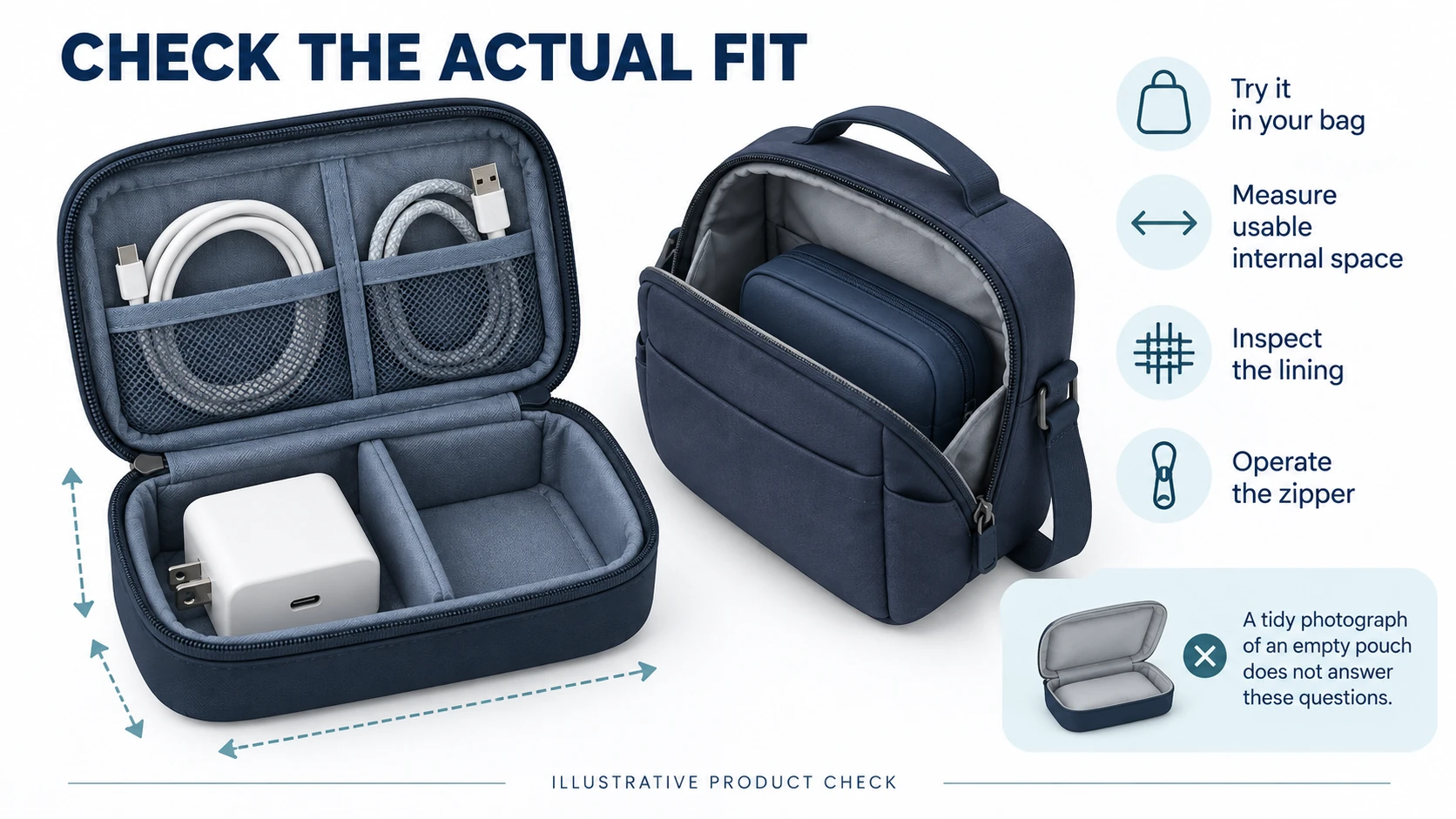
For the hypothetical commuter pouch, place the intended charger and cables inside, close it and check whether it fits the intended bag. Measure usable internal space, inspect the lining and operate the zipper. A tidy photograph of an empty pouch does not answer these questions.
Keep dated photographs and the accepted specification. If the sample fails, describe the defect and request a corrected version before approving the product. A different zipper, material or size needs a new decision; the supplier should not substitute it silently.
Then evaluate the packed item. Ask for its packed dimensions and weight, the proposed service and the destinations covered by the quote. Check whether packaging, handling and any relevant destination charges are included or separate.
A sample shipment can expose problems with the item, packaging and communication. It does not establish a reliable delivery average. Record order placement, processing, carrier acceptance and arrival separately, and make your initial customer promise only from evidence you can support.
Product-specific obligations also need attention before a sales test. Electrical items, cosmetics, children’s products and other regulated categories can require knowledge and documentation beyond a visual sample check. If you cannot establish what applies to the actual product and destination, resolve that gap before offering it for sale.
06
Calculate how much acquisition you can afford
Start with the amount you retain from the sale, excluding taxes collected for remittance. Subtract the product, fulfillment, payment and other variable costs. Include a realistic allowance for refunds, replacements and other exceptions, then revisit that allowance when actual orders provide evidence.
Consider an illustrative offer sold for $36. Assume $9 for the product, $6 for packing and delivery, $1.50 for payment fees and $1.50 for expected exception costs. These assumed non-ad variable costs total $18.
At $36 revenue and $18 in non-ad variable costs, the offer has $18 available for acquisition before fixed overhead and profit. If you want $4 of contribution after acquisition, the working acquisition ceiling is $14. These figures are hypothetical planning inputs, not supplier quotes or industry benchmarks.
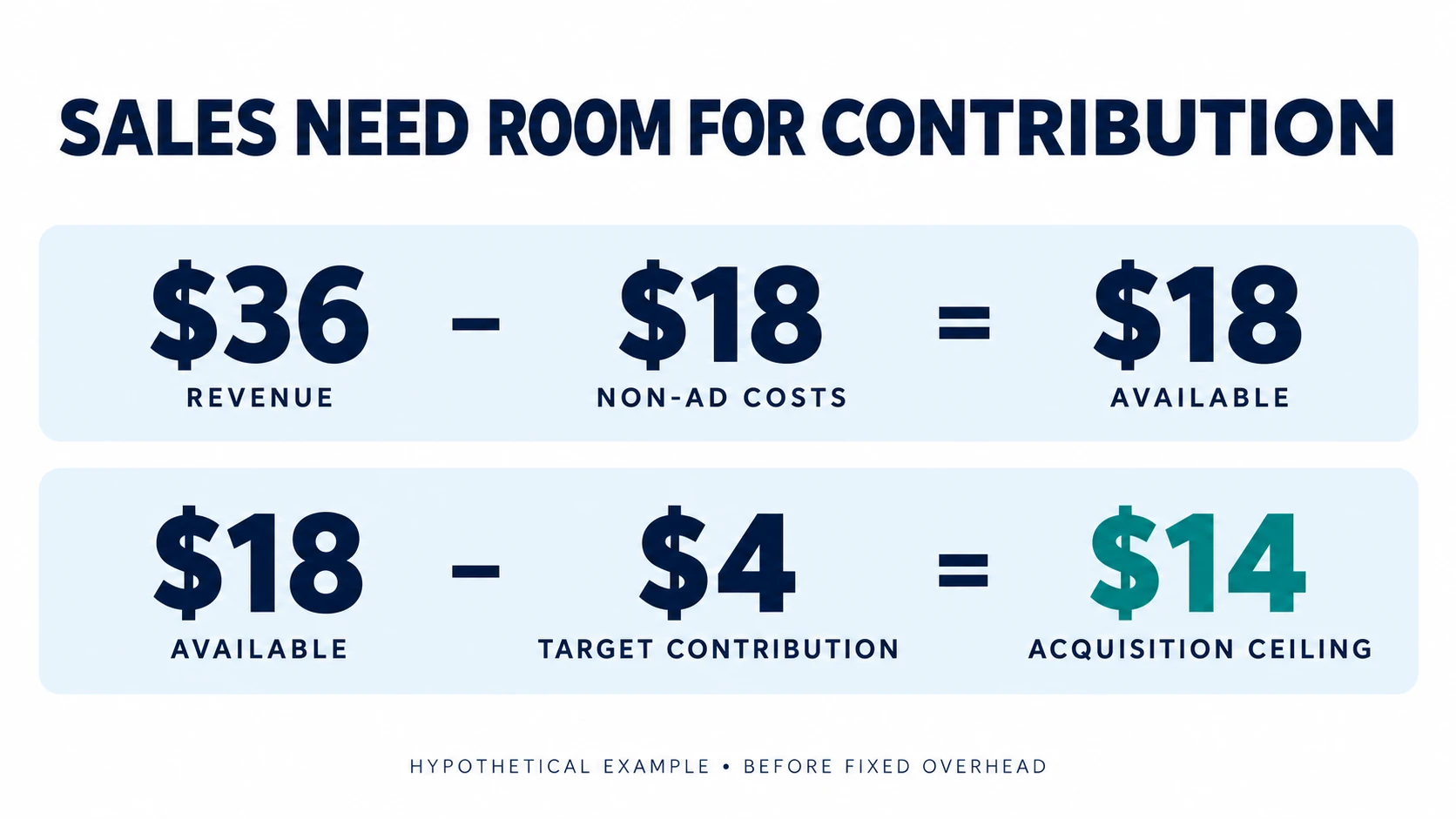
This distinction matters when judging results. An acquisition cost of $16 would leave $2 per order in the example. Sales would be occurring, but the offer would miss the chosen $4 contribution target.
Recalculate when the offer changes. A discount reduces retained revenue. A heavier bundle can raise freight. A replacement can consume both another product and another delivery charge. Do not count repeat purchases as available cash until your own evidence supports that expectation.
Keep one-time sample and setup spending visible in the overall test budget. Separating it from per-order costs helps you understand the offer without pretending that the business has no overhead. Use the dropshipping profit margin calculation when comparing contribution with the wider business result.
07
Run a limited test and diagnose the result
Prepare an accurate product page, original or authorized creative, a working checkout and clear delivery and return information. Confirm that the supplier can accept the intended orders. Testing demand with a product you cannot deliver creates a different problem from a weak advertisement.
Set the test’s spending limit and review conditions before starting. There is no universal budget that proves a winner. Your price, traffic cost, available audience and tolerance for loss determine how much evidence you can afford to collect.
Follow the order through the full process:
- Check that relevant visitors reach the page and see the intended offer.
- Record purchase behavior alongside the traffic source and spend.
- Reconcile paid orders, discounts, cancellations and acquisition costs.
- Confirm the correct variant is accepted, packed and shipped.
- Review delivery, customer questions, refunds and replacements.
If visitors arrive but do not buy, inspect the offer and checkout before declaring the product unwanted. The price may be unclear, the delivery promise unattractive or the page inconsistent with the ad. A broken payment method needs repair before more traffic.
If orders arrive but contribution is weak, compare actual costs with your assumptions. You may need another offer, supplier or acquisition approach. Increasing volume does not repair a negative per-order result by itself.
If the product sells but customers receive the wrong variant or damaged goods, pause the affected offer and resolve fulfillment. Demand and delivery quality require separate decisions. Preserve records of the incident and verify the correction with the actual item and process.
08
Increase volume only when the order remains repeatable
Review groups of orders together rather than celebrating the best day. Keep the offer version, traffic source, supplier version and delivery route identifiable. Recent orders may not yet have reached customers, so their apparent contribution can omit later support and refund costs.
Before increasing spending, confirm available stock, replenishment arrangements and capacity for the exact variant. Ask what changes at the proposed volume. A supplier may require advance inventory, different packaging or another shipping service, each of which changes your exposure.
Increase commitments in steps that you can observe and reverse where possible. Keep a defined response to quality failures, late dispatch or deteriorating economics. A product remains worth backing only while customers receive the promised offer and the resulting orders meet your business requirements.
09
Frequently asked questions
Can I find winning products with free tools?
Yes. Search tools, ad libraries, marketplace pages and customer feedback can produce a useful shortlist. Samples, suitable creative and real-order testing may still cost money. Free discovery does not remove the need to verify the actual offer.
How many products should I test at once?
Test only as many as you can fund, supply and evaluate separately. A small related shortlist makes it easier to understand differences in customer response. Testing many unrelated products with very little evidence for each can leave every conclusion uncertain.
Does a viral product mean the market is saturated?
Virality alone does not establish competition or opportunity. Compare the offers already available in your target market and the reason a buyer would choose yours. If comparable sellers provide a better delivered offer and you have no useful difference, revise or skip that candidate.
When should I stop testing a product?
Stop when the agreed loss limit is reached, a material product or fulfillment issue appears, or the available evidence shows that your offer cannot meet its requirements. If the test failed because of a fixable checkout or measurement problem, repair that problem and make a fresh, bounded decision about further spending.