
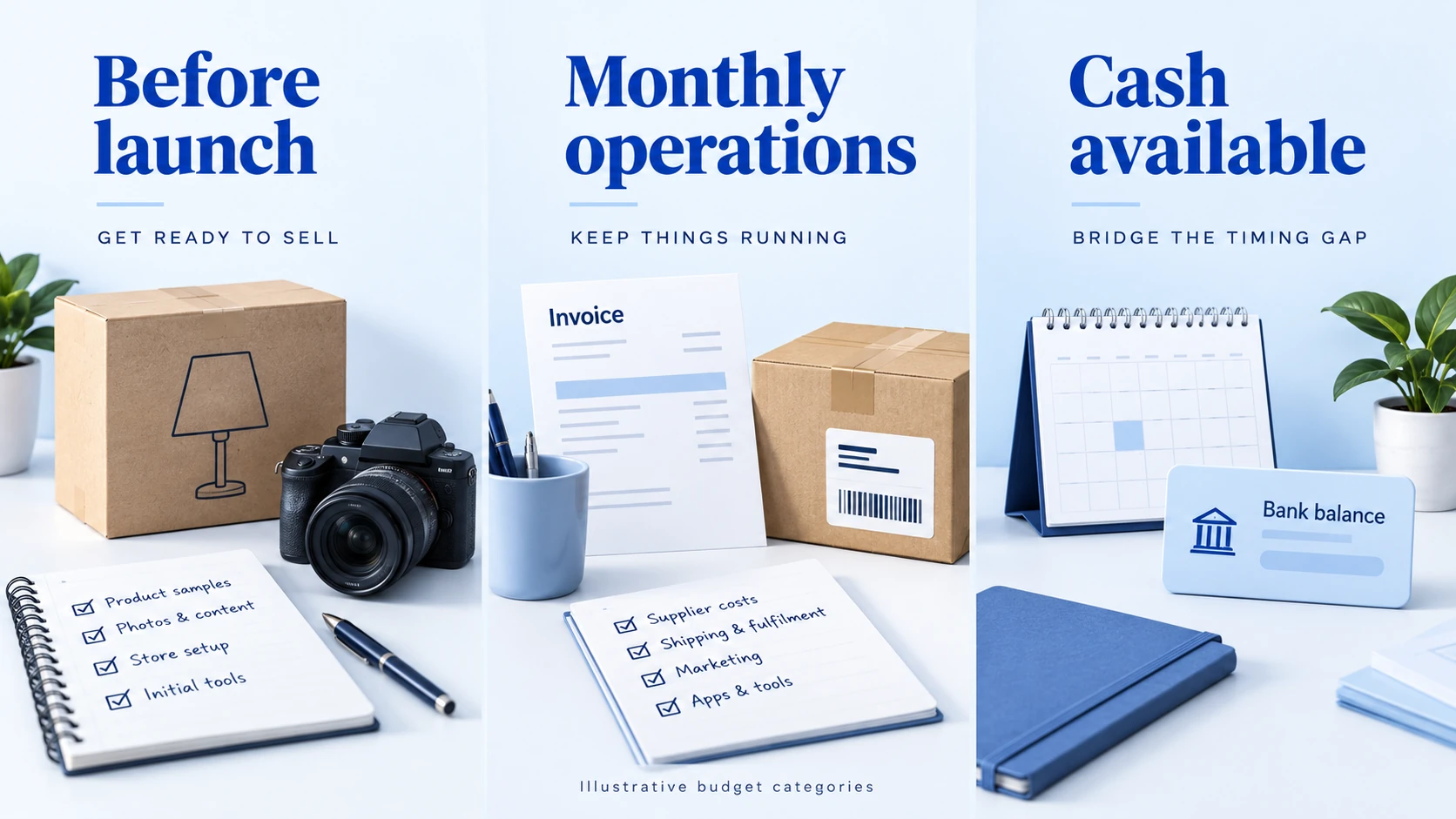
Shopify dropshipping costs include the store subscription, setup, apps, products, fulfillment, shipping, payment fees and customer acquisition. You also need cash to pay suppliers while customer payments are still moving toward your bank account. The monthly Shopify bill is only one part of the budget.
As checked on September 15, 2026, Shopify’s US pricing lists Basic at $39 per month when billed monthly, or $29 per month when billed yearly. Those figures do not describe the total cost of starting or operating a dropshipping business. Your product, market, payment arrangement and testing plan determine the rest.
Build the budget in three parts: expenses before launch, the economics of a normal month, and the money that must remain available between outgoing payments and incoming payouts. Keeping those parts separate prevents an attractive subscription price from hiding an unaffordable launch.
01
What Shopify itself costs
Shopify’s current US pricing page lists the following standard subscription choices. Prices below are in USD, before applicable taxes or other charges; regional prices, promotions and account terms can differ.
- Basic: $39 billed monthly, or a $29 monthly equivalent billed yearly.
- Grow: $105 billed monthly, or a $79 monthly equivalent billed yearly.
- Advanced: $399 billed monthly, or a $299 monthly equivalent billed yearly.
An annual monthly equivalent is a comparison figure, not a monthly payment schedule. At $29 multiplied by 12, Basic’s annual subscription represents $348 for the year before applicable taxes. Check the actual checkout and billing commitment before using an annual rate in a first-month cash budget.
Start with the plan that provides the capabilities your store needs. A more expensive plan may make sense for staff access, specific functionality or payment-rate savings. It does not make an untested product profitable. The Shopify dropshipping guide covers how the platform fits into the wider operating model.
Treat an introductory promotion separately from normal operating cost. A short discounted period can lower the first invoice, but the budget should still show what happens when standard billing starts.
02
Separate setup, running costs and supplier cash
Before comparing “startup budgets,” check what each total contains. A store build, a month of advertising and cash sitting ready to pay suppliers are different uses of money.
Setup expenses can include product samples, domain registration, initial photography or creative work, paid design help and any required business setup. Some are optional; others depend on what you sell and where the business operates.
Running expenses include the subscription, app charges, order costs, marketing and customer support. Separate fixed monthly costs from costs that increase with orders, contacts, messages or usage.
Working cash covers the timing gap between paying suppliers and receiving usable payouts. It is money available to fund the business, rather than a second charge for the same products.
A sample budget should include the landed sample cost, not just the product price. Buying three low-priced items can still involve several shipping charges if they come from different suppliers. Use samples to answer a defined question about the product, packaging, dispatch or delivery; an unexamined sample is just another expense.
For software, read the billing unit. An app may charge monthly, per order, by product count or by usage. A free tier can be enough for an early test, but record the threshold at which it becomes paid. Do the same for email and other communication tools as the contact list grows.
Do not automatically buy a premium theme or a large app bundle before testing checkout and fulfillment. Spend first on requirements that change whether the customer can buy, receive and use the product. Evaluate optional polish against a specific observed problem.
03
Build the cost of a fulfilled order
Start with the revenue you retain after discounts, then deduct the costs attached to that order. A useful planning calculation is:
Revenue per order − product − fulfillment and shipping − payment charges − expected recovery cost − customer acquisition = contribution before fixed costs.
Use a consistent treatment of taxes and shipping revenue. Tax collected for remittance is not available profit. If you charge the customer shipping, include that revenue and the corresponding supplier or carrier cost; do not make one disappear because the other is labeled shipping.
The product quote also needs a defined scope. Check whether it includes picking, packaging, handling, an agent fee and any import-related charges. Record currency conversion costs when you pay in a different currency. Two supplier prices are not comparable if one includes delivery and the other stops at the warehouse.
Payment charges require a separate line. Shopify’s payout-fee guidance directs merchants to the actual rate in Settings → Payments. The cost can vary with the plan and payment method, so use your account’s applicable rate rather than a generic percentage.
When a third-party payment provider is involved, Shopify’s own transaction charge can sit alongside the provider’s processing fee. The third-party transaction-fee rules explain applicability and exceptions. Check the methods you actually offer; “Shopify Payments enabled” is not enough information to price every possible transaction.
Include an allowance for refunds, replacement shipments and other recovery costs. This is a forecast based on your assumptions or observed history, not a claim that every order incurs that exact amount. Shopify states that the original card processing fee is not returned when a Shopify Payments transaction is refunded in its refund guidance.
04
A transparent 100-order monthly budget
Here is a hypothetical model for a small store selling one type of product. These are planning assumptions, not typical supplier quotes, advertising results or a profit forecast. All amounts are USD. The example excludes sales tax collected for remittance, income tax, financing and owner pay.
Assume 100 orders at $40 each, after discounts, with no separate shipping charge to the customer. Revenue is $4,000. For each order, assume:
- Product: $12.00.
- Shipping: $6.00.
- Handling and packaging: $1.50.
- Payment processing: $1.46, using an illustrative 2.9% plus $0.30 on $40.
- Expected refunds and recovery, net of any assumed recoveries: $1.20.
- Customer acquisition: $10.00.
The variable cost totals $32.16 per order, leaving $7.84 contribution. Across 100 orders, that is $784 before fixed expenses. Deduct an illustrative $61 monthly fixed budget—$39 subscription, $20 apps and $2 domain-cost allocation—and the model leaves $723 before the excluded costs.
The model’s fixed expense allocation is not the same as its invoices. The domain may be paid annually. Likewise, if you choose annual Shopify billing, its cash payment happens differently from the monthly expense represented in the model.
Now change only acquisition cost from $10 to $16. Contribution falls to $1.84 per order, or $184 across 100 orders. After the same $61 fixed costs, only $123 remains. A $6 change in acquisition cost reduces the result by $600 without changing the subscription at all.
At a $7.84 contribution, $61 of fixed costs requires eight whole orders to cover those fixed costs in this simplified model. That does not mean the business recovers its setup spending after eight sales, or that advertising will produce those sales at the assumed cost. It answers one narrower question: how many orders with those economics cover that month’s fixed expenses.
Use the dropshipping unit economics guide when your products have different order values, return patterns or fulfillment costs. A store average can hide a product that loses money each time it sells.
05
How much cash to set aside before launch
Choose the launch scope first: products to sample, destinations to support, the test period and the maximum marketing spend you are prepared to lose. Then put actual quotes and billing dates against that scope.
For an illustrative monthly-billed launch, suppose you set aside $39 for the first subscription month, $20 for an app, $24 for an annual domain, $150 for samples and $200 for initial creative work. Those assumptions total $433 before advertising and supplier funding. Add a deliberately capped $500 marketing test and the planned outlay becomes $933.
This is an example of how to add the items, not a recommended minimum. It excludes business registration, professional advice, taxes and any other requirements specific to your product or jurisdiction. Replace each assumed amount with your own quote before committing.
Supplier funding comes next. Suppose orders grow to 10 per day and you must pay $19.50 per order for product, shipping and handling. That creates $195 of supplier payments per day. If your planning scenario requires you to fund five calendar days before usable cash catches up, the supplier-payment gap alone is $975.
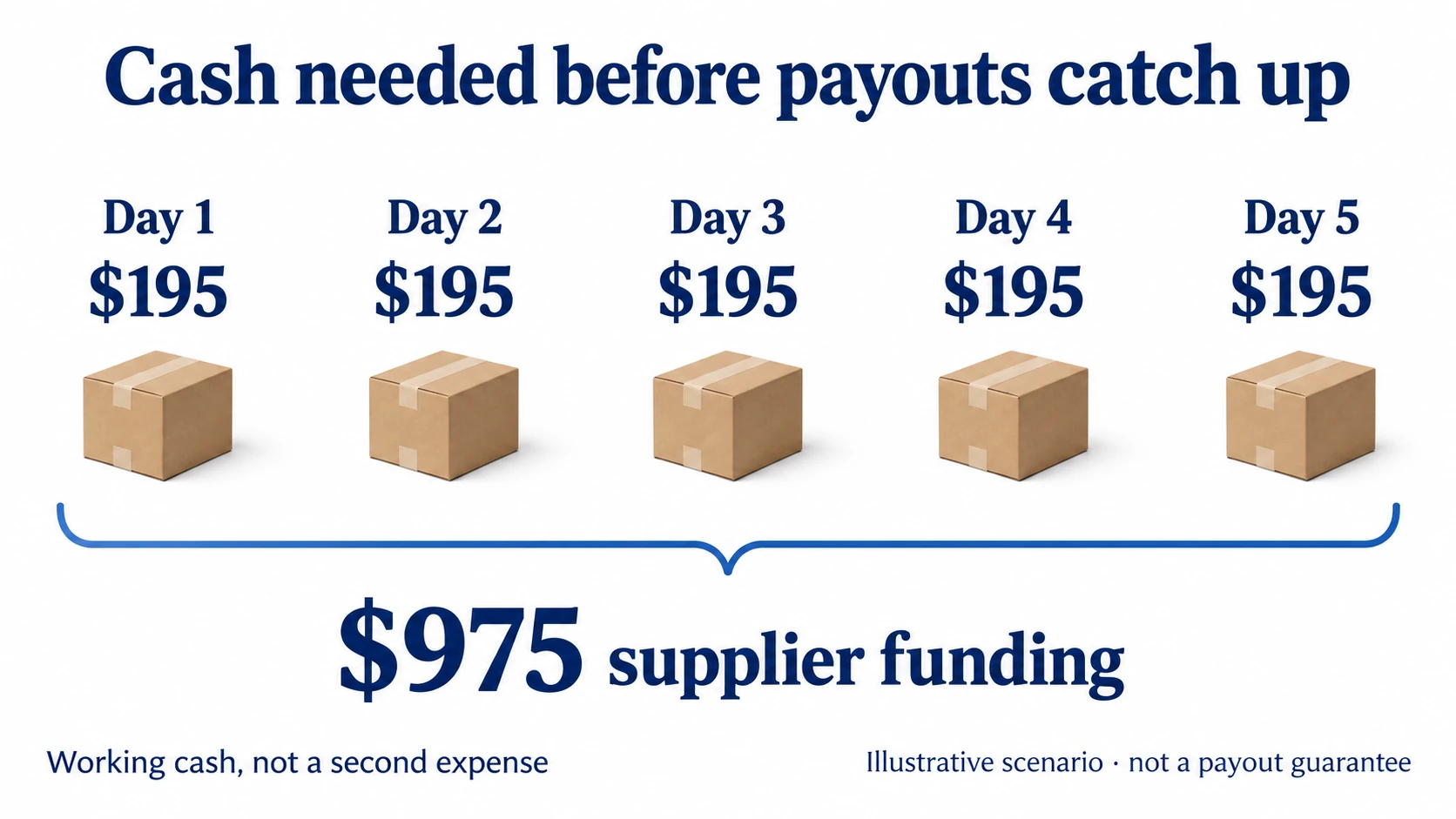
The $975 is working cash for expenses already represented in the order economics. Do not subtract it a second time as a monthly expense. Add any advertising invoices, refunds or other payments that fall due during the same gap when deciding how much cash must be accessible.
Shopify’s payout-timing documentation distinguishes settlement, payout scheduling and bank processing. Timing varies by region and risk level, and weekends, holidays or account reviews can matter. The five-day scenario above is deliberately illustrative; it is not a Shopify payout promise.
Before increasing sales, check both questions: Does each order contribute enough? Can the business fund the next supplier payments if incoming cash arrives later than expected? Growth can increase the second requirement even when the first answer is positive.
06
Choose paid tools and upgrades by their effect
Pay for a tool when it solves a defined problem at a sensible cost. A product importer, order-routing integration and tracking tool can overlap. List the jobs you need before purchasing three subscriptions that partly duplicate each other.
For a subscription that saves manual work, estimate the actual time saved and the errors avoided. Include setup, supervision and exception handling. A tool that submits orders quickly but leaves failed submissions invisible may shift the work rather than reduce it.
For a plan upgrade based on processing-rate savings, use a simple calculation: extra monthly plan cost ÷ reduction in the applicable fee rate. The result is the eligible payment volume needed for the fee saving alone to cover the upgrade.
For example, an entirely hypothetical $60 monthly increase and a 0.2 percentage-point reduction produce $60 ÷ 0.002 = $30,000 of eligible monthly payment volume. This is not a recommendation for a particular Shopify tier. Use the current difference between your actual plans, payment methods and billing terms; feature needs can justify an upgrade independently.
Keep a review date for tools added during a test. Canceling an unused tool may require more than removing its visible feature from the storefront, so check the app’s billing and cancellation terms directly.
07
Check the costs that averages hide
Look at orders by product and destination. A lightweight domestic order and a bulky international parcel can share the same retail price while leaving very different contributions.
Review these cost changes before expanding the offer:
- A second item causes a second supplier shipment rather than a combined parcel.
- Packaging increases the carrier’s billable weight.
- A payment method or currency adds charges absent from the original model.
- A remote destination adds a delivery surcharge.
- A refund leaves payment or shipping costs unrecovered.
- An app moves into a higher billing tier as orders increase.
Free shipping changes what the customer pays at checkout, not whether someone pays for transport. If you absorb the charge, test the margin at the destinations you actually serve. A profitable domestic average can conceal a loss-making international option.
Keep customer acquisition assumptions separate for paid and unpaid traffic. Organic content may avoid a per-click bill, but production and management still use time or money. Do not label that work free when comparing channels.
08
Review the budget against actual bills
At the end of the first operating period, compare the plan with the records that produced the money movements. Use the Shopify bill for subscription and billed app charges, payment records for processing deductions, supplier invoices for purchasing and delivery, and advertising invoices for acquisition spending.
Reconcile refunds and supplier credits separately. A customer refund can leave your account before the supplier approves a reimbursement. Record what is actually recoverable and when it arrives, rather than assuming the two events cancel each other immediately.
Update the next budget with observed order mix, shipping charges and recovery costs. Keep the original assumptions beside the actuals long enough to identify which ones changed the result. The profit margin guide can help distinguish the margin you are measuring from the cash currently in the bank.
09
Frequently asked questions
Can I start Shopify dropshipping with only the subscription fee?
You may be able to create a store, but that does not fund samples, supplier orders, marketing or customer recovery. Calculate the costs of the launch you intend to run and the cash required before payouts arrive.
Is $29 the amount I pay each month for Basic?
The current US $29 figure is a monthly equivalent with yearly billing. The standard monthly-billed US price checked for this article is $39. Check the current offer, locale and billing commitment in your account.
Do I need paid apps immediately?
Only where the required job cannot be handled adequately by the available tools and your current process. Check free-tier limits, order or usage charges, and overlapping functions before purchasing.
Are supplier payments an extra cost beyond the per-order budget?
They are the cash payment of product and fulfillment costs already in that budget. A working-cash reserve funds their timing; it should not be counted as a duplicate expense.
What cost deserves the most attention?
Inspect the costs that materially change your contribution and cash needs. Depending on the store, that may be acquisition, shipping, product costs or refunds. The worked example shows why a small subscription saving cannot compensate for a much larger per-order problem.