
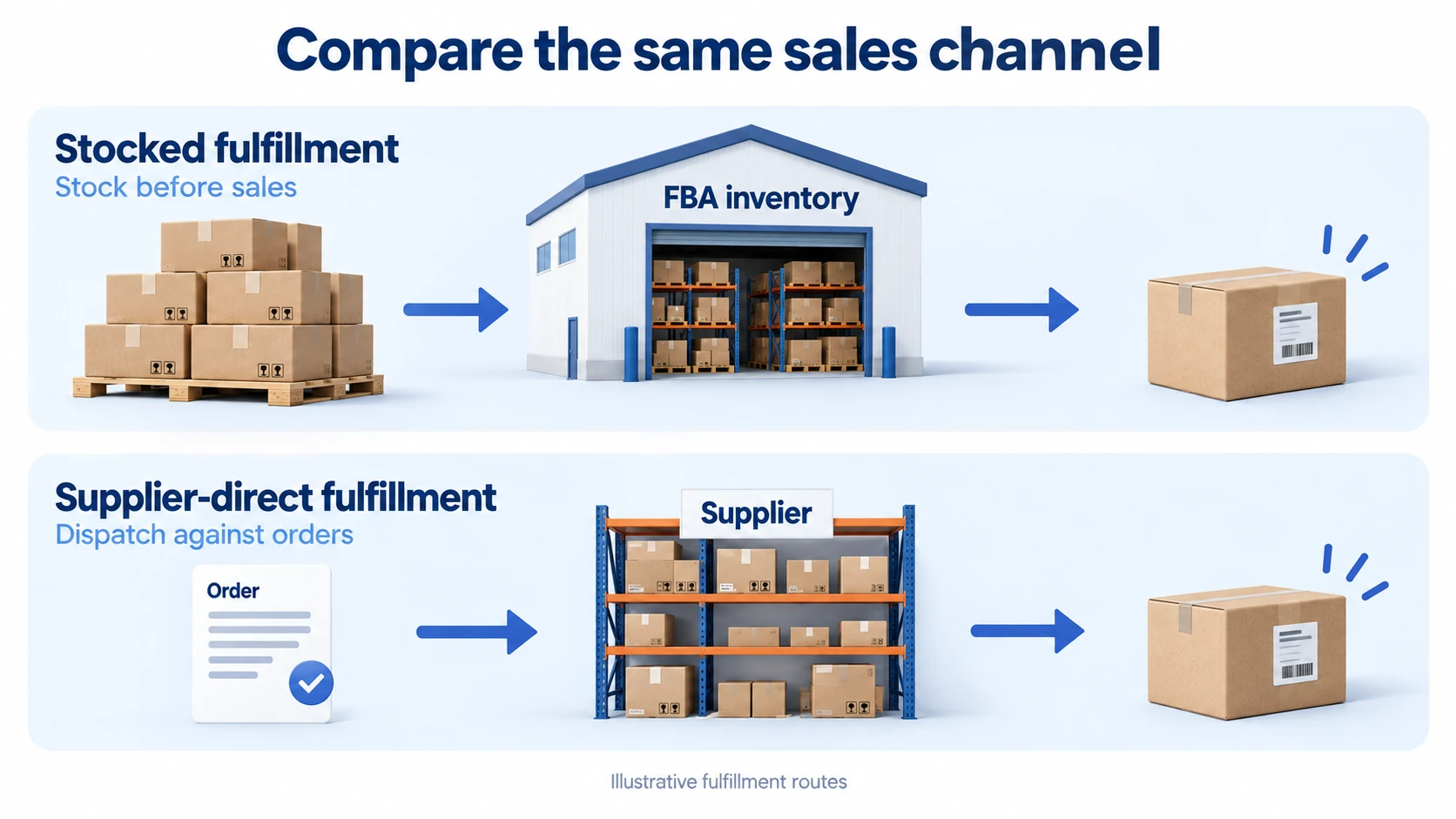
Choose Amazon FBA when an eligible product has enough expected demand to justify buying stock and sending it into Amazon’s fulfillment network. Choose dropshipping when limiting the initial stock purchase matters and a supplier can reliably fulfill the orders you accept. Compare the full costs and cash requirements for the same product and sales channel before deciding.
Neither method guarantees a profitable business. FBA changes where stock is held and who fulfills orders; dropshipping changes how you source and fulfill individual orders. Customer demand, selling price, advertising, product suitability and supplier quality still matter.
01
First separate the sales channel from fulfillment
There are three arrangements commonly mixed together in this comparison: selling on Amazon with FBA, selling on Amazon with a supplier fulfilling orders, and selling through your own store with a supplier fulfilling orders. The last option changes the sales channel as well as the fulfillment method.
An illustrative comparison has two decisions. First choose where the customer orders: Amazon or your own store. Then choose how the order is fulfilled: stocked inventory in Amazon’s network or an agreed supplier-direct route where applicable. Changing both decisions at once makes it harder to identify why the economics differ.
If you compare an FBA offer with a Shopify dropshipping store, include the different customer-acquisition and store costs. Amazon traffic is not a guarantee of sales, and an independent store does not receive customers merely because it exists.
For a cleaner fulfillment comparison, hold the marketplace, product, selling price and demand assumptions constant. Then change the sourcing, storage and dispatch costs. You can assess the independent-store alternative separately afterward.
02
What FBA and dropshipping actually change
With Fulfillment by Amazon, you send eligible inventory into Amazon’s network before those units are sold. Amazon stores and fulfills it, with customer service and returns handled under the program. You still need to source suitable goods and manage the commercial decisions around them.
In a supplier-direct arrangement, the supplier dispatches an individual customer order under the agreed process. You may avoid a large advance inventory purchase, but you depend on the source to have the right item and perform the promised service when an order arrives.
Inventory and cash commitment
FBA: you fund inventory, preparation and inbound movement before customer sales recover that cash. Unsold units remain a business problem even though they are stored elsewhere.
Dropshipping: the agreement may let you purchase against individual orders. You still need funds for supplier payments, shipping, refunds and other expenses before all customer proceeds are available to spend.
Physical fulfillment
FBA: the stock must be received and available in Amazon’s network before it can support the intended offer. Sending cartons is a separate event from having sellable inventory ready.
Dropshipping: supplier acceptance, picking and carrier handoff happen through the source’s operation. A transmitted order or created label does not by itself confirm that the correct parcel has entered the delivery network.
Product and customer responsibility
FBA: outsourced handling does not settle whether the product is appropriate, accurately described or profitable. Quality and replenishment decisions still need an owner.
Dropshipping on Amazon: you must meet the applicable seller and order requirements. The Amazon dropshipping guide explains the wider arrangement; a supplier’s willingness to ship does not itself establish that arrangement.
03
Compare the full cost of one delivered order
Start with a real product specification: dimensions, weight, quantity, category, destination and selling price. Use the same item in each calculation. A cheaper supplier variant or a different pack size can make a comparison look better without answering the original question.
Amazon provides tools for estimating fees and comparing fulfillment methods. Enter the relevant product details and your own costs, then retain the date and assumptions. An estimate is a planning input, not a promise about the final charges or sales.
For the stocked route, investigate:
- Product purchase and any preparation or labeling.
- Inbound freight and applicable placement or receiving-related costs.
- Fulfillment and storage charges for the actual item.
- Costs associated with returns and unsold or unsuitable inventory.
- Selling fees, advertising and your other operating expenses.
For the supplier-direct route, investigate:
- Per-unit product cost and order handling.
- Packaging or customer-facing paperwork work.
- Outbound shipping and destination-dependent charges.
- Supplier membership or automation costs.
- Returns, replacements, failed deliveries and support work.
- The same applicable selling and acquisition costs used in the other comparison.
Avoid counting the same expense twice. If inbound freight is included in landed product cost, do not deduct it again as a separate cost per sold unit. If a fixed monthly charge is already allocated to every order, do not subtract that same amount a second time from the monthly result.
04
A worked example: better contribution, larger cash commitment
The following numbers are deliberately hypothetical. They are not current Amazon rates, supplier quotes or an observed store result. They isolate how a fulfillment choice can improve contribution while increasing the amount of cash committed before sales.
Assume the same product sells on Amazon for $30. For the stocked route, suppose product cost is $8, preparation and inbound allocation total $2, and fulfillment costs $5. For the supplier-direct route, suppose product cost is $12 and dispatch costs $6. In both routes, assume $7 for the same selling and other variable costs.
The stocked route leaves $8 per sold unit: $30 minus $8, $2, $5 and $7. The supplier-direct route leaves $5: $30 minus $12, $6 and $7. The illustrative stocked advantage is $3 per sold unit before any costs excluded from these assumptions.
Now suppose the stocked arrangement requires 200 units at $8 each. That commits $1,600 to product inventory before sales, plus the relevant upfront preparation and freight payments. The $1,600 is the purchase of those units; it is not a second expense to subtract after already charging $8 for every unit sold.
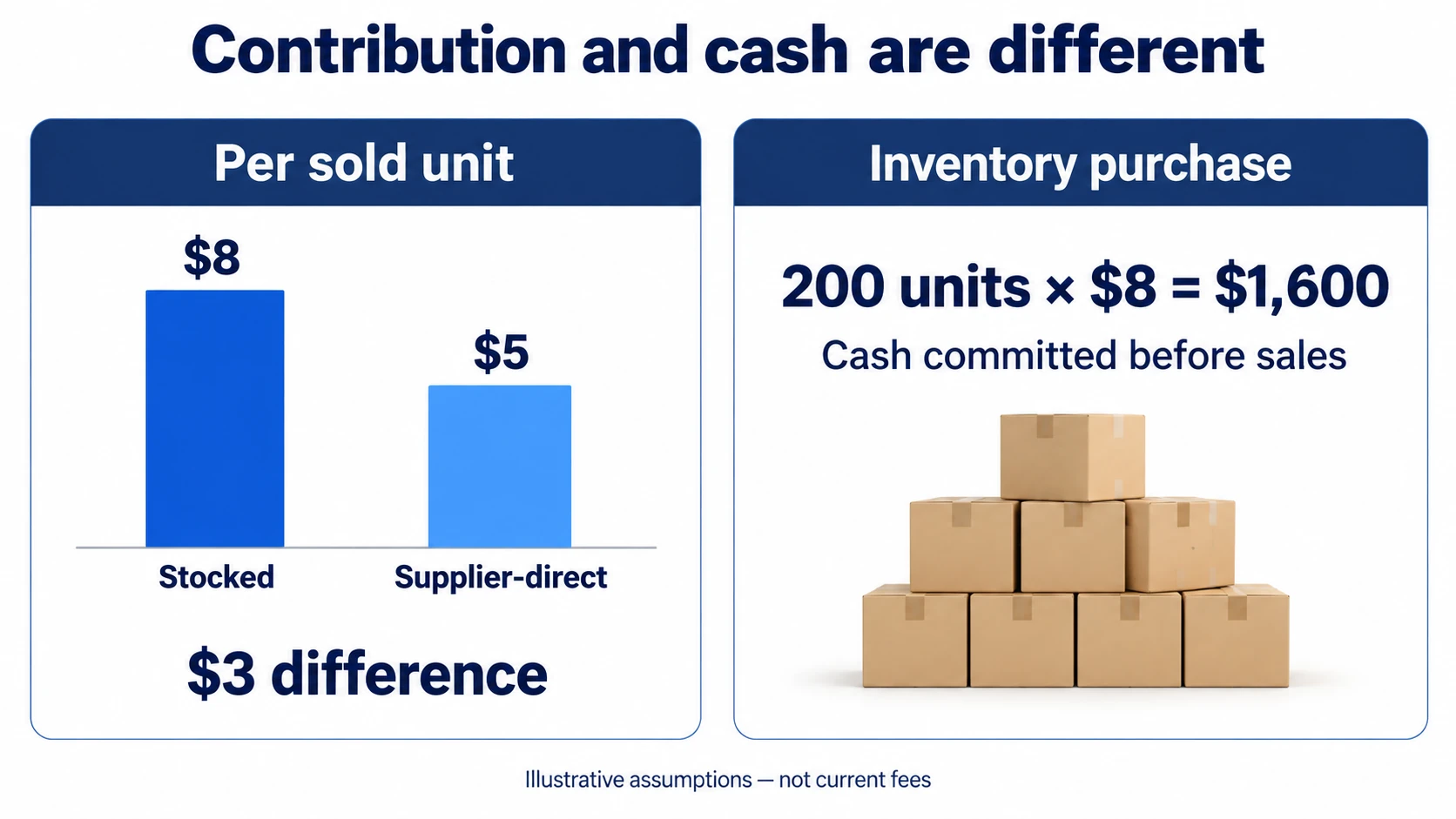
If the stocked route also adds $300 of incremental fixed costs for the comparison period, the $3 contribution advantage needs 100 sold units to cover that $300. At 60 sold units, the advantage is $180 before the fixed cost, leaving a $120 disadvantage. At 150 sold units, it is $450 before the fixed cost, leaving a $150 advantage.
That calculation answers an operating question. It does not tell you when all the inventory cash returns to the bank, how much the remaining stock can be recovered for, or what happens if the sales price falls. Those need separate assumptions.
Read contribution and cash together. The higher-contribution route may be attractive for a dependable seller and unaffordable for a business that also needs cash for its next replenishment, refunds and operating bills.
05
Test slower sales and a lower selling price
A forecast becomes more useful when it includes a disappointing outcome. Ask what happens if units sell more slowly, a competitor reduces the market price or a portion of stock cannot be sold in its original condition.
For stocked inventory, estimate how long the first purchase remains on hand under the slower scenario. Include the relevant carrying, storage and exit costs. Do not assume that every unsold unit will eventually sell at the original price.
For dropshipping, slower demand may reduce the number of units you buy, but it does not erase advertising experiments, subscriptions, sample costs or customer-service work. A route with little prepaid stock can still lose money.
Recalculate the same example with a lower price before making the inventory decision. A price reduction changes both routes’ contribution; it can make a previously comfortable stocked commitment much harder to recover. Use the actual fee behavior for your account rather than assuming every cost stays fixed when price changes.
Amazon’s Revenue Calculator guide explains how to compare scenarios using your price and cost inputs. Keep a separate cash forecast beside the calculation so that a positive estimated margin does not hide an upcoming payment shortfall.
06
Quality control happens before the fulfillment choice pays off
FBA can give you an opportunity to inspect and prepare a batch before sending it into the network. That opportunity is valuable only if somebody actually defines the product requirements and performs the appropriate checks.
A supplier-direct order may provide less opportunity for you to examine the exact unit before the customer receives it. Ask what the supplier checks, which defects it can identify and what evidence is available. A sample approved last month does not show that every later unit matches it.
In either route, specify the variant, pack quantity, accessories, labeling and condition. Establish how the source handles a batch change or substitution. If those details are unresolved, changing the fulfillment destination will not fix the product problem.
Also plan for a defect discovered after orders begin. Identify affected stock or orders, determine what must stop, and record the customer remedy and supplier investigation separately. Stocked and supplier-direct routes create different locations to investigate, but both require a response.
07
Delivery speed and returns depend on the actual arrangement
FBA provides access to Amazon’s fulfillment operation for eligible inventory. Its practical benefit depends on stock being ready in the network and the offer’s applicable service. A carton still in transit to a fulfillment center cannot support the same promise as available units.
Prime eligibility also belongs in this comparison. Amazon’s FBA overview identifies Prime delivery as a benefit for eligible FBA products. The badge and displayed delivery date change the offer customers compare, so a cost-only calculation can miss a reason to test FBA. Keep the inventory purchase in the cash model, and measure any change in conversion and contribution instead of assuming Prime will increase sales.
FBA is not the only route to Prime. In the U.S., Seller Fulfilled Prime requires prequalification, a successful trial and continued performance compliance. Supplier-direct fulfillment does not receive Prime status merely because the supplier promises fast shipping. Compare the eligibility and delivery promise available to your actual offer, including the operating cost of maintaining them.
Supplier-direct delivery depends on the dispatch location, handling process, carrier service and destination. A domestic supplier may offer a useful route; a cross-border route may have different constraints. Avoid assigning a universal delivery time to the word “dropshipping.”
Compare the complete customer journey:
- When is the order ready to fulfill?
- Who can confirm the correct unit was dispatched?
- What happens when tracking stops progressing?
- Where does a return go and who acts on it?
- Which costs remain with your business after the customer is refunded?
For FBA, understand the relevant return and inventory outcomes under the program. For supplier fulfillment, agree on the return address and reimbursement process before launching. A supplier’s internal decision time may be longer than the time you have to resolve the customer issue.
08
Which route fits a new or growing seller?
Consider FBA for a product you can fund and replenish
FBA may fit when the product is eligible, its demand evidence is credible, the full cost leaves enough contribution and you can carry the inventory commitment. You also need a supplier capable of replenishing the same specification rather than supplying one successful sample.
Start with the quantity your evidence and cash position support. A discount for a much larger order is not automatically a saving if it creates unsold stock. Include the next purchase in the cash plan; replenishment can be due before the first batch has fully paid you back.
Consider dropshipping for controlled tests or a suitable long tail
A supplier-direct route may fit products whose demand is still uncertain, provided the service and rules allow you to make a truthful offer. It can also be useful for selected slower sellers when buying a full batch would create an unattractive stock commitment.
The supplier still needs dependable availability, order acceptance and returns. Low initial inventory spending should not be used to justify an unqualified source. Keep the first catalog small enough to investigate actual fulfillment problems.
Delay either route when the product is unresolved
Neither method is ready when the listing does not match the goods, required information is missing or the economics work only by ignoring returns and acquisition costs. Resolve the product or change the proposal before choosing where it will be shipped from.
That is often a more useful decision than selecting a model because a general comparison calls it beginner-friendly.
09
Use a hybrid only when the transition is deliberate
You can assign different fulfillment methods to different products where the account and arrangements permit. Amazon’s own overview discusses combining dropshipping and FBA. The operational work is deciding which products belong in each route and keeping availability accurate.
A reasonable transition begins with observed demand and actual order costs, then checks whether a stocked batch would improve the result after its additional costs and cash commitment. Recheck the product specification and preparation requirements before sending the batch.
During the transition, track three quantities separately: supplier-available units, stock moving toward the fulfillment destination and units actually available there. Do not offer the same physical units twice or treat inbound stock as already ready.
Keep the customer promise tied to the route that will fulfill the order. If a backup source has a different handling time or product version, it is not an interchangeable fallback. Resolve those differences before switching orders.
Review the hybrid after enough real orders to understand its costs. Move a product because the evidence supports the change, not because reaching a particular sales milestone makes FBA mandatory.
10
Frequently asked questions
Is Amazon FBA more profitable than dropshipping?
It can be for a particular product and volume, but there is no universal result. Bulk sourcing and fulfillment costs may improve contribution, while storage, unsold units and the cash commitment can weaken the overall outcome. Compare the same product and channel with complete assumptions.
Is dropshipping the same as FBM?
No. Seller-fulfilled or merchant-fulfilled orders can be handled by your own operation or another agreed provider. Dropshipping is one possible supplier arrangement within that broader fulfillment context; not every seller-fulfilled order is dropshipped.
Can I start dropshipping with no money?
Avoid assuming that. Even without a large stock purchase, you may need to pay suppliers and shipping before proceeds are available, fund samples and software, and cover refunds or other expenses. Build a cash plan from the actual payment timing.
Does FBA remove the need to manage inventory?
It outsources physical storage and fulfillment under the program. You still need to decide what to buy, how much to replenish and what to do with slow or unsuitable stock.
Should I test with dropshipping and always move to FBA?
No. A test can provide useful demand and order evidence, but the stocked route still needs its own eligibility, cost and cash evaluation. Some products may remain better suited to the original arrangement, while others may not be worth continuing at all.