

When a dropshipping parcel appears lost, identify the affected items and the last reliable shipment event, open the appropriate trace, and arrange the customer’s remedy under the original promise and applicable rights. Keep the supplier or carrier claim separate from that customer decision. A tracking gap alone does not establish loss, and a claim reference does not resolve the order.
Follow the parcel and the customer commitment at the same time. Someone needs to find out where the goods went; someone also needs to decide what the buyer can expect next. Assign both actions instead of repeatedly sending the same tracking link.
The dropshipping tracking guide explains the underlying events and handoffs. This guide addresses the point where those events no longer give the customer a dependable answer.
01
Confirm which parcel and items are missing
Start with the order line, variant, quantity and destination. Match them to the supplier purchase and parcel reference. A single customer order can contain several parcels, and an integration can attach more than one tracking number over time. Do not assume the first number shown belongs to every item in the basket.
Ask the buyer what has arrived. If a bottle arrived but the separate replacement lid did not, the problem concerns the lid’s parcel. A message marking the entire order delivered can conceal that distinction. Conversely, a lid packed with the bottle but missing on opening requires a missing-contents investigation, not a search for a second parcel that never existed.
Keep an incident record with the store order, affected lines, supplier reference, original and final-mile tracking numbers, destination, promised dates, last verified event and customer report. Include the person handling the trace, the person authorizing the remedy, and the next update time.
Preserve the event text and its source. An app’s summary such as “in transit” can hide whether the carrier has the parcel or only shipment information. Check the carrier’s own record where available and ask the provider to explain conflicting statuses.
02
Start from the last reliable event
A label exists, but acceptance is unconfirmed
Ask the supplier or warehouse for physical handoff evidence and the collection reference. The parcel may still be awaiting packing, pickup or a valid booking. It may also have moved without the event being synchronized; investigate that possibility instead of assuming either delivery or loss.
UPS distinguishes label creation from possession: a label-created status reflects received shipment details, while possession and movement are later events. Apply the actual carrier’s definitions to the order.
If the parcel is located at the warehouse, arrange a supported dispatch plan and address any missed promise. Do not open a transit-loss claim merely to describe an order that was never handed over. Correct the fulfillment status so the customer does not continue receiving misleading transport updates.
The parcel was accepted, but updates have stopped
Check the service, route, last scan, expected delivery range and known exception messages. Long-distance movement can occur without frequent scans; UPS’s tracking explanation explicitly notes that some shipments may not be scanned again until a destination hub. An absent scan is missing information, not proof that the package stayed still.
Compare the gap with the service’s normal event pattern and the actual customer deadline. Contact the carrier or account holder when the trace process allows it. Record what triggered the investigation: missed expected delivery, an unexplained exception, or another stated condition.
Avoid resetting the customer’s waiting period every time a supplier replies “please wait.” A new message should add verified information or a decision. If there is no reliable revised date, say that and determine the applicable next action.
The parcel is at a pickup point or an attempted delivery failed
Confirm the collection location, access instructions, any reference required and the carrier’s actual collection deadline. Verify that the customer received the notice through a reliable channel. A ready-for-collection event is different from receipt by the buyer.
For a failed delivery, establish the reason before assigning responsibility. An incomplete address, access problem, unavailable recipient and carrier mistake require different fixes. Ask only for the information needed to arrange the next attempt or other appropriate resolution.
Tracking says delivered, but the customer has not received it
Check the recorded date, location, delivery evidence and address against the order. Ask the customer to check a stated safe place, reception or another household recipient where relevant and practical. Do not ask them to search unfamiliar properties or confront strangers.
Open a delivery enquiry when the evidence does not resolve the discrepancy. A scan can be useful evidence without proving that this particular buyer received the goods. Keep “delivered, receipt disputed” separate from an ordinary in-transit delay in your case record.
03
Open a trace with enough identifying information
Identify who owns the shipping account. Your supplier or agent may be able to see details, raise enquiries or submit documents that the store cannot access directly. Agree who sends the request and who monitors replies; avoid several parties opening disconnected cases for the same parcel.
For the trace, prepare the sender and recipient information, tracking references, mailing or handoff date, parcel description, contents and any identification that could help locate the item. Share customer information through an appropriate support channel and only with the parties that need it.
USPS’s missing-mail process starts with checking tracking and describes the information needed for a search. It currently permits a Missing Mail search request starting seven days from mailing. That is a USPS search condition, not a worldwide definition of loss or a mandatory seven-day wait before helping a customer.
An illustrative trace might identify one kraft carton containing a navy pouch, connect it to the original tracking number and a final-mile reference, and preserve the last verified acceptance event. Matching those identifiers is more useful than forwarding a screenshot that says only “package missing.”

Request a useful response from the account holder
Ask for the enquiry reference, what information was submitted, any response deadline and the next action if the carrier does not answer. “We contacted logistics” does not tell support whether the case exists or when to follow up.
If a request cannot be filed, record the reason. It may be too early under that service’s process, the wrong account may be attempting it, or the required shipment detail may be absent. Resolve that specific gap and keep the customer decision moving on its own timeline.
Do not change the parcel’s recorded status to “confirmed lost” until the available evidence supports that statement. A customer can need a remedy before a carrier has formally concluded its investigation. Preserve the distinction rather than changing the facts to fit an internal workflow.
04
Decide what the customer is entitled to next
Look at the original delivery promise, what is now known, the buyer’s circumstances and applicable rules. Determine whether a supported further wait, replacement, cancellation or refund is appropriate. A supplier reimbursement condition cannot automatically replace the customer’s rights against the store.
For EU consumer orders, Your Europe describes delivery obligations and late-delivery remedies, including additional delivery time in many circumstances and exceptions where that is unnecessary. Apply the relevant conditions to the transaction rather than treating every delayed parcel identically.
If the goods were never shipped, a different obligation may be relevant. The US FTC prompt-delivery guidance concerns shipment promises and required delay handling. Do not use a pre-shipment rule as if it were a universal carrier-loss deadline.
Waiting needs a supported plan
Explain the reliable information available, the expected next event and when you will update the buyer. If no delivery date is supportable, do not invent one to make the reply sound complete. Check what consent or other handling the actual circumstances require.
An investigation update might say: “We have confirmed that [carrier] accepted the parcel on [date], but we do not yet have a reliable delivery date. We opened enquiry [reference]. We will contact you by [date/time] with the result or the next available resolution.” Add the customer’s actual options; this is not a complete legal notice for every market.
A replacement needs its own checks
Confirm the item, variant, quantity, destination, stock and delivery plan. If a gift date has passed or the customer has already chosen a refund, another parcel may not meet the agreed outcome. Obtain any necessary agreement before release.
Link the replacement to the original order and case. Give it a distinct shipment reference, mark it as a replacement rather than another sale, and ensure only one team can authorize dispatch. Ask whether interception or return of the original is possible, but do not promise either until the provider confirms it.
A refund needs completion evidence
Record the affected lines, amount and relevant treatment of shipping and tax. Coordinate with the payment process and stop any incompatible replacement instruction. Tell the buyer what has actually been processed and the relevant payment-status information, rather than calling an internal approval a completed refund.
Use the returns guide for the broader refund and replacement process. A physical return cannot be the automatic prerequisite for resolving goods the customer never received.
05
Handle the original parcel if it reappears
Resolve this branch before it creates a second problem. A parcel can arrive after a replacement was dispatched or a refund was completed. Keep the original tracking active in the case so support notices the event.
If the customer now has both items, explain the appropriate next step under the transaction and applicable rights. Where a return is agreed or required, supply an authorized destination and practical instructions. Do not impose an unexpected charge simply because the carrier recovered a parcel later.
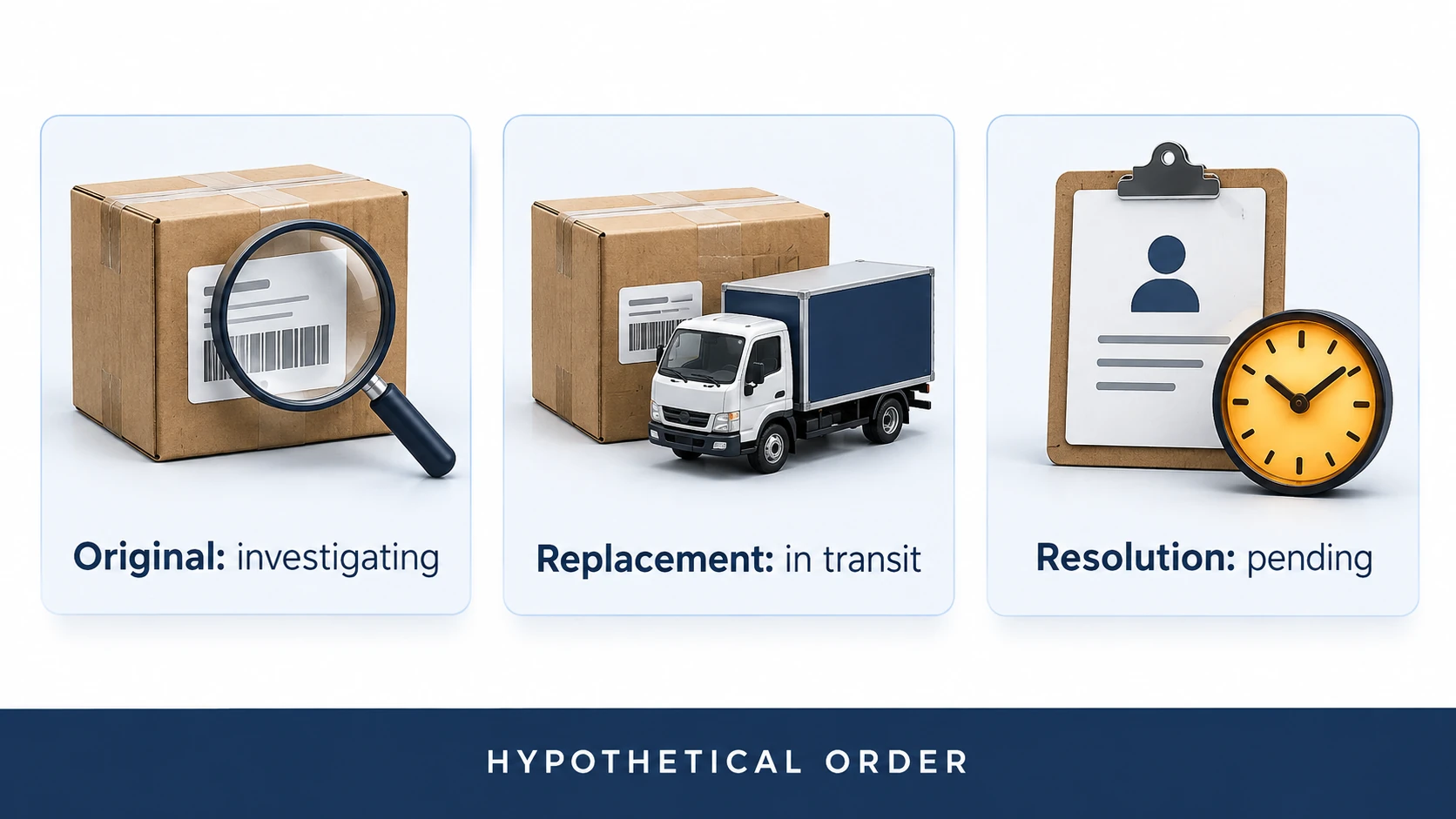
For example, a hypothetical order can have three separate records: the original parcel under investigation, a replacement parcel in transit and the customer resolution still awaiting completion. If the original arrives, update that record before deciding whether the replacement can be stopped. One order-status field cannot safely replace all three records.
If a carrier or supplier later pays a claim on a parcel that has been recovered, notify the relevant party and follow the applicable adjustment process. Keep the recovery truthful; do not silently retain contradictory claim facts or count the same lost item twice.
06
Recover costs without hiding the customer’s case
Check the supplier agreement, carrier service and any coverage purchased. Establish which costs a successful claim could recover and what evidence it requires. Product cost, retail value, shipping charge and declared value are not automatically the same amount.
UPS’s claim guidance explains the role of tracking, proof of value and the shipper’s account. Account restrictions and country-specific conditions can affect how a claim is made. Keep the relevant current terms with the shipment rather than copying one carrier’s deadline into every case.
Ask whether an approved supplier recovery is a cash refund, credit for future orders or replacement goods. Record the value and timing accurately. A promise of account credit cannot fund a refund from today’s bank balance.
A replacement-cost example
Assume a hypothetical $40 sale originally incurred $14 product cost, $6 shipping and $2 payment fees. Ignoring tax and overhead, the original contribution was $40 − $14 − $6 − $2 = $18.
If the agreed solution is a replacement costing another $14 plus $6 shipping, contribution becomes −$2 before any recovery. If a $10 supplier credit is subsequently confirmed, contribution becomes $8. An unapproved claim should remain a separate expected or disputed amount, not be counted as completed recovery.
If the solution instead is a full $40 refund with original costs still incurred, the result is $18 − $40 = −$22 before recovery. These are separate invented scenarios. Do not add replacement costs to the refund scenario unless both actually happened, and do not choose a remedy solely because one scenario costs less.
07
Close the incident only when the promised actions finish
Track customer resolution, parcel investigation and financial recovery independently. The buyer may be resolved while the carrier claim remains open; the carrier may close a trace while the refund is still unfinished. Neither should conceal the other.
For customer closure, retain the refund confirmation or replacement delivery evidence and the relevant conversation. For the trace, retain the outcome and any recovered-parcel instructions. For recovery, retain the actual payment, credit or denial, plus any justified follow-up.
Review open cases by the next promised action and age, not only the most recently received message. A quiet case can still be overdue. Give each unresolved record an owner and escalate before a customer or claim deadline is missed.
If a customer challenges the resolution, return to the relevant evidence rather than sending the same closure template. Check whether the issue is a missing refund, a replacement not received, or a disagreement about the original facts. Reopen the appropriate action without losing its earlier history.
08
Reduce repeat losses and prevent false alarms
Group incidents by supplier, dispatch location, carrier service, destination and parcel configuration. Distinguish confirmed losses from delays, collection failures and disputed delivery. Combining them into one “lost rate” can point the team toward the wrong repair.
For a hypothetical group of 500 dispatched orders, five confirmed lost orders would equal 1%. If another ten are still being traced, report those ten separately. It is premature to claim a final 1% loss rate for the whole group while those outcomes remain unknown. State whether your denominator is orders or parcels, especially when some orders split.
Use the failures to choose a concrete action: verify physical handoff, improve label readability, correct address validation, review a weak route or clarify collection notices. An extra tracking email does not repair an unreadable label or a missed pickup.
Check that the fix reaches an ordinary new order. The operations section of the Dropshipping Hub connects tracking with fulfillment, inventory and customer outcomes. Better visibility helps most when it leads to a specific action before the buyer has to ask again.
09
Frequently asked questions
How many days without tracking means a package is lost?
There is no universal number. Check acceptance, service expectations, the last event and that carrier’s trace rules. Keep the customer promise and applicable remedy timeline separate from the carrier’s investigation schedule.
Should I refund only after the carrier pays me?
Do not make that your universal rule. Determine and meet the customer’s applicable remedy independently. Pursue supplier or carrier recovery through the relevant agreement and evidence.
What if tracking says delivered?
Check the delivery evidence, address, possible recipient and item-to-parcel mapping. Investigate a genuine discrepancy rather than treating either the scan or the complaint as conclusive on its own.
What if the original arrives after a replacement?
Update both shipment records, check whether any movement can be stopped, and agree the appropriate customer handling. Correct the claim if recovery changes the facts, and avoid unexpected duplicate charges.