
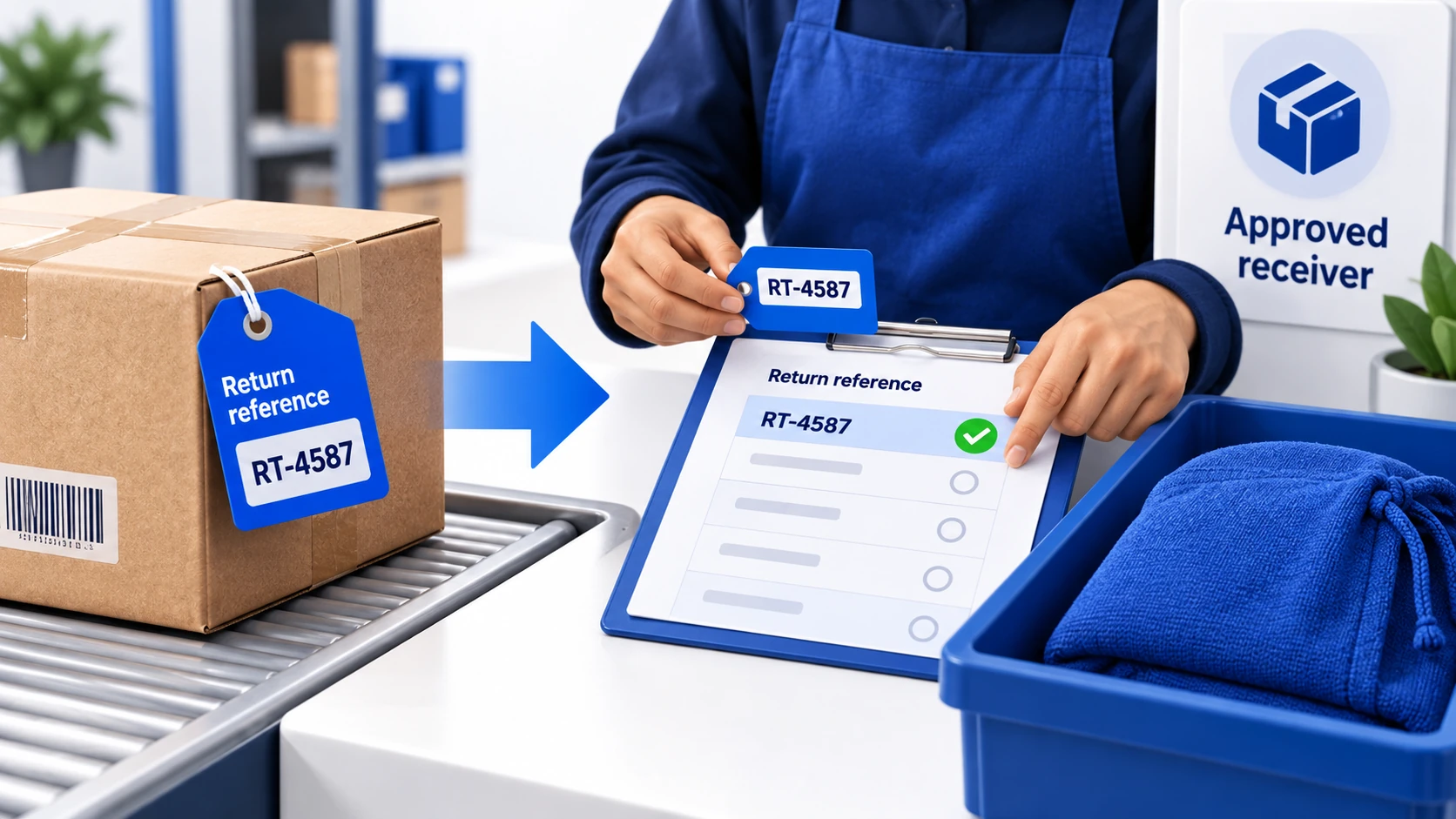
A dropshipping return address should belong to a receiver that has agreed to accept and process that particular item. It can be your supplier’s approved facility, your own suitable premises, or a contracted returns provider. Confirm the destination, return reference, costs and next action before telling the customer to ship anything.
An address is only useful when someone can connect the arriving parcel to the customer’s order. A building that accepts deliveries but cannot identify, inspect or report the goods can leave you paying for transport while the refund case remains unresolved.
Choose the destination alongside your dropshipping returns process. That wider process determines the customer’s options; this guide explains where an authorized return should go and how to make that movement work.
01
Separate the addresses attached to your business
Your registered business address, dispatch address and authorized return address can be different. The registered address identifies the business. A dispatch address describes where outbound goods enter a shipping process. A return address identifies the party expected to receive a specific parcel and perform the agreed work.
The address printed on the original shipping label may serve a carrier’s undeliverable-parcel process. It does not establish that the same facility accepts customer returns, recognizes your store’s orders or issues supplier credits. Ask the provider before using it in instructions.
Similarly, do not copy a warehouse address from a supplier’s website, a verification document or another merchant’s guide. Permission to describe a business location is different from permission to send customers’ goods there. A supplier might receive its own products at one site and route inspected returns to another.
For AIDrop Agent, a published business or warehouse location should not be treated as an automatic return destination. Obtain instructions for the specific order and agreed service before arranging a shipment. The examples here do not authorize returns to any AIDrop facility.
A simple way to expose the difference
Imagine a parcel arrives at the right street address with no return reference. Reception signs for it, but the returns team does not know the store, order or item. The carrier has evidence of delivery to the building; the merchant still has no confirmation of what was received. An approved destination needs both a physical receiving point and a way to identify the return.
That distinction should appear in your internal records. Keep the legal contact address where it belongs, the dispatch location with shipping settings, and the authorized return destination with the relevant return. Avoid using one general address field to perform all three jobs.
02
Choose the receiving option for the work required
Start with the expected action after arrival. Does the item need inspection for a supplier claim, refurbishment, local resale, consolidation, or controlled disposal? A nearby address can be convenient for the customer while still being the wrong place for that work.
Return directly to an approved supplier facility
This can fit when the supplier accepts that item and return reason, can match your reference, and needs the goods to inspect or recover value. Obtain approval before sending a label. Specify whether the supplier will issue a refund, account credit, replacement, repair assessment or merely a receiving report.
Check the conditions behind acceptance: supported products, required accessories, who pays transport, any inspection charge, and the handling of an item the supplier disputes. Ask what happens if a parcel arrives after an operational deadline or with a missing reference. The supplier’s commercial conditions still need to be considered separately from the remedy owed to your customer.
Direct return becomes less attractive when cross-border transport is expensive, the supplier cannot identify consumer parcels, or its acceptance decision remains vague. “Send it to us and we will see” gives the buyer a destination without giving the merchant a dependable outcome.
Receive returns at your own suitable premises
This gives you direct access to the item and may work at modest volume if the premises can safely receive, store and inspect it. Account for receiving hours, parcel security, staff time and the space needed to keep unidentified or damaged goods separate from saleable stock.
Your own address also creates practical obligations. Someone must notice a delivery, match it to the order and report its condition. A parcel left unopened for a week can be just as difficult for support as one lost in a distant warehouse.
Do not use a residential address casually if privacy or tenancy conditions make it unsuitable. A mailbox or virtual-office service may have restrictions on parcels, storage, inspections or product types. Verify the actual service; a postal address alone does not supply returns handling.
Use a local returns provider or 3PL
A contracted provider can give customers a nearer destination and perform defined receiving work. Ask precisely which work the fee buys. Scanning a label, photographing contents, testing a product, repacking it and reselling it are separate activities.
Confirm how the provider reports exceptions, whether it supports your products, and who owns the goods while stored. Establish the fee for unidentified parcels, long storage, additional photographs, disposal and forwarding. If goods will eventually go back to the supplier, include that second movement in the plan.
A local return location does not prove that orders ship locally or that your business has a local operating entity. Describe it accurately in the customer journey. If the service only consolidates goods, do not present it as a repair center.
Resolve an eligible case without physical return
Sometimes the appropriate customer resolution does not require moving the item. Consider this when the applicable remedy, product condition, supplier arrangement and recovery economics support it. Record who approved the decision and whether the customer should retain the item or await further instructions.
Do not turn that option into a universal promise. An item may be needed for inspection, contain a safety hazard, or require a specific disposal route. For damage cases, use the damaged-item workflow before telling someone to repack, use or discard the goods.
03
Compare the additional costs of a return
Choose among workable options after establishing what the customer is entitled to. The cheapest handling route cannot justify withholding a required remedy. Within that boundary, compare the costs and recovery attached to each physical movement.
Include the return label, receipt and identification, inspection, storage, forwarding, repacking, and any import-related charges. Distinguish the amount you can recover from an optimistic resale listing price. An opened item may be worth less, and its resale may require checks or work.
A bounded return-versus-recovery calculation
Suppose a hypothetical returned item would yield $18 after any resale fee, assuming it is confirmed saleable. A local route costs $6 for the label, $3 for receiving and $2 for inspection. The additional recovery after those costs is $18 − $6 − $3 − $2 = $7, before any omitted storage, tax or other costs.
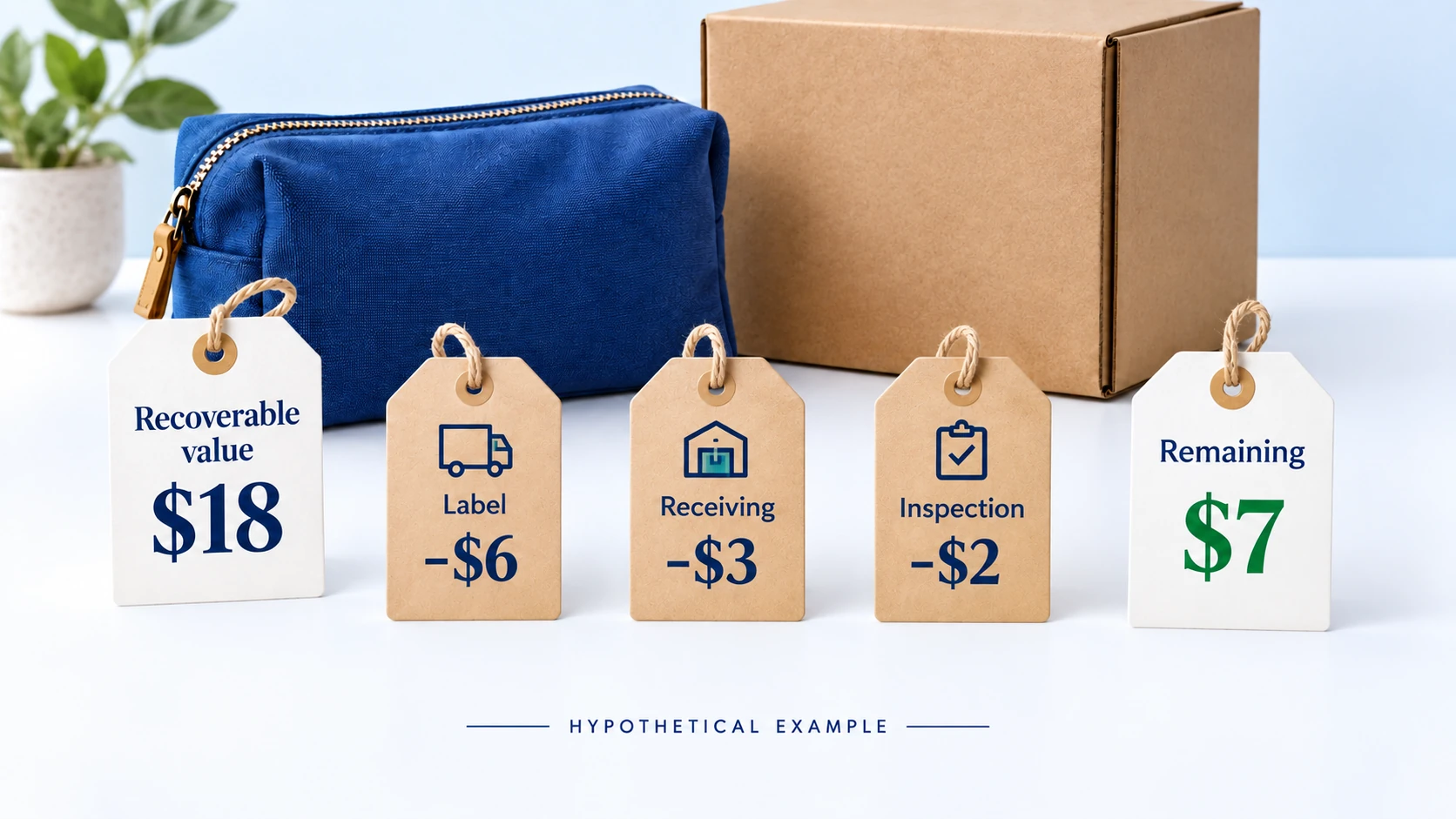
Suppose sending the same item to its supplier instead would generate a confirmed $14 credit, with $16 return transport and $2 handling. That route has an additional recovery of $14 − $16 − $2 = −$4. Under those assumptions, local handling is $11 better. These invented amounts are not supplier quotes or AIDrop rates.
Now change one assumption: only half of comparable returned units prove saleable, with the others recovering nothing. Expected recovery before handling is 50% × $18 = $9. Against the same $11 local cost, the result is −$2. That illustrates why inspecting the actual product and using realistic recovery assumptions matters; it does not establish a measured resale probability.
The customer’s refund is excluded from this comparison because it is assumed to be the same under both options. If the customer outcomes differ, establish which are permitted and agreed before comparing cash. Also keep cash and account credit separate: a supplier credit that can only offset future purchases does not immediately fund a customer refund.
04
Get receiving approval before issuing instructions
Create a return authorization that the receiver can use. It need not be a complex system, but it should connect the order line, customer instruction and inbound parcel. A return merchandise authorization number, often shortened to RMA, is one way to make that connection.
Before release, confirm:
- The merchant, customer order, affected item and quantity.
- The receiver’s legal or trading name, complete address and contact details required for the shipment.
- A return reference and exactly where it should appear.
- The accepted product condition and any accessories to include.
- The shipping method, label payer and any operational dispatch deadline.
- The receiving report, inspection scope and next decision expected after arrival.
Confirm the country and postal code explicitly. An otherwise correct business name can exist at several locations. For an international destination, ask the receiver how its address should appear on the label and which contact details are necessary; avoid manually abbreviating unfamiliar address elements.
Agree on the receiving report
For an ordinary return, a useful report records arrival date, parcel reference, item identity, quantity, visible condition and any discrepancy. Ask whether the team can provide photographs when identity or damage is disputed. Define what inspection actually covers rather than treating “checked” as proof of complete functionality.
Agree how quickly the receiver normally sends that report and who is notified when it is late. Set this operational target from the service you have contracted, while preserving any earlier customer deadline that applies. Do not promise a two-day inspection simply because it sounds reasonable in a policy template.
Keep unmatched goods in a separate receiving status. “Received, identity unresolved” is more accurate than “completed” when the outer label arrived but the contents have not been matched. Escalate the missing information without silently adding unidentified goods to saleable inventory.
05
Give the customer one clear set of instructions
An approved return should leave the buyer knowing what to send, where to send it, how to identify it and what happens next. Send instructions through the existing order conversation so the customer can connect them to the purchase.
An adaptable message could read:
We have arranged the return of [item and quantity] from order [number]. Please use [provided label or approved method] for [confirmed receiver and complete address]. Include return reference [reference] in the location shown in the instructions. Send [specified accessories] with the item. We will [explain the next update and applicable refund or replacement process]. Contact [support channel] if you cannot use this method before buying another label.
Add only the fields that fit the order, and replace every bracket before sending. Explain any customer-paid postage accurately and in advance where required. If you supply a prepaid label, make clear whether it covers the entire return or only one parcel.
Ask the buyer to retain the dispatch receipt or tracking reference. This can help trace a missing parcel, but do not create a blanket rule that only one form of proof can ever support a customer claim. Handle missing paperwork according to the actual facts and applicable rights.
Multi-item orders need item-level instructions
Two products bought together may belong at different receiving locations. Avoid sending one generic label for the whole basket unless the receiver has agreed to accept both. If separate parcels are needed, explain the division and costs before asking the customer to pack them.
For a bundle, identify whether all components need to return or only the affected part. A warehouse receiving an incomplete kit needs to know whether that was authorized. Otherwise an agreed partial return can be wrongly reported as missing contents.
06
Make the platform use the approved destination
After confirming the real receiving process, check the return app or store settings. Saved locations and default labels can continue pointing to an old warehouse even after support starts emailing a new address.
Shopify’s return-label guidance explains selecting a saved return location. Its documented native return-label service has eligibility limits, including US address requirements; it is not a universal international-label generator. Check the current route and carrier support before promising that a label can be created in the admin.
Shopify also documents return-rule settings separately from the written policy. Check both. A fee configured in software or an item marked final sale does not, by itself, establish that the treatment is valid for every market or defect.
Test the process using a representative fulfilled order in an appropriate test setup. Inspect the displayed destination, item quantity, return reference, customer message and fee. Check a second case from another supplier if its routing differs. Stop before sending a real customer a test instruction or purchasing an unnecessary label.
07
Handle cross-border returns as a separate shipment
A return crossing a border needs a supported service and accurate shipment information. Ask the carrier or qualified customs contact what description, value, references and documents the route requires. Identify who handles clearance and any import request at the receiving end.
Do not assume that marking a parcel “return” automatically removes duties or paperwork. Do not describe a commercial return as a gift or invent a zero value to avoid a charge. Keep the original order and export references available where the relevant procedure needs them.
Before giving the buyer an overseas address, establish whether they can use the proposed service and whether the receiver will accept delivery. A low-value item should not spend weeks moving toward a facility that will refuse an import payment or reject an unrecognized return.
Customer rights also depend on the transaction and jurisdiction. UK government guidance distinguishes faulty goods and distance-selling cancellations. Your policy must not compress every return into the supplier’s commercial window. Determine the actual customer’s remedy and timing independently of whether a foreign supplier has approved reimbursement.
08
Resolve routing failures without sending the buyer in circles
The customer used the original label address
First find the parcel. Ask for the tracking reference, destination used and dispatch evidence, then contact the party responsible for that location. Explain the situation without promising recovery you have not confirmed. If your own instructions were inconsistent, correct them and account for the resulting cost when deciding the resolution.
The receiver refuses or cannot identify the parcel
Check the authorization, address version, parcel reference and accepted product scope. Ask whether the problem can be resolved before another movement is arranged. Do not immediately tell the customer to buy another international label while the first parcel’s location remains uncertain.
Tracking says delivered, but inspection is missing
Use the delivery evidence to open a receiving enquiry. Ask which team took possession and whether the parcel sits among unidentified goods. Keep the customer updated under the applicable timeline. A warehouse backlog does not automatically extend the merchant’s obligations.
The address changes while returns are in transit
Keep the old receiving route operational for the returns already authorized, or agree a traceable forwarding arrangement. Record which address version each customer received. Update new labels and messages together, then track the outstanding old-address parcels individually.
09
Close the goods movement and the customer case separately
Receiving, inspection, customer refund and supplier credit are different events. Record each when it actually happens. A warehouse scan should not automatically restock an item still awaiting inspection; a supplier’s promise to issue credit should not be marked as cash received.
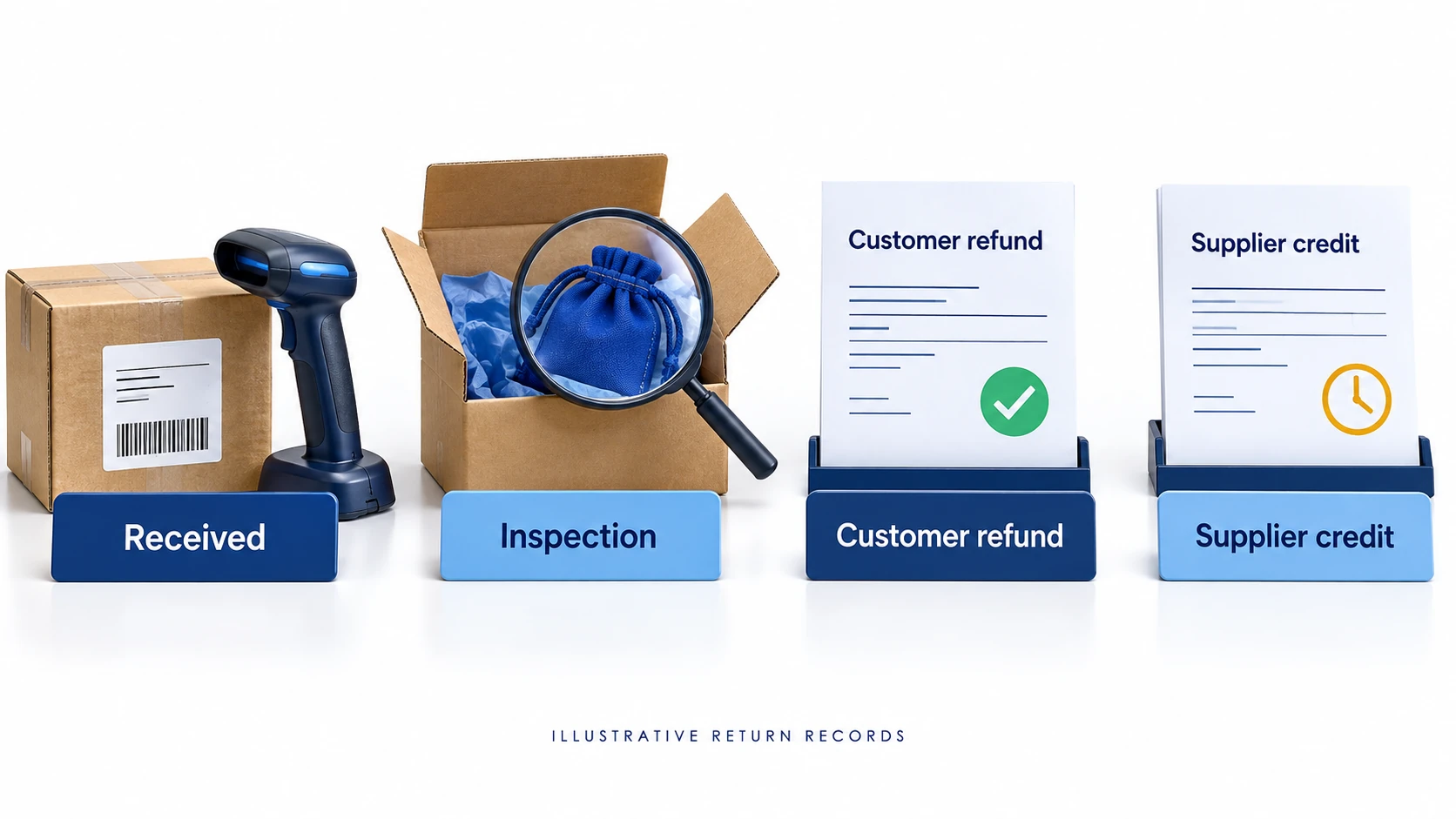
For example, a returned pouch can be received on Monday, identified on Tuesday, and approved for local resale on Wednesday. The customer’s refund may follow a different applicable timetable, while a supplier credit is still disputed. One “return complete” checkbox cannot accurately describe all of those states.
Reconcile open returns regularly: instructions issued but no known dispatch; parcels moving; delivered parcels awaiting identification; inspected items awaiting disposition; refunds unfinished; and supplier credits still open. Assign the next action to the party able to complete it.
The operations section of the Dropshipping Hub connects returns with fulfillment, tracking and inventory. A dependable return address is one part of that operation: the customer can reach it, the receiver knows what to do, and the merchant can see the result.
10
Frequently asked questions
Can I use my supplier’s address without asking?
No. Confirm that the location accepts your item, return reason and reference, and establish the resulting action. A dispatch address or published company location does not prove return authorization.
Do I need a local return warehouse immediately?
Choose from your actual markets, products, customer obligations and receiving workload. A local provider may reduce transport distance, but its fees and handling scope still need to work. There is no universal order-count threshold that makes one necessary.
Can I give customers a PO box or virtual address?
Only if the provider and carrier support the parcels and required work. Check size, product restrictions, receiving, storage and identification. A mail-forwarding service should not be described as an inspection or repair facility unless it supplies that service. For Shopify’s native return-label tool specifically, the documented address requirements require a valid US street address and exclude PO boxes as return addresses.
Should every return wait for inspection before a refund?
Do not apply a universal rule. Refund timing depends on the reason, transaction and applicable rights. Build the receiving process around those obligations rather than assuming a supplier’s inspection delay controls the customer outcome.