

Dropshipping samples are physical products you order to assess an offer before relying on it for customer sales. Order identified variants that cover the important differences, check them against written requirements, and record what passed or failed. Approve the specific reference and scope you examined; one good sample does not approve every future unit or establish legal compliance.
A useful sample order answers a question: whether a zipper works reliably in ordinary use, whether the supplied size matches the listing, whether the printed design is readable, or whether the parcel arrives with the correct accessories. Buying an attractive example without deciding what to check leaves much of that work undone.
Sample approval becomes one input to the wider dropshipping quality control process. It creates a reference for later checks; it does not replace them.
01
Decide what the sample must prove
Write down the decision that the sample will support before ordering. Choosing between two suppliers, approving a new material and checking customer delivery are different tasks. They may require different units and shipping routes.
Product suitability
Check whether the item performs the ordinary job described in your proposed offer. Identify the required dimensions, materials, included parts, finish and functions. Match those requirements to the customer’s likely use, rather than to whatever features the supplier happens to photograph.
If your product research found complaints about missing accessories or an awkward closure, include those points in the sample check. The research tells you where uncertainty matters; the physical item lets you investigate it.
Customization approval
A customized sample can establish an agreed print, color, placement, material or packaging configuration. Ask whether it uses the intended production process and components. A hand-finished presentation sample may show design intent without demonstrating what the ordinary production run will look like.
Fulfillment observation
A sample sent through the proposed customer route lets you observe processing, packing, tracking and delivery for that order. A sample couriered directly from a sales representative may be useful for product review, but it does not test the normal warehouse workflow.
Label the purpose of each order. If you need both a design sample and a normal-route shipment, request them separately rather than assuming one parcel proves both.
02
Choose variants by the differences that matter
There is no universal number of samples that makes a dropshipping product ready. Coverage should follow the differences that could change the result: construction, size, material, color treatment, accessory set, supplier or fulfillment source.
Start with a short list of distinct risks. Two colors might share construction but use different surface finishes. Two sizes might use different patterns or fittings. A bundle may introduce a packing error that cannot occur in a single-item order.
Cover differences before buying duplicates
Choose examples that expose the relevant variation. For a simple organizer sold in two sizes, check both sizes if capacity or dimensions are part of the offer. If a darker fabric creates a different print result, include that color instead of checking only the easiest light background.
Do not automatically extrapolate from one supplier to another selling a similar-looking item. Preserve the supplier and product identity in the record. If two listings come from an unknown common source, that uncertainty is a reason to verify the actual items, not evidence that they are interchangeable.
Use repeats to investigate consistency
Repeated units of the same variant can reveal visible inconsistency between the items you receive. They are especially useful after an earlier defect or when a feature is difficult to make consistently. A later ordinary order can also show whether the reference remains reproducible.
A few repeats do not support a reliable population defect rate. If all three units pass, the finding is that those three units passed the stated checks. Avoid converting that result into “100% quality” or a claim that an entire lot has been inspected.
A six-unit plan and its budget
Suppose you are evaluating an organizer in two colors and two sizes. An illustrative first plan orders one of each combination, then two more of the variant whose closure needs closer investigation. That is six units: four for variant coverage and two additional repeats.
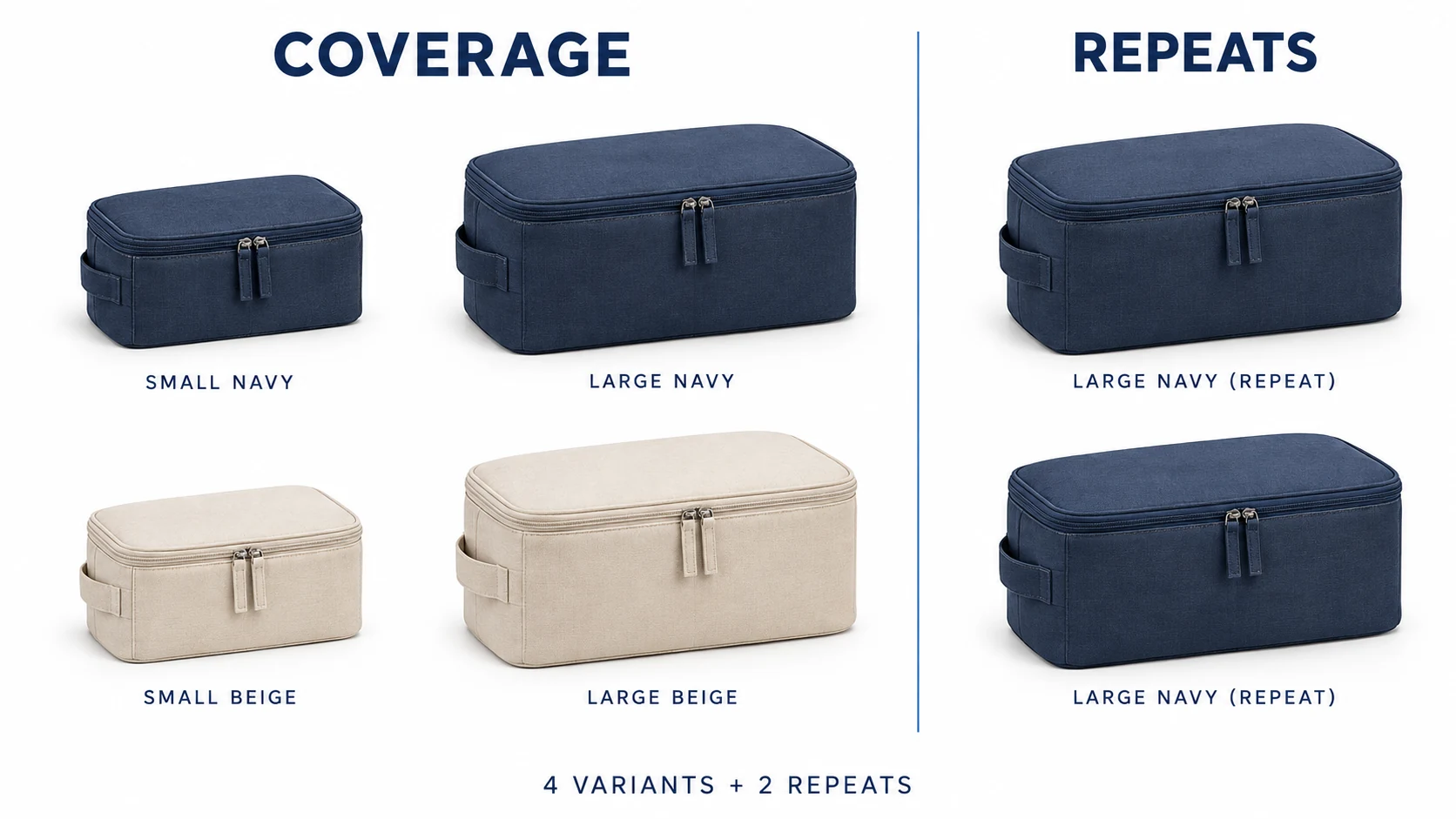
At a hypothetical $18 per unit, the products cost $108. Add $54 freight and $18 in other quoted charges for a $180 sample budget. Include separate laboratory, inspection or second-round costs if the decision requires them; they are not covered by this example.
The plan gives you evidence about the four combinations and limited repeatability evidence for one. It does not approve every other color, another supplier or a revised construction. If the budget cannot cover a materially different variant, narrow the launch scope rather than pretending the untested difference has been checked.
03
Send a sample order brief
Make the request specific enough that the supplier can ship the intended item and you can recognize it when it arrives. Keep the confirmed request with the invoice and tracking record.
Include:
- Supplier product code, your variant description and quantity of each.
- Material, size, color, functions and accessories that matter to the decision.
- Any artwork or packaging reference and its version.
- Whether the item should come from current saleable stock or a proposed production process.
- The requested fulfillment origin, shipping service and destination.
- The evidence and decision you need before accepting a substitute.
Ask the supplier to identify any difference between the sample and the intended repeat supply. A temporary accessory, different fabric or alternative box may be acceptable for a limited review, but record that limit before using the sample to approve a launch.
Confirm fees and timing
Request sample cost, customization or setup charges, freight, known destination charges and any credit toward a later order. Get the conditions for that credit in writing; it may depend on a particular quantity or purchase deadline.
Ask separately when the sample can be ready, when it can be handed to the carrier and which delivery estimate is being quoted. A ready-made stock sample and a custom preproduction sample can have very different preparation requirements.
Sample programs also have provider-specific conditions. Printful’s sample-order documentation ties availability to an eligible connected store and applies account allowances. Check the current terms in your account before basing the schedule or budget on a sample discount.
Preserve the normal-order test
If the purpose is to observe the customer route, ask the partner to use the intended packing and fulfillment process. Record any special handling the sample received. Expedited transport or extra manual inspection may help you obtain a reference quickly, but those changes limit what you can infer about future orders.
For supplier comparisons, use the same written requirements where possible. The supplier-finding guide helps structure the earlier sourcing decision; the sample now tests whether the shortlisted offer meets your actual requirements.
04
Follow the parcel before opening it
Save the order confirmation, payment time, any readiness notice, carrier acceptance evidence and delivery event. Keep processing time and transit time separate. A created tracking number does not by itself show that the carrier has received the parcel.
Record promised dates and actual events using consistent time zones. If the supplier changes the dispatch estimate, preserve both the original promise and the explanation. One shipment cannot establish a dependable long-term delivery range, but it can reveal a communication or handoff problem worth resolving before launch.
When the parcel arrives, photograph its exterior before opening. Note crushed areas, tears, moisture or signs of repacking. Then photograph the packing layers and product condition. This sequence helps distinguish what was visible on arrival from damage that could have happened during inspection.
Retain the packaging until the check is complete and any problem is resolved. If the unit is damaged, the outer carton, protective material and shipping label may help the supplier or carrier assess the issue. Ask for the actual claim procedure instead of discarding evidence after taking one close-up photo.
05
Inspect against a written check sheet
Use a repeatable record: requirement, method, observed result and decision. Write the acceptance requirement before assessing the item wherever possible. Otherwise, an appealing sample can tempt you to lower the standard after seeing it.
The check sheet can be a simple document. The important point is that a second person could understand what was checked, what happened and why the item passed or failed.
Identity and completeness
Confirm the supplied model, variant, dimensions and included parts against the request. Record visible product identifiers and packaging labels. Photograph the full set so that a missing attachment cannot disappear into a vague note about “good overall quality.”
If identity cannot be established, hold approval. A sample of uncertain origin is a weak reference for repeat purchasing even if its finish looks good. Ask the supplier to resolve the mismatch and identify the repeat-order item.
Dimensions and construction
Measure the features that affect fit or use with an appropriate tool and method. State the unit and measurement points. For a soft item, agree how it is laid out or loaded; inconsistent methods can create a false disagreement over size.
Inspect seams, joints, fasteners, edges and surfaces that matter to the product. Record the location and size of a visible defect where that information helps the supplier reproduce the finding. Compare against the agreed requirement, not an assumed industry tolerance.
Ordinary function
Follow the intended use and instructions. For a simple organizer, that could include filling it with the intended contents, operating the closure and checking whether accessories remain accessible. State the conditions and repetitions you used so the finding has a defined scope.
For example, “closure caught at the same corner on three of ten ordinary open-and-close cycles with the agreed contents” is more actionable than “zipper feels cheap.” Ten cycles here would be your recorded screening method, not a standardized durability test or a claim about service life.
Do not improvise hazardous electrical, pressure, heat or chemical tests. Where safety or regulated performance is involved, use a qualified laboratory and the applicable method. A store operator’s visual or functional review cannot replace that work.
Presentation and claim accuracy
Compare the physical item with the proposed listing. Check color descriptions, scale, included accessories, readable instructions and packaging promises. If the sample supports a narrower claim than the draft page, correct the page before launch.
Use photos of the actual reviewed item for your own observations, subject to your rights to use and market the product. A supplier render can remain useful as design material, but it should not be confused with evidence that your delivered sample had the depicted feature.
Compliance evidence is a separate check
Identify the requirements for the product and destination, then obtain and verify the applicable documentation. Check whether the report or certificate covers the actual model, construction and relevant tests. A similar product name on a PDF is not enough to connect it to the item you plan to sell.
For the United States, CPSC third-party testing guidance explains that nearly all children’s products require testing for applicable safety rules by a CPSC-accepted laboratory. It also addresses retesting after material changes affecting compliance. That is a specific regulatory process, distinct from approving appearance or ordinary use in your sample review.
06
Compare suppliers without hiding failures
Use the same critical requirements for each candidate. Separate conditions that must pass from preferences that can be traded against cost. A missing required part should not disappear inside an average score boosted by attractive packaging.
For each supplier, write a short decision note covering product identity, mandatory checks, significant defects, delivered sample cost and unresolved questions. Keep observations separate from the supplier’s proposed explanation. “Supplier says the next unit will be corrected” remains a promise until the correction is checked.
An illustrative comparison might find that Supplier A meets the dimensions and closure requirement but needs clearer care instructions, while Supplier B has better print presentation but the closure repeatedly jams. If a working closure is mandatory, B remains on hold regardless of its visual score. A can progress only within the conditions you have actually approved, including correction of the instructions if they are required for launch.
Price then becomes a comparison between acceptable offers. Include the repeated supply quote, shipping assumptions, packaging and service scope; the sample invoice alone may not reflect future order economics.
07
Decide what to do with a failed sample
A failure is useful when it leads to a clear correction or rejection. Send the supplier the product identity, check method, expected result, observed result and supporting photos or video. State the decision that is paused.
A correctable, identified problem
Ask what changed, which units or components are affected and what the replacement will demonstrate. Agree who pays for the correction and freight under your arrangement. Avoid accepting an unexplained promise that the next batch will be “better.”
Recheck the failed point on the revised sample and check for consequences of the change. A tighter component may fix movement but make assembly difficult; a changed ink may improve contrast but alter the surface result. Preserve the first sample and label the replacement so you can compare them.

A critical or unresolved problem
Hold the affected launch when the item cannot meet a necessary requirement or when safety or identity remains unresolved. Do not keep ordering replacements without a credible correction plan. Decide whether to change the product specification, use another supplier or stop the candidate.
If the sample arrived damaged, distinguish the observed damage from its unproven cause. Compare the packing configuration and request investigation. A damaged parcel may require a packaging correction, a product correction or both; the initial photograph alone does not settle responsibility.
08
Approve an identified reference
When the relevant checks pass, create an approval record linking the physical reference to the supply agreement. Give the sample a unique identifier and store it where it can be retrieved without being mixed with rejected versions.
The record should name the supplier, product and variant, sample identifier, relevant specification version, inspection date, reviewer, passed checks, exceptions and permitted next step. Attach the photographs, measurements and any separately verified documentation needed for that decision.
For example, “approved reference S-04 for the medium black organizer with accessory pouch, specification revision B; packaging approval pending” permits a narrower action than “product approved.” Keep the packaging condition visible so that the product approval does not accidentally release an unfinished parcel configuration.
Ask the supplier to acknowledge the reference used for repeat orders. For a custom product, agree how both parties will preserve an equivalent reference and resolve differences later. If one physical sample is likely to fade, wear or be consumed during checking, preserve the specification and dated evidence as well.
An approved reference is sometimes called a golden sample. The name does not add authority. Its usefulness comes from clear identity, agreed requirements and a way to compare later supply against it.
09
Keep approval current after launch
Sample approval should feed the receiving or production checks appropriate to the arrangement. QIMA’s product-inspection guidance describes independent inspections and risk-based inspection frequency. Inspecting a production lot is a different evidence exercise from accepting a supplier-selected sample.
Request notice of changes to materials, components, construction, production source, customization or packing that could affect the approved result. Decide which checks need repeating before changed units are released. A new color may need only specific appearance checks; a new material or function can require a wider review, including applicable compliance work.
Use early customer complaints and returns to revisit the reference. If an ordinary order differs, preserve its identity and compare it with the approved specification. Do not quietly redefine the standard to match the newly supplied item.
Keep a short change log: what changed, why it changed, what was rechecked and who approved the next step. The quality and packaging section of the Dropshipping Hub connects this reference approval with the broader work of packing, inspection and order control.
10
Frequently asked questions
Should I order samples before selling a dropshipping product?
Physical samples are a practical way to investigate product and delivery claims before depending on them. Prioritize the differences that affect use, fit, presentation and the customer promise. For products requiring formal testing or documentation, complete that separate work as well.
Are dropshipping samples free?
They may be paid, discounted or credited against a later purchase, depending on the supplier and program. Confirm the sample price, freight, other charges and credit conditions. Do not assume a free product means a free delivered sample.
How many samples should I order?
Order enough to cover the material differences relevant to your decision, then add repeats where consistency needs investigation. State what remains unchecked. A small sample plan can support a limited launch decision, but it cannot establish a precise defect rate for all future supply.
Can I approve a product from photos or video?
Photos and video can help screen a candidate and clarify a visible problem. They leave limits around feel, fit, operation and whether the shown item matches repeat supply. Use physical review or appropriate independent inspection for the checks the decision actually requires.
What if the sample is good but customer orders are different?
Identify the affected orders and compare actual supply with the approved reference. Hold the affected release where necessary, request an explanation and corrective action, and recheck before resuming. The original sample gives you a reference for that investigation; it does not guarantee that later units will match.