
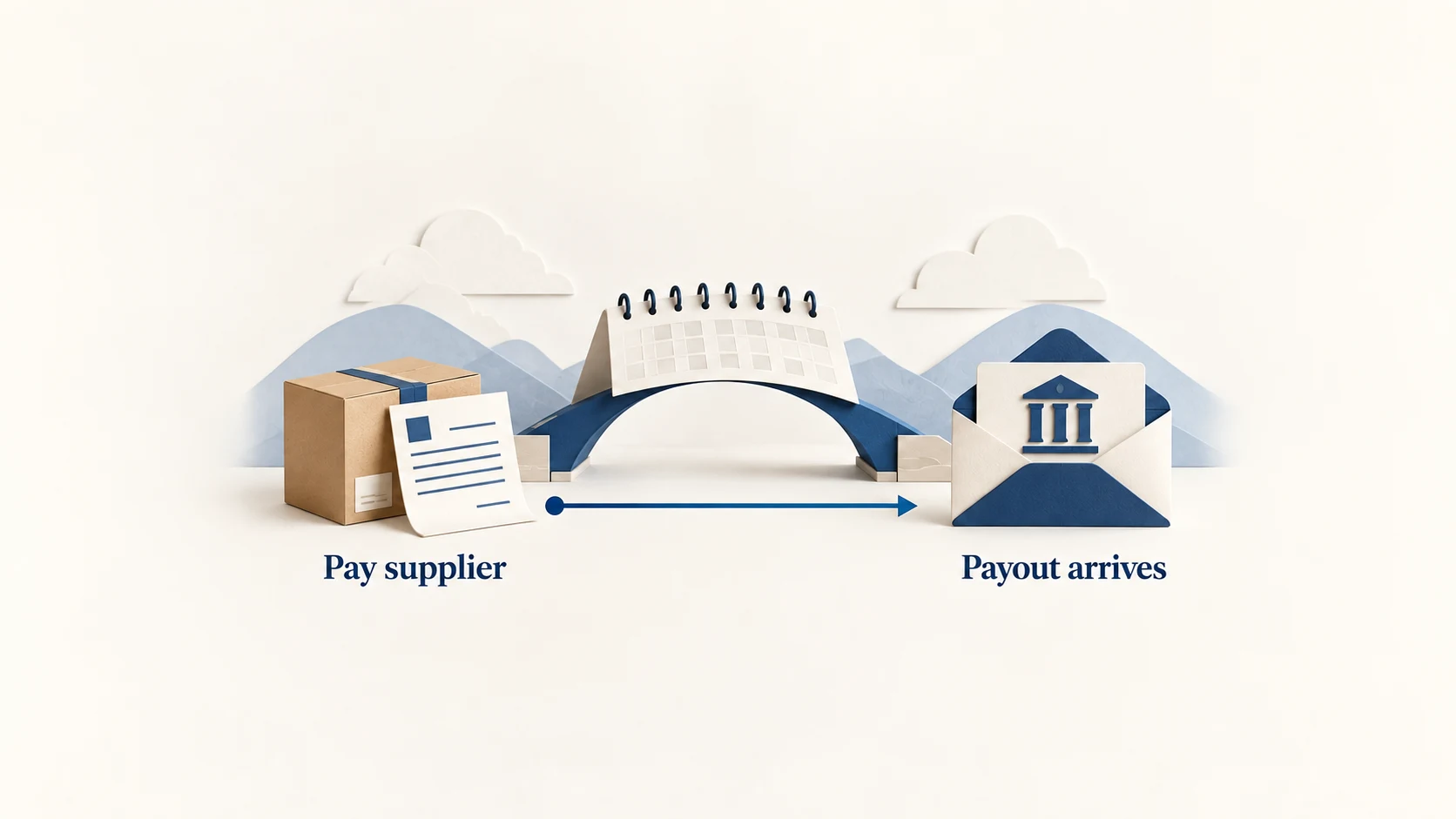
Dropshipping cash flow is the money available to meet bills on the dates those bills must be paid. Customers may pay before you purchase an item, but their payment can remain pending with a processor while the supplier requires immediate funding. Plan from usable cash, confirmed payout dates and upcoming obligations, then test what happens if receipts arrive late.
A profitable order can still create a temporary funding gap. The unit economics guide helps calculate what an order leaves after costs. This article follows a different question: whether the money is available when the supplier, advertising platform or customer needs it.
01
Separate the dates in every sale
Keep at least four dates visible: customer payment, supplier payment, processor payout and bank availability. Add the due dates of advertising bills, shipping adjustments and refunds. A sales report usually cannot answer all of these questions.
Stripe’s payout documentation separates settlement timing from the payout schedule and notes that banks can take additional time to make received funds available. Its schedule guidance also explains that changing payout frequency does not itself make pending funds settle sooner. Use the dates shown for your account, with a reasonable allowance for uncertainty, rather than borrowing another seller’s schedule.
Treat the balances differently:
| Balance or event | How to use it in a cash plan |
|---|---|
| Customer payment captured | Evidence of payment activity; not automatically spendable bank money |
| Processor pending balance | Track when it is expected to become available |
| Processor available balance | Check payout eligibility, timing and any restrictions |
| Payout in transit | Record the expected bank arrival; keep delay risk visible |
| Cleared bank funds | Starting point for payments, after other commitments and restrictions |
An available processor balance is not the same as cash already in your supplier payment account. Transfers between currencies or banks may introduce another step. The useful question is whether the required payment can actually be made before the deadline.
Confirm the supplier’s side too. “Pay per order” can mean payment before acceptance, before dispatch or another agreed point. An automatic order feed does not tell you when the supplier takes money. Ask for the payment trigger and the consequence of insufficient funds.
Use one row for each future movement
A practical forecast starts with transactions rather than one weekly sales total. Keep separate columns for the amount expected and the amount that actually cleared. This makes a missed receipt visible without deleting the original assumption.
| Forecast field | What belongs in it |
|---|---|
| Reference | Payout, invoice, refund or order-group ID |
| Account and currency | The bank, wallet or processor that will send or receive the money |
| Due or available date | When a payment must leave or a receipt can actually be used |
| Expected amount | The net cash movement, with deductions identified |
| Evidence and confidence | Bank clearance, payout notice, supplier terms or an unconfirmed estimate |
| Commitment | Already owed, conditional on new orders, or discretionary |
| Actual date and amount | What happened, once confirmed |
| Owner and action | Who resolves a delay, short receipt or uncovered payment |
Maintain a balance for each account as well as the combined view. A supplier wallet can cover orders accepted through that supplier, but may not pay advertising or a customer refund. A USD balance may need conversion before it can fund a payment in another currency. Include the transfer, cost and availability date instead of assuming all displayed balances are interchangeable.
Internal transfers should appear as an outflow from one account and an inflow to the other. They do not create new business cash. If the destination has not received the money, mark it in transit; otherwise the combined forecast can briefly count it twice.
02
Build a cash calendar for one order group
Here is a hypothetical USD calendar, using September 14–18, 2026. The dates are chosen for illustration and do not represent a provider’s payout schedule or an AIDrop Agent customer result.
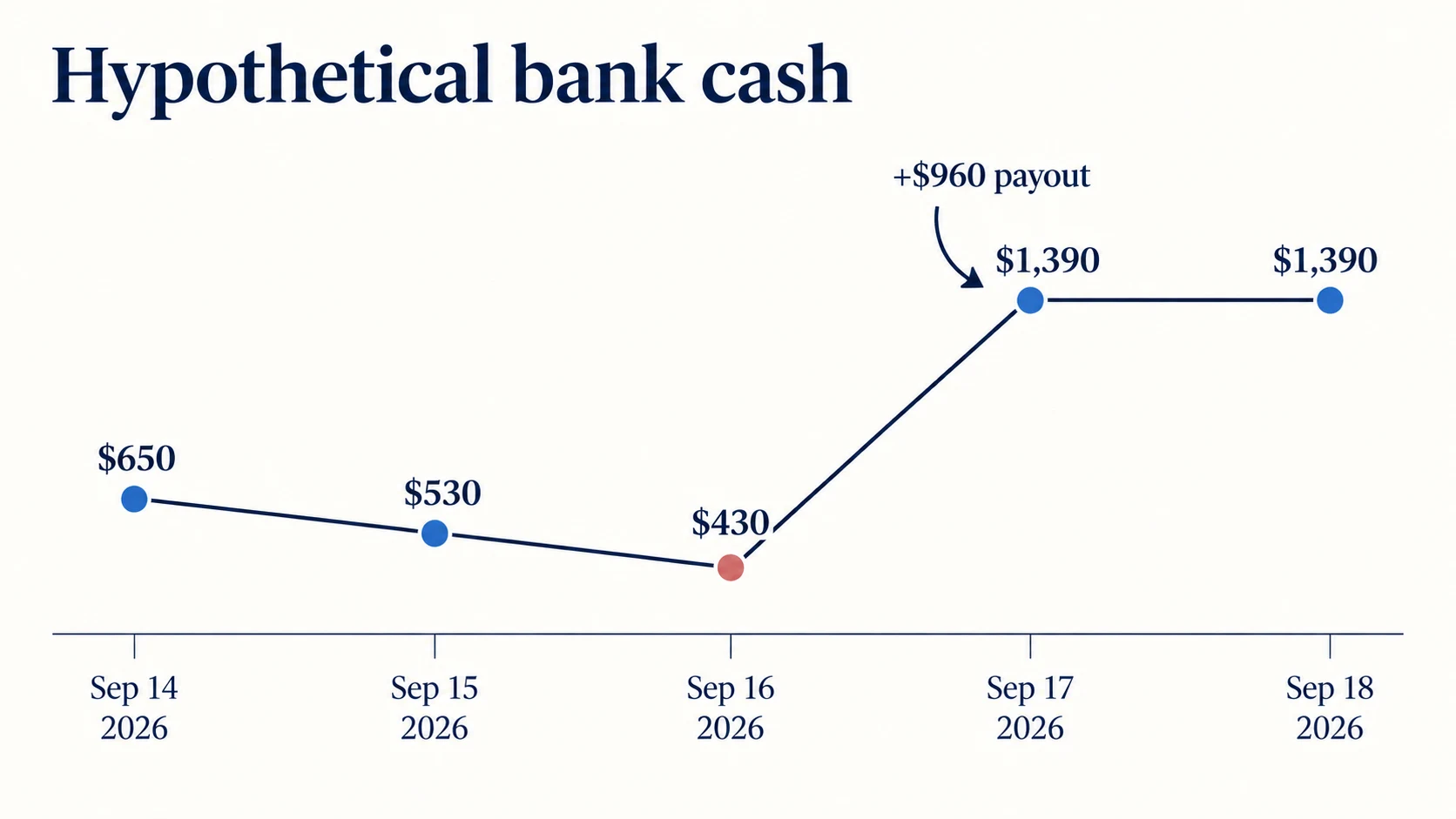
Start with $1,500 in cleared, unrestricted bank cash. On September 14, a group of orders creates $1,000 in captured customer payments. A $40 processing fee leaves an expected $960 payout, assumed to reach the bank on September 17. The supplier requires $600 on September 14, and advertising costs $250 that day.
A $120 refund for an earlier order group is funded directly from the bank on September 15. A separate $100 operating bill falls due on September 16. There are no other transactions in this simplified example.
| Date | Bank cash movement | Closing bank cash |
|---|---|---|
| Before September 14 | Opening available cash | $1,500 |
| September 14 | Supplier −$600; advertising −$250 | $650 |
| September 15 | Earlier-order refund −$120 | $530 |
| September 16 | Operating bill −$100 | $430 |
| September 17 | Net payout +$960 | $1,390 |
| September 18 | No further movement in base case | $1,390 |
The lowest balance is $430, before the payout arrives. The $1,000 in captured customer payments does not enter the bank column on September 14. The $40 fee is already reflected in the $960 receipt and must not be deducted from bank cash a second time.
This calendar is not a profit statement. The earlier-order refund belongs to a different order group, and the operating bill may cover a different period. Taxes, owner withdrawals and other bills are excluded from the illustration, but must appear in a real business forecast when applicable.
Use the lowest projected available balance to assess the funding gap, not the total sales recorded during the week. A forecast with a comfortable ending balance can still miss a supplier payment halfway through the period.
03
Stress the calendar before raising spend
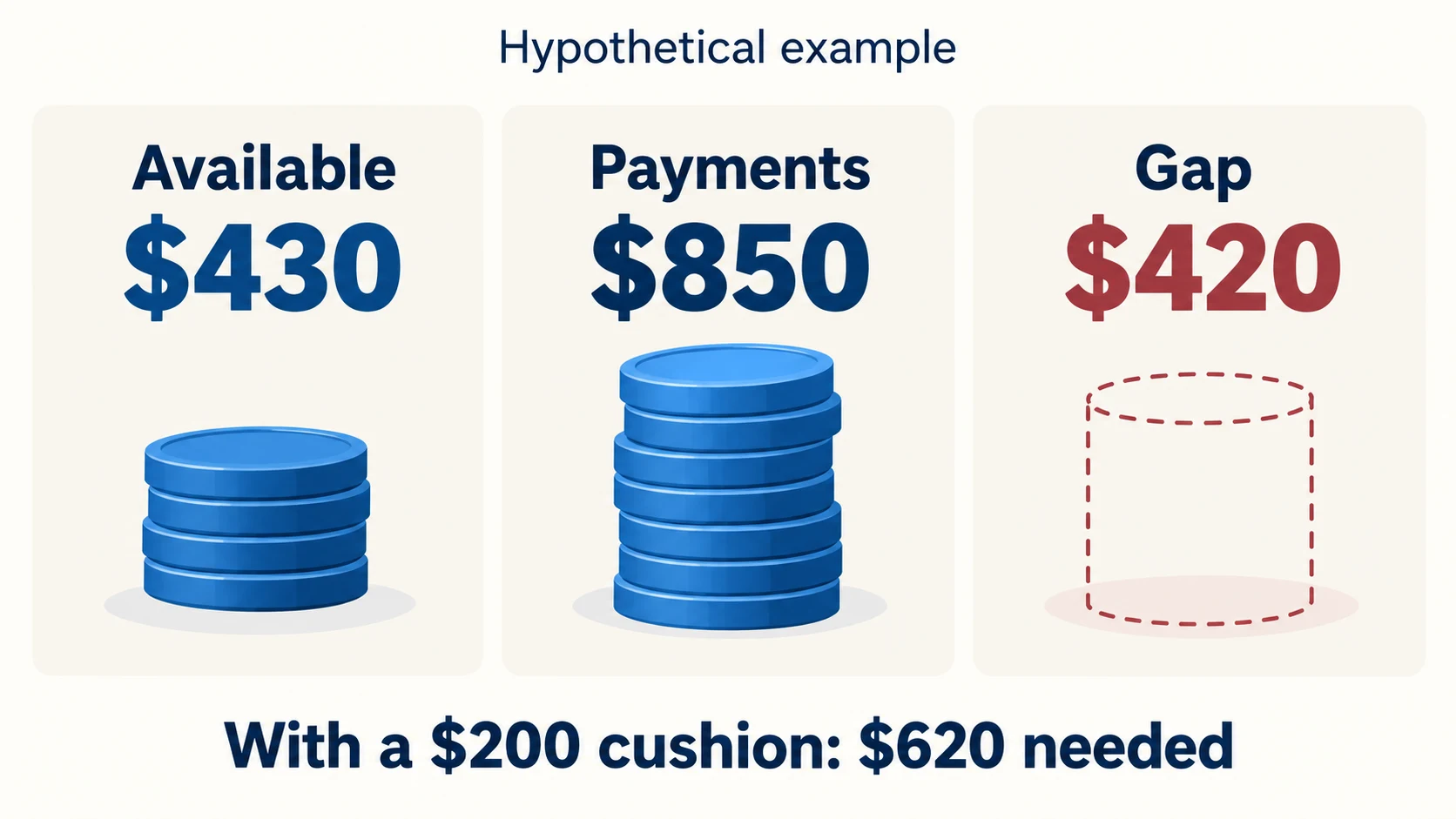
Keep the base case, then change one important assumption. Suppose the $960 payout is delayed beyond September 18. The business still has $430 after the September 16 bill. If a second order group needs another $600 supplier payment and $250 advertising payment on September 18, cash falls to −$420.
That negative amount means the plan cannot be executed with the stated cash. If you also want to preserve a $200 minimum cushion, you need $620 more available funding by that date, or an equivalent reduction or deferral of obligations. The $200 is an illustrative management choice, not a recommended reserve for every business.
| September 18 scenario | Calculation | Available bank cash |
|---|---|---|
| Payout arrives; second group proceeds | $430 + $960 − $850 | $540 |
| Payout delayed; second group proceeds | $430 − $850 | −$420 |
| Additional funding needed to end at $200 in delayed case | $200 − (−$420) | $620 |
The customer receipts from that second group would need their own future payout entry. They cannot be assumed to fund its same-day supplier bill. Growing order volume can enlarge the gap even when each order has positive expected contribution.
Also test a slower supplier credit, a higher refund amount and a payout reduced by a reserve or dispute. Avoid adding every possible worst case into one unexplained number. Keep a few named scenarios so you know what action each one would require.
A useful stress case should change a decision. You might delay discretionary advertising, reduce the number of new orders accepted, arrange verified funding or negotiate a different payment date before accepting the next group. Do not solve the spreadsheet by moving a confirmed supplier bill to a later date without agreement.
Calculate how many additional orders the cash can support
Use the stressed calendar to set an operating limit before accepting more commitments. Start with funds available before the next receipt you can rely on. Subtract already committed payments and the minimum cash you intend to protect. The remainder is the amount available for new exposure during that interval.
Continuing the hypothetical delayed-payout example, the business has $430 after the existing bill. Protecting $200 leaves $230 for new activity. Assume each additional order requires $30 of supplier funding and $10 of acquisition spend before any new payout arrives. Under those simplified assumptions, the cash supports five additional orders: floor($230 ÷ $40), leaving $230 in the bank after spending $200. A sixth would leave $190 and breach the chosen cushion.
This is a funding calculation, not a prediction that ads will produce exactly five orders. Advertising can spend without generating a sale, and organic orders can arrive after an ad pause. Set a separate spend cap and an order-acceptance or availability control. Monitor both; stopping an ad does not remove obligations from orders already accepted.
The calculation also changes when costs are uneven. A remote-area parcel or a multi-item basket may need more than the assumed $30. Use the relevant mix or review large orders separately. Include any fixed fee due before the payout in committed payments before dividing by the per-order amount.
04
Give refund money a clear owner
Customer refunds and supplier recoveries have separate timing. A refund can be due before a supplier agrees to credit a defective item, and the credit may not cover all shipping or handling costs. Plan the customer’s payment without treating an unconfirmed supplier claim as available cash.
Keep a short refund schedule with the amount, expected payment date, funding source and status of any upstream recovery. The dropshipping returns guide explains how the customer response and supplier claim can be managed together without confusing responsibility.
Check how your payment provider funds refunds. A refund might reduce a future payout, use an available processor balance, or trigger another funding action under the provider’s rules. Put it into the forecast once, through the route actually used. Recording both a lower payout and a separate bank outflow for the same refund would overstate the cash requirement.
Distinguish your own cash cushion from a processor reserve. A management cushion is money you decide not to spend. A processor reserve restricts access under the account arrangement. Shopify’s reserve overview explains that reserved funds can be used to cover potential disputes and refunds and are subject to the reserve terms.
Do not count restricted funds as available operating cash. Record the reserve amount and release conditions separately. An expected release date can inform a scenario, but it should not erase the risk that a payment must be made first.
Put each refund into the correct cash route
For Stripe specifically, refund funding guidance says refunds use the available balance rather than pending funds. Insufficient funds can leave card refunds pending; other payment-method refunds can fail. Some regions also permit automatic bank debits to recover a negative balance. Check the actual account and refund status before assigning a cash date.
In a hypothetical forecast with a $960 payout before a new $120 refund, two different routes are possible. If the refund is deducted before payout and nothing else changes, the expected receipt becomes $840. If the $960 has already reached the bank and the refund is funded separately, retain the $960 receipt and add the $120 funding outflow on its actual expected date. Recording both a reduced $840 payout and another $120 outflow would count the same refund twice.
Group unresolved refund exposure by the orders that created it. Keep requested refunds separate from an estimated allowance for orders still in transit or recently delivered. As a request becomes confirmed, replace the corresponding estimate where appropriate; do not automatically add it on top. Use observed outcomes from comparable, sufficiently mature groups when available, and state the assumption when history is limited.
05
Negotiate payment terms precisely
Supplier credit can reduce the time between money going out and money coming in, but only if the terms are explicit. Ask when an invoice becomes due, which orders qualify, the credit limit, accepted currencies, transfer fees and what happens when the limit is reached.
“Weekly billing” leaves several questions unanswered. Does the supplier invoice on Friday for orders already dispatched? Are orders released before the invoice is paid? Is payment due immediately or several days later? Which timezone and holidays affect the deadline? Put the actual arrangement into the calendar.
Prepaid supplier wallets require their own balance check. The bank transfer funds the wallet; later order deductions consume it. For liquidity planning, monitor both the bank and the wallet, and avoid counting the same order deduction as another bank payment if the wallet already funded it. Confirm whether unused wallet funds can be withdrawn and how long that takes.
Credit cards can move the payment date, but they introduce limits, repayment dates and possible costs. Record the actual card bill rather than treating the available limit as revenue. Before relying on borrowed funds, assess the downside if sales slow or a payout remains unavailable; the calendar should show repayment as well as the initial relief.
Include stock purchases and the repayment date
An MOQ or an allocated-stock arrangement can create a cash requirement before individual customer orders exist. Put the deposit, balance payment, inbound freight, storage and any agreed disposal or withdrawal charge on their own dates. Record which payments are binding and which can still be canceled. A lower unit price does not fund that earlier commitment.
Compare the purchase with the existing delayed-payout scenario. If it consumes the money needed for accepted orders, a projected saving on future sales does not remove the immediate shortfall. Ask whether a smaller allocation, staged purchase or confirmed later payment would change the dates without creating unsupported delivery promises.
When considering extra funding, compare usable amount, clearance date, restrictions, fees and repayment date. Owner funding, supplier credit and borrowing have different consequences, but all need a real source and a complete repayment or settlement path where applicable. Do not enter an unapproved facility as confirmed cash simply because an application has been submitted.
06
Update a rolling forecast
Use a daily view while cash is tight or the store is changing quickly, then a weekly view for later periods. Forecast far enough to include the next meaningful payment and refund cycle. The appropriate horizon depends on your actual terms, not a fixed rule that every store needs the same number of weeks.
Start each update from reconciled balances. Replace last week’s estimates with actual receipts and payments, then carry forward the remaining obligations. A dropshipping accounting reconciliation helps explain differences before they enter the forecast as supposed new income or expense.
For each forecast receipt, record its source and confidence: confirmed bank availability, scheduled payout, unsettled sales or speculative future sales. The base plan should make those distinctions visible. An optimistic sales target should not look identical to a transfer already in transit.
For each payment, record whether it is committed, variable with new orders, or discretionary. Existing customer orders create obligations that deserve attention before optional growth spending. Include subscriptions, tax payments, wages, owner withdrawals and debt payments where they apply; small recurring deductions can change the lowest balance.
Compare forecast with actual outcomes and ask why the difference occurred. A delay caused by a bank holiday needs a different correction from a recurring underestimation of refunds. Revise the assumption that failed instead of adding a general buffer whose purpose nobody remembers.
Separate a timing miss from a cost problem
Review the lowest balance in each relevant scenario, not just the final weekly total. A payout delay shifts a receipt; an extra refund changes the amount retained; a higher parcel charge changes the cost of accepting new orders. Keep those changes separate so the response matches the cause.
For each variance, record forecast amount/date, actual amount/date and reason. If a payout is two days late but unchanged in amount, update the arrival assumption for similar transfers and check bills within those two days. If it is $80 lower because of an identifiable adjustment, correct the receipt and investigate that adjustment rather than moving the expected date indefinitely.
At the daily review, confirm the next payment that could fail, its owner and the action deadline. Possible actions include using already cleared funds in another eligible account, obtaining a confirmed payment extension, reducing optional spending or limiting new commitments. If none covers the gap, escalate before the due date and keep affected customer orders visible. A forecast becomes useful when it leads to a specific action while there is still time to take it.
07
Recognize when growth must pause
Set a minimum available-cash level that reflects your own obligations and uncertainty. Then decide who can authorize additional spending and what evidence they need. This is more useful than waiting for a supplier wallet to run empty after orders have already been accepted.
Pause discretionary growth when the updated forecast shows an uncovered payment, an unexplained payout restriction or a growing backlog that increases refund exposure. Continue managing accepted orders and customer communication. A pause in acquisition is an operating decision to protect commitments already made.
Resume when the specific constraint has changed: money has cleared, a payment extension is confirmed, an incorrect restriction has been resolved, or the order volume has been reduced to an affordable level. A stronger sales day alone does not establish that the cash problem has disappeared.
The practical goal is a calendar you can act on. You should be able to point to the next supplier payment, identify the funds that will cover it, and explain what happens if the expected payout is late. That is what lets growth remain a choice instead of becoming a scramble for money.
If funding remains tight even when payouts arrive as planned, review the underlying offer and costs through the economics and risk section. A timing adjustment cannot repair an order that consistently consumes more money than it earns.
08
Frequently asked questions
Can customer payments fund my supplier orders immediately?
Only when the funds are actually available through a payment method the supplier accepts. Captured payments may still be pending or awaiting payout. Check your processor and bank timing alongside the supplier’s payment deadline.
How much cash buffer does a dropshipping store need?
Calculate it from the lowest projected balance under relevant delay and refund scenarios, then add the cushion appropriate to your obligations. A fixed percentage of sales or a universal number of weeks can miss the timing of your largest bills.
Does positive cash flow mean the store is profitable?
No. Owner funding, borrowing or delayed bills can improve the current bank balance without creating profit. Conversely, profitable sales can require funding before payouts arrive. Review both the cash calendar and the order economics.