
Test products without pre-buying finished stock.
Print-on-demand (POD) is a dropshipping model in which an item is made only after a customer orders it. That lowers finished-goods inventory exposure, but it moves risk into the production handoff: artwork version, product fit, print method, acceptable variation, QC, packing, and delivery must still match. AIDropAgent coordinates those China-side decisions and returns exceptions before they become silent order failures.
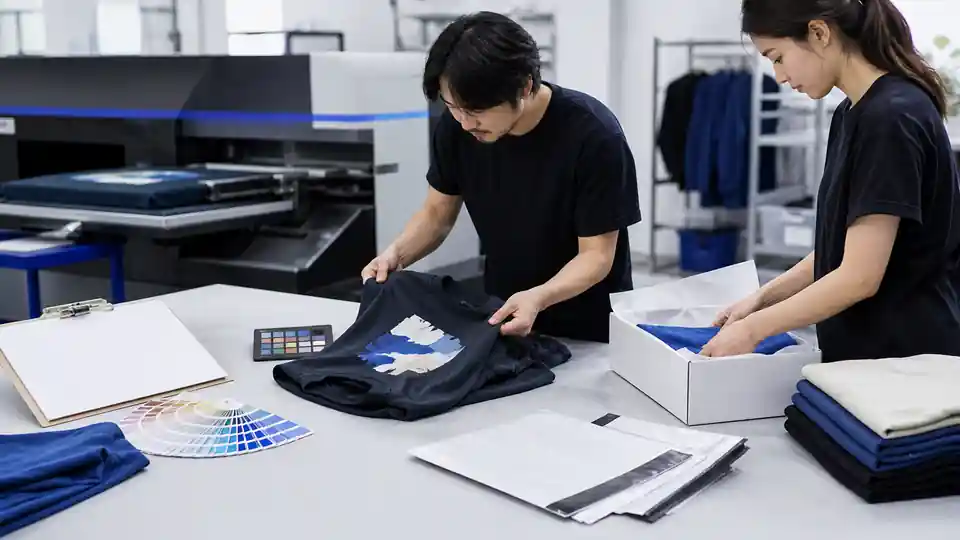
Approve the production reference first.
Production file
Check: dimensions, resolution, color mode/profile, transparency, bleed/safe area, fonts, line weight, and file naming.
Gate: ready, repairable, or new artwork required.
Product fit
Check: product/blank, surface, color, size, print method, placement area, wash/use conditions, and supplier capability.
Gate: compatible, constrained, or unsuitable.
Approval reference
Check: SKU-to-artwork map, version, approver, sample requirement, allowed tolerance, and effective date.
Gate: test print authorized or listing held.
Compare what the sample proves—and what it cannot.
Compare
Compare: placement, scale, color movement, edge detail, texture interaction, finish, product condition, and packing presentation.
Document
Document: sample photos, product/blank, method, artwork version, settings where available, observed variation, and affected SKU.
Decide
Decide: approve, approve a named tolerance, revise the file, change the product/method, or reject the sample.
Set variation limits and stop rules.
Expected variation
Expected variation: small color, placement, texture, or finish movement within the approved reference and product/method limits.
Action: continue and record when monitoring is useful.
Review condition
Review condition: repeated drift, borderline placement, changed blank/product, new supplier/method, or a visible customer-promise risk.
Action: hold affected production and compare with the approved sample.
Evidence
Defect evidence: wrong artwork/version/SKU, major misplacement, missing print, contamination, damage, unreadable detail, or agreed-limit failure.
Action: reprint, replace, rework, or reject with affected scope.
Connect the correct design, production method, and fulfillment instruction.
Map
Input: store SKU/order.
Resolve: product/blank, variant, artwork version, placement, method, and approval state.
Produce
Execute: retrieve the controlled file, produce, compare critical points, record any hold, and release the completed item.
Fulfill
Complete: apply the approved pack, dispatch through the chosen route, and return status/tracking or a named exception.
Use a unit economics stack without pretending risk disappears.
1. Product + print
Product/blank, print/decoration, setup or file repair, sample, component, and any method-specific minimum.
2. Fulfillment + delivery
Per-order production handling, inspection, packing, dimensional weight, route, destination, tracking, and delivery-service assumptions.
3. Risk + service reserve
Failed print, reprint/replacement, stockout, approved variation, return/refund exposure, and management time spent on unresolved exceptions.
Start with POD; add inventory only after repeat demand proves the case.
Print-on-demand is one operating mode, not a permanent commitment. The right step depends on design stability, service promise, variation tolerance, and how much inventory attention the store is ready to own.
Print on demand
Use when: designs are being validated or order volume does not justify finished inventory.
Visible output: approved artwork version, production method, SKU-to-file binding, and order-level status.
Watch: per-order production time, method variation, and exception handling remain part of the customer promise.
Small China-side batch
Use when: repeat designs need tighter consistency, faster packing, or coordinated inserts and labeling near the supply base.
Visible output: approved sample, batch quantity, inventory owner, QC release, and reorder rule.
Watch: the batch saves repeated production coordination but introduces cash, storage, and obsolete-design exposure.
Destination stock or 3PL
Use when: destination demand and service requirements justify local receiving and dispatch.
Visible output: forecast boundary, receiving and QC rule, service target, stock trigger, and exit path.
Watch: local speed is bought with more fixed handling, forecast dependence, and inventory ownership.
Decision rule: move up the ladder only when the next mode solves a documented consistency, handling, or service problem. A lower unit price by itself is not enough if it increases cash exposure or version risk.
Questions about Print on Demand Dropshipping
Does the mockup guarantee the printed result?
No. A mockup communicates intent. The physical result depends on the file, print method, material, product, color, placement, and process. A test print provides better evidence.
Can every design use the same file settings?
No. Requirements vary by product, print area, method, material, color, and artwork detail.
How are POD quality issues handled?
The workflow should connect the order, file version, product/variant, observed result, evidence, agreed tolerance, and remake, hold, accept, or other next action.