
A 3PL stores and fulfills inventory for another business. For a dropshipping store, it becomes useful when selected products have enough dependable demand to justify holding stock and when the new fulfillment arrangement improves the customer promise at an acceptable total cost. You can move proven items into a destination warehouse while continuing to source slower products after each order.
The decision includes an inventory purchase, a service contract and a replenishment plan. A lower pick-and-pack fee alone cannot tell you whether the change pays off. Unsold units, inbound freight and minimum charges remain part of the decision even when the warehouse dispatches orders correctly.
Keep the wider dropshipping inventory management process in place. A 3PL changes who holds and handles goods; it does not remove your responsibility for availability, product selection or customer commitments.
01
What changes when a dropshipper uses a 3PL?
In a conventional supplier-direct arrangement, the supplier dispatches a customer parcel after you place the corresponding purchase. In a stocked 3PL arrangement, goods reach a warehouse before the customer order. The warehouse receives an instruction, picks the stored item, packs it and hands the parcel to a carrier.
That physical change can remove procurement and international replenishment from an individual customer’s waiting time. It also means someone must fund stock before knowing which exact customers will buy it. If you purchase and own that inventory, those orders use stocked fulfillment even if the rest of your store continues to dropship.
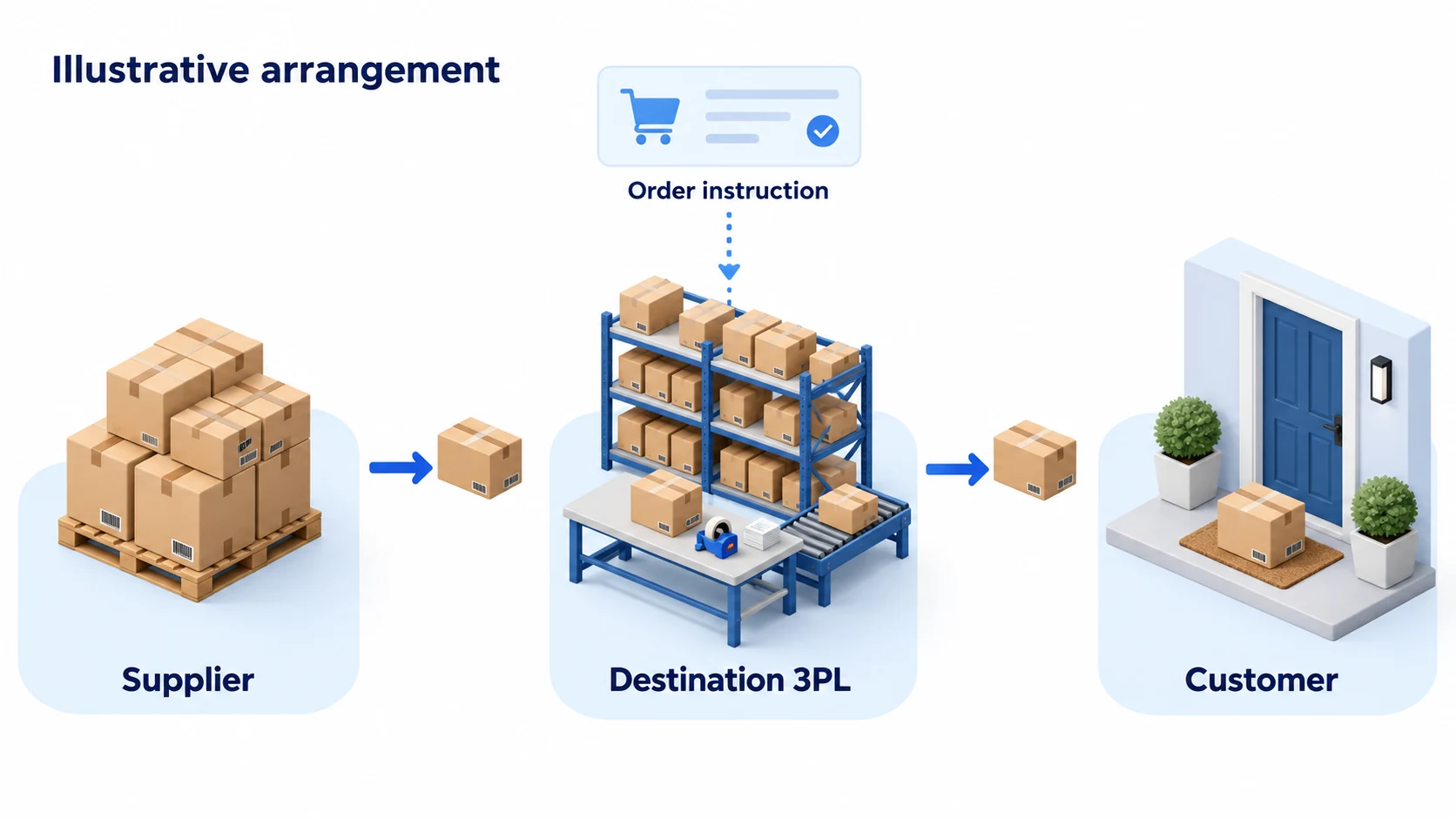
An illustrative arrangement has three separate participants: the supplier replenishes a destination 3PL, the store sends paid-order instructions to that 3PL, and the 3PL sends parcels to customers. The inventory purchase and the customer order are separate transactions. Stock ownership follows the agreement, not the building in which cartons sit.
Do not assume the provider also sources products
A fulfillment company may receive products you purchase elsewhere. Sourcing, sample approval, factory follow-up, product inspection, freight booking and import arrangements may be separate services. Ask which tasks the proposed contract actually includes and who performs the others.
Likewise, a provider describing itself as a dropshipping agent may arrange supplier purchases and parcel dispatch without operating a destination stocking program. Compare the actual movement and responsibilities rather than choosing by the label. The dropshipping fulfillment guide explains the order-level handoffs that still need to work.
02
Decide which products deserve destination stock
Start with a product and destination combination. Total store sales can hide a catalogue with one strong item, several seasonal variants and many occasional sellers. Stocking every variant because the store has grown can put cash into the wrong sizes or colors.
Use recent fulfilled orders, cancellations, returns and stockout periods to understand demand. A product that sold little while unavailable has incomplete demand evidence. A product that sold quickly during a one-off promotion does not automatically support the same replenishment quantity next month.
A move is easier to justify when
- Demand repeats in a defined market and a manageable set of variants.
- The current customer wait includes a step that pre-positioned stock can remove.
- Product quality and packaging specifications are stable enough to purchase a batch.
- Margin can cover receiving, storage, local dispatch and exception handling.
- You can finance replenishment without depending on selling every unit immediately.
Keep supplier-direct fulfillment available when
Demand is sparse, designs change frequently or many variants sell only occasionally. A bulky low-value item may also accumulate storage and domestic parcel costs that undermine the apparent advantage. Calculate the actual package dimensions and destination mix before moving it.
Some products need a different provider because of handling restrictions, temperature needs, batteries, expiry dates or other product requirements. Obtain explicit acceptance for the item and the proposed transport service. A general statement that a warehouse handles ecommerce goods is insufficient evidence for a particular product.
03
Compare the full cost of the same orders
Give each candidate the same sample order profile:
- Units per order, packed dimensions and weight.
- Destination areas and monthly volume.
- Expected receipts and returns.
Separate normal single-item orders from bundles, oversize parcels and special packing. Otherwise, a cheap quote can simply describe an easier order than you actually ship.
ShipBob’s published pricing explanation identifies implementation, receiving, warehousing and order picking, packing and shipping as standard cost areas. It also describes customized quotes and additional charges for some services. That is useful evidence for asking complete questions, not a current price quote for your store.
Account for arrival and storage
Include freight to the destination, applicable import costs, delivery to the facility, receiving and any preparation required before units become usable. Ask how the provider charges a noncompliant receipt, missing labels or cartons that need sorting. Identify who pays when the supplier sends an incorrect quantity.
For storage, establish the measurement basis and billing period. Bin, shelf, pallet and volume-based quotes are not directly interchangeable. Model the stock that will remain during a slow month, including packaging materials if they occupy separately charged space. Find out whether minimums or age-related fees affect the total.
Account for each shipment and exception
Ask whether handling includes the first item, additional items, packaging materials and inserts. Check the carrier service, billable weight, destination surcharges and adjustment process. A warehouse handling fee is not necessarily the full parcel delivery charge.
Add expected return processing, inspection, restocking, disposal and replacement handling where relevant. Use your own history for the expected frequency, then test a worse scenario. Do not treat the provider’s return service as a promise to refund customers or decide whether an item may be resold.
Check how the monthly minimum is credited
A minimum spend and an additional fixed fee produce different bills. Ask which charges count toward the minimum, which remain outside it and whether unused capacity carries forward. 3rd Party’s fulfillment-cost explanation describes minimums that charge the difference when eligible activity falls short; your agreement must specify its own treatment.
For an illustrative $500 minimum with $400 of eligible activity, a difference-only arrangement adds $100, making that part of the bill $500. It does not add another $500 to produce $900.
Separately billed postage, storage or other excluded charges still need to be added according to the agreement. Keep this minimum-spend calculation separate from a genuinely additional monthly overhead charge.
04
Separate operating break-even from cash exposure
Consider a hypothetical comparison in which the existing supplier-direct route costs $11 per fulfilled order for the logistics activities being compared. The stocked route costs $8 for those same activities, including allocated inbound logistics, receiving, handling, packaging and local delivery. Product cost, selling price and other unchanged store costs are excluded from both sides.
Suppose the stocked route also adds $300 a month of overhead and storage not included in that $8. The illustrative saving is $3 per order, so 100 orders cover the $300. At 80 orders, the calculation is $240 minus $300, or a $60 disadvantage. At 200 orders, it is $600 minus $300, or a $300 advantage before other changed costs.
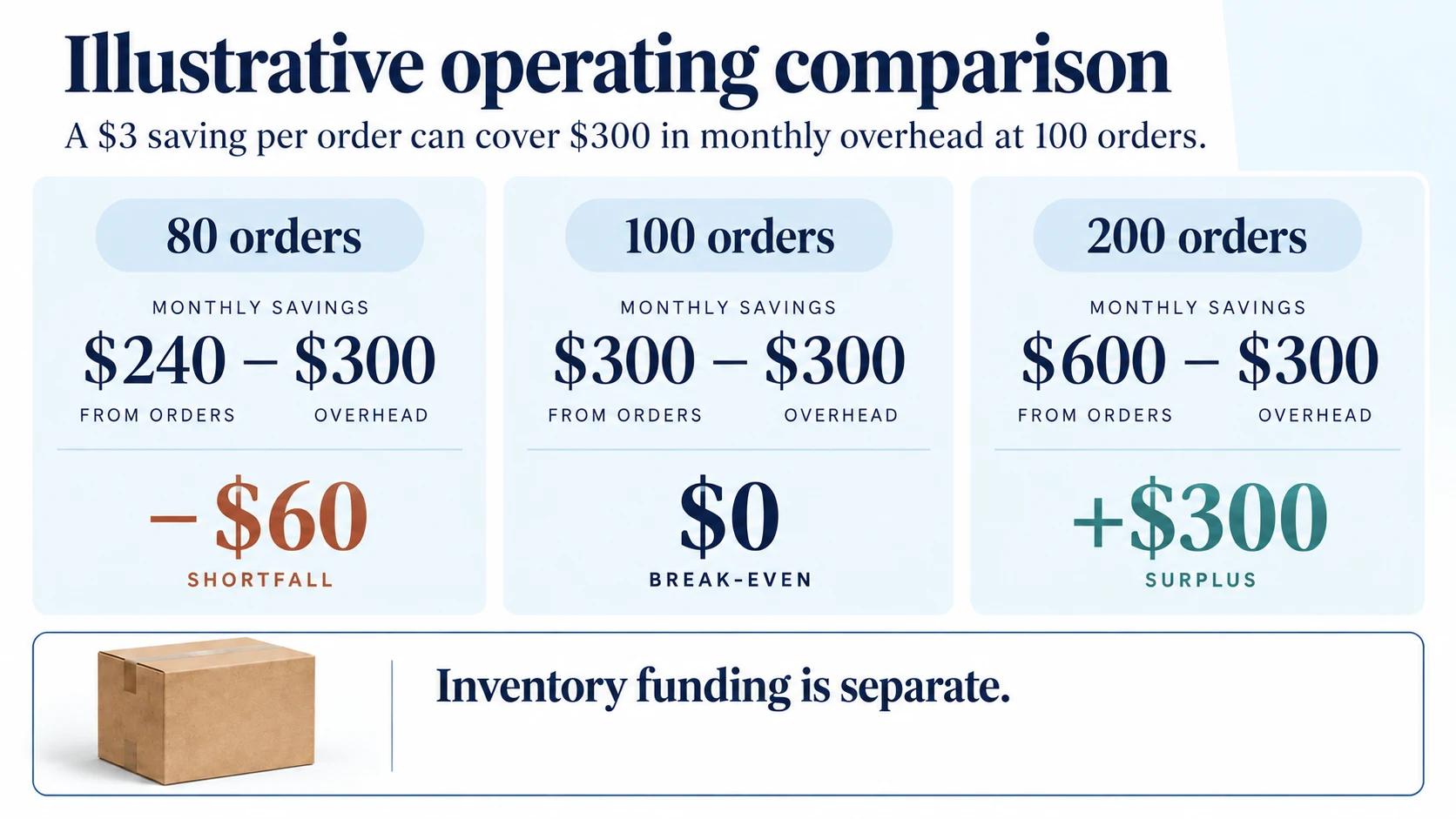
These are assumed inputs, not provider rates or a recommended order threshold. If costs already appear in a per-order figure, do not add them again as monthly overhead. If the product purchase price or returns change, include those differences too. Use the same comparison period and cost boundaries for both routes.
A purchase of 500 units at an assumed $6 each still requires $3,000 of product funding. The operating comparison does not make that commitment disappear. If only 200 units sell in the first month, 300 units remain tied up in inventory, subject to their actual resale prospects and any additional carrying costs.
This distinction explains why a route can look cheaper per shipment while making the business harder to finance. Review the unit economics guide alongside a cash forecast. Include the timing of supplier deposits, freight payments, warehouse bills and customer settlement, not just average profit.
05
Ask a provider to demonstrate the work you need
Use a representative SKU and order to test the proposal. Supply the barcode, variant name, unit dimensions, packaging version and any handling restrictions. Ask how the warehouse records a receipt, quarantines a problem and reports available inventory.
For dispatch, ask what starts the service clock. An imported order may still be unpaid, on hold, missing information or waiting for stock. A promised processing window needs:
- A defined eligible order.
- A cutoff time and working calendar.
- A completion event that distinguishes label creation from physical carrier handoff.
Check the practical limits of the service
Confirm whether the provider can perform the exact bundle assembly, insert, packaging or inspection you require. Ask for the instruction format and approval process. A photograph of an attractive packing station does not establish that the warehouse can follow your specific configuration repeatedly.
Request a sample bill generated from the same order profile used in the quote. Then ask about a small receipt, a split shipment, an address correction and a return. The aim is to learn how the bill changes when normal work becomes an exception.
Agree on contacts and response responsibilities. You need a way to stop a questionable batch, investigate a quantity variance and request a correction before more orders are released. Record the evidence required for a stock or service claim and the contractual reporting windows.
06
Put ownership and exit terms in writing
Specify whose inventory is being stored, how it is identified and how records can be exported. Clarify responsibility for shortages, damage, insurance arrangements and any limitations that apply. Review these terms in the context of the actual contract rather than assuming that a provider reimburses the full retail price.
Before sending stock, understand the exit process:
- Notice and final billing.
- Transfer preparation and pallet or carton charges.
- Collection access and the time needed to release goods.
- Handling of outstanding customer orders and returns during a move.
Keep product data and order records accessible outside a single provider’s dashboard. The service may work well for years, but you should still be able to reconcile stock and move it without rebuilding the catalogue from screenshots.
07
Onboard with a small, fully traceable receipt
Approve the product and packaging specification before sending a commercial batch. Align the supplier’s SKU, the store’s variant and the warehouse’s identifier. Include units per carton, quantity, barcode placement and any lot or expiry information the product requires.
Send the inbound notice in the provider’s required format. Retain the packing list and delivery reference. When the shipment arrives, reconcile the expected quantity with what was counted, accepted, held and made available. A delivery signature does not by itself show that every unit passed receiving.
Test the order connection before releasing volume
Shopify’s location documentation explains that fulfillment apps and 3PL services can be represented as locations, with inventory and routing configuration attached to them. Confirm how your specific integration creates and updates those records rather than manually duplicating the same stock under another location.
Test one normal order, a multi-unit order, an unavailable variant and a cancellation. For each, check:
- Store reference, SKU and quantity.
- Address and service.
- Acknowledgment and stock movement.
Verify what happens when the same request is retried, and whether a cancellation can still stop work after picking begins.
An illustrative pilot follows four observable events: the warehouse receives the correct units, the store routes an eligible order, the warehouse hands the correct parcel to the carrier, and the store receives the corresponding shipment update. A failed event is a reason to fix that handoff before increasing volume.
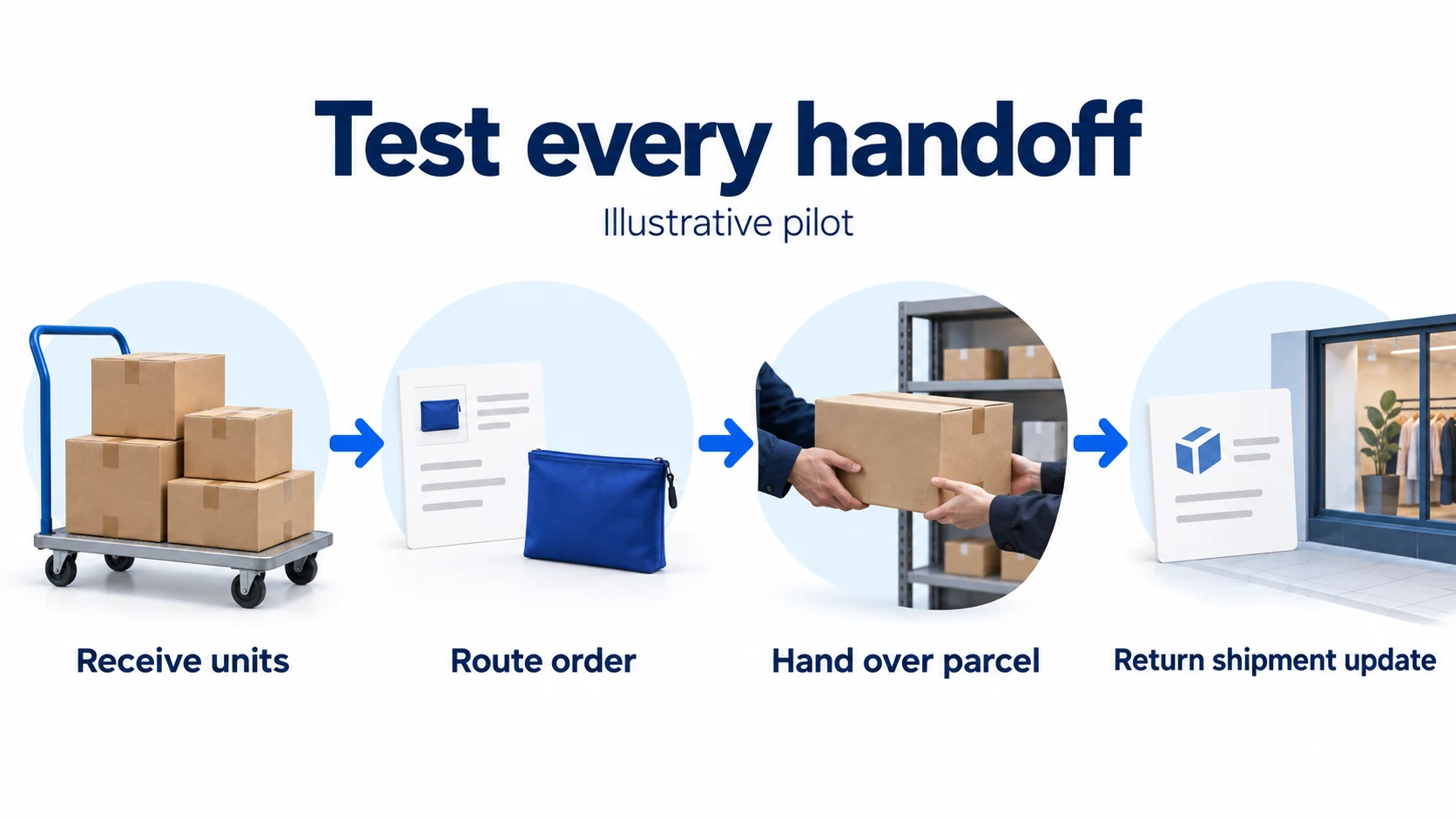
Do not use a successful label test as the only acceptance criterion. Review an actual permitted test shipment, its contents, packaging, tracking and invoice. Where returns are part of the service, test the receiving and disposition steps as well.
08
Run a hybrid catalogue without confusing the promise
A store can stock selected products locally while shipping others from the supplier. Give the system accurate location-level availability and define which destinations each route serves. Present delivery information appropriate to the actual basket, including possible separate parcels.
Shopify’s order-routing documentation describes rules such as minimizing split fulfillment and ranking locations. Review the rule order and test mixed baskets. A preferred warehouse cannot fulfill a missing variant merely because it ranks first.
If local stock runs out, decide whether the alternative route can meet the customer promise before allowing automatic fallback. A longer supplier-direct route may require changed delivery information or stopping sales. Record how the customer and support team will see the selected route.
09
Measure the move against the original decision
Review the move using consistent measures:
- Eligible orders dispatched on time and delivery outcomes.
- Incorrect items and inventory variances.
- Total billed cost and stock age.
Keep definitions stable so a provider cannot appear faster merely because more orders are excluded from the dispatch measure.
Compare invoices with the quote assumptions and actual order mix. Investigate why a cost changed: more remote destinations, extra items, a larger carton, low volume or a charge outside the agreed scope. Use the finding to correct the plan or challenge an incorrect bill.
Replenish according to sell-through and complete replenishment time, including receiving. Reduce or stop purchases when the expected demand changes. Moving stock to a professional warehouse does not make an obsolete variant easier to sell.
The broader operations resources connect these decisions with supplier coordination and customer-order control. Expand the stocked programme only when the evidence supports both the service improvement and the inventory commitment.
10
Frequently asked questions
Can a 3PL fulfill dropshipping orders without stock?
It needs access to the goods before dispatch. Some arrangements receive items after customer orders or coordinate cross-docking, but the exact service must be agreed. A conventional stocked 3PL programme expects inventory to be received before orders are released against it.
How many orders do I need before using a 3PL?
There is no universal threshold. Calculate the incremental fixed cost, per-order difference, stock commitment and service benefit for the relevant products and market. Provider minimums and product handling requirements can matter more than total store volume.
Does a 3PL guarantee faster delivery?
No general guarantee follows from using a 3PL. Destination stock may remove a long replenishment leg from customer orders, but availability, processing, carrier service and destination still determine the result. Use the provider’s actual agreed conditions and pilot evidence.
Should I move every product at once?
Usually the more controllable starting point is a limited group with repeat demand and stable specifications. Keep the rest on its existing route while checking receiving, order handling, costs and sell-through. Expand based on the results of that defined group.