
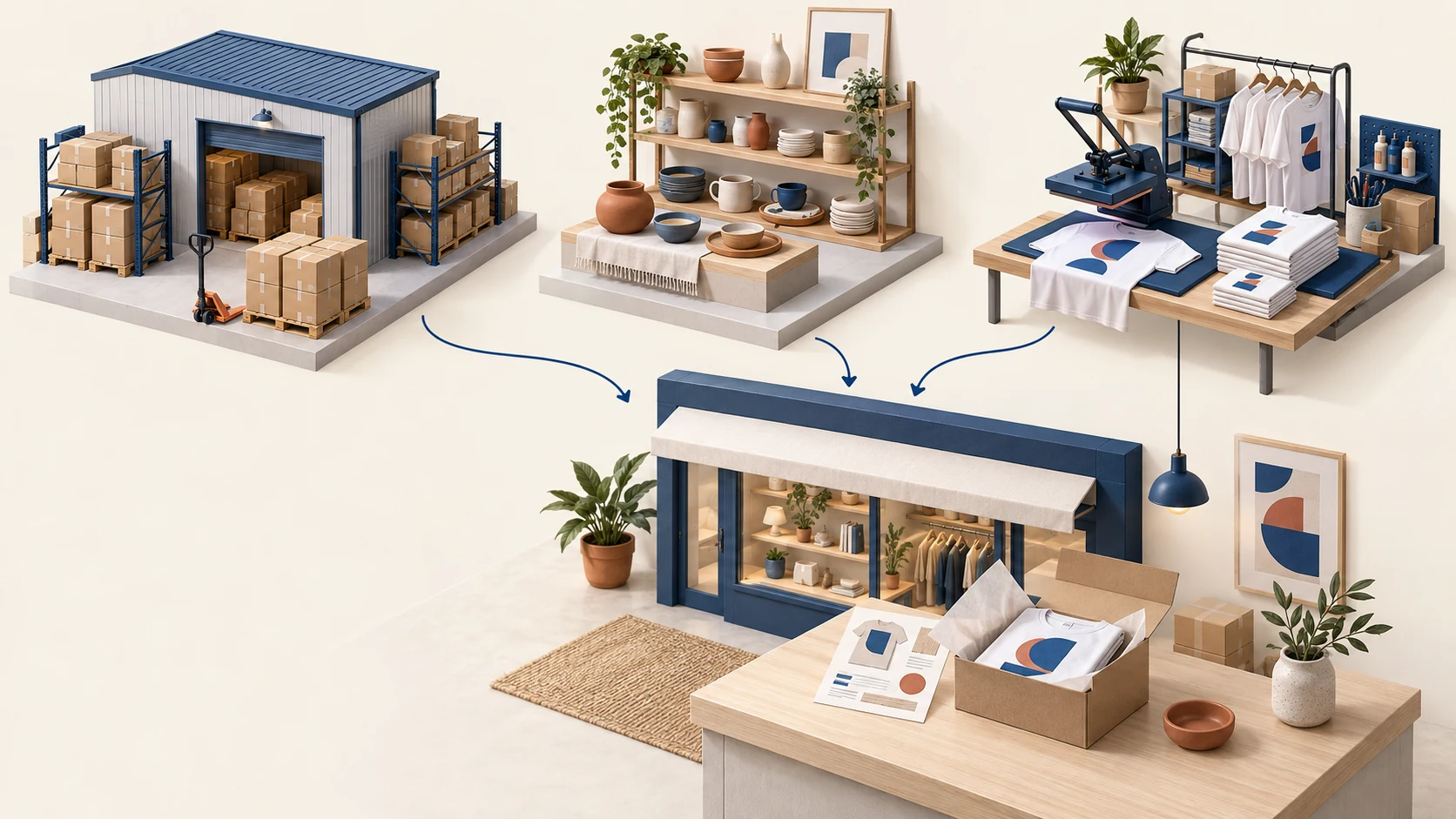
Shopify stores can source dropshipping products through CJdropshipping or Zendrop, supplier marketplaces such as Syncee and Spocket, eligible brands on Shopify Collective, and print-on-demand services such as Printful. These options solve different purchasing problems. Choose the product and fulfillment arrangement first, then confirm that its Shopify connection supports the way you intend to sell.
A supplier with suitable products can still be a poor match for your delivery countries, packaging or returns. An app that imports a listing neatly does not resolve those differences. This guide compares documented options and shows how to narrow them to a supplier you can actually launch with. It is a documentation comparison, not a hands-on supplier performance test.
For store setup, payments and the wider operating model, start with the Shopify dropshipping guide.
01
Start with the kind of supplier you need
A merchant selling an existing household product needs a different source from a designer selling original printed shirts. An established shop adding complementary brands has another set of requirements.
| Your requirement | Sources worth investigating | What determines the fit |
|---|---|---|
| General products with sourcing and fulfillment support | CJdropshipping, Zendrop | Actual variant, dispatch location, service quote and packaging |
| Catalogs from separate regional suppliers | Syncee, Spocket | Each supplier’s destinations, stock, terms and permission to sell |
| Other Shopify brands that ship to your customers | Shopify Collective | Store eligibility, supplier connection and price-list access |
| Products carrying your original designs | Printful | Blank product, print method, production time and sample quality |
| A manufacturer or wholesaler you already know | Direct agreement with a compatible Shopify integration | Individual-order capability, data exchange and exception handling |
The last option is easy to overlook. A manufacturer does not need to appear in a popular app to be commercially suitable. It does need a workable method for receiving orders and returning stock and tracking information. If it only sells cartons, cannot identify individual variants or has no process for customer returns, a Shopify connector will not turn it into a ready-made dropshipping supplier.
02
Compare the named options on their actual role
CJdropshipping: sourcing and fulfillment in one service
CJ’s Shopify listing describes product sourcing, order synchronization, packaging customization, bundles and a shipping-cost calculator. This makes it a candidate when you need help finding an item or preparing a package, rather than simply importing an existing supplier catalog.
Ask for a quote against the exact variant and destination. A catalog product, an item awaiting procurement and stock already held near the customer can have different dispatch arrangements. Treat the chosen arrangement as part of the product you are buying. An advertised local-delivery estimate should not become a promise for every item in the catalog.
Zendrop: distinguish US suppliers from China fulfillment
Zendrop’s US supplier guidance makes an important distinction: its US supplier products ship within the United States and do not support custom branding or private labeling. Some use supplier-branded packaging. The China fulfillment route has different destination and branding arrangements, including its Private Agent Program.
That distinction can settle the shortlist early. A store needing its own packaging for customers in several countries should not select a US listing solely because its delivery estimate looks attractive. Processing time also comes before carrier transit; do not quote the transit figure as the complete order-to-door time.
Syncee: select the supplier behind the marketplace
Syncee’s Shopify setup guide provides filters for ship-from location and supplier location, supplier storefronts, shipping details and products that require approval. The individual supplier handles shipment. The marketplace connection helps exchange listings and orders, but it does not make every supplier’s service identical.
This route suits a merchant who wants to compare multiple catalogs while keeping Shopify integration relatively consistent. Start by checking that the supplier ships the chosen item to your target countries. A supplier’s business address and the warehouse that dispatches a particular product are separate facts.
Spocket: regional sourcing with a branding distinction
Spocket’s listing emphasizes US and European products and branded invoicing. A branded invoice is useful, but it does not establish that the parcel, product label or manufacturer packaging will carry your brand.
For a store with a distinctive unboxing experience, ask specifically about the physical package. For a store primarily concerned with domestic delivery, inspect the individual item and warehouse. The marketplace’s regional focus is a starting point for discovery, not proof that every listing ships domestically to every customer.
Shopify Collective: sell products from eligible Shopify brands
Collective connects Shopify retailers with supplier stores. Retailers import shared products, customers buy from the retailer, and suppliers ship the orders. This can suit an existing shop adding relevant brands without purchasing that inventory upfront.
Eligibility and supplier connections matter. It is not an unrestricted catalog available to every store worldwide. The brand’s assortment and commercial terms also shape what you can offer. Look for products that improve your existing range instead of importing unrelated items just because they are available.
Printful: a different route for original designs
Printful’s Shopify integration supports designing products, publishing them to a store and having orders produced and shipped. Its print methods include options such as direct-to-garment printing and embroidery.
Here, the sample decision includes the blank garment or object, artwork placement and print result. A mockup cannot demonstrate how a print feels, how colors reproduce or how a garment fits. Order the actual configuration you intend to sell, including each materially different print method or blank.
03
Narrow the shortlist before ordering samples
Write a short purchasing brief with the intended product, variants, selling countries, expected order pattern and packaging. Include anything that would make the product unusable for your offer: a different plug, missing instructions, an incompatible size or a return address your customers cannot reasonably use.
Send the same brief to a small shortlist. The reply should identify a specific item and dispatch arrangement. A broad catalog link leaves too many variables unresolved.
Confirm the product, warehouse and destination together. Stock in one country does not help an order assigned to another warehouse, and a route available for a small parcel may not accept a battery or an oversized package.
For branded goods, obtain the necessary permission and documentation before selling. For products with safety, labeling or import requirements, identify the applicable market rules and the evidence for the exact item. A supplier’s general assurance is not a substitute for product-specific documentation.
If a supplier cannot provide an essential specification, pause that item rather than filling the gap in your listing. You can continue evaluating other products from the same source without approving the uncertain one.
04
Use samples to check the offer customers will receive
Place a paid sample order through the intended fulfillment route. Keep the listing version and order confirmation so that you can compare what arrived with what was promised.
Inspect the product’s dimensions, material, included parts, variant and instructions. Examine the parcel as well: protection, labels, invoices and any other seller’s promotional material. Photograph discrepancies and ask whether the supplier can correct them consistently.
A useful sample review ends with a decision. Accept the item as described, change your offer to match the item, request a corrected sample, or reject it. A vague impression that the product “looks fine” is difficult to use when a later shipment differs.
One successful sample establishes what happened on that order. It does not prove future stock availability or a reliable delivery rate. Keep monitoring the first customer orders, especially after a packaging change, a new warehouse or a replacement product.
05
Compare the complete cost of the same order
Product price matters only alongside the charges required to deliver that product. Compare the same item, quantity, destination and shipping service, with the same assumptions about duties and taxes.
Consider this hypothetical quote for one ordinary parcel. The figures are illustrative, not AIDrop or supplier rates.
| Cost per order | Supplier A | Supplier B |
|---|---|---|
| Product | $8.00 | $9.40 |
| Handling and packaging | $1.20 | $0.60 |
| Shipping | $7.30 | $5.90 |
| Total of these quoted costs | $16.50 | $15.90 |
Supplier B has the higher product price but is $0.60 cheaper on these three lines. At 100 identical orders, that is $60. The comparison remains incomplete if one quote requires prepaid inventory, storage, an app subscription or a minimum monthly charge.
List those extra commitments separately. Allocate a subscription across a realistic order count, rather than assuming the store will reach the supplier’s best-volume scenario. Also estimate the cost of a replacement, an unsuccessful delivery and a returned product. Use your own observed frequency when available; show a range when it is not.
Check cash timing alongside cost. Paying the supplier before your customer-payment payout arrives creates a funding requirement even when the sale is profitable. Keep enough accessible funds to fulfill the orders already accepted.
06
Verify what the Shopify connection sends and receives
A listing import is the beginning of the connection. Before launch, confirm how the supplier identifies each Shopify variant, updates stock and receives the correct delivery details.
For one test order, trace these events:
- The chosen variant maps to the correct supplier item.
- The order reaches the provider without being purchased twice.
- Supplier payment completes and the order is accepted for fulfillment.
- The shipped quantity and tracking return to the correct Shopify order.
- The customer receives an accurate notification.
Syncee’s current guide, for example, separates customer payment from payment to the supplier. It also says an order cannot be modified within Syncee after it has been paid and forwarded; changes then require contacting the supplier. That is a practical reason to validate addresses before release and know whom to contact afterward.
Ask what happens when stock disappears, a variant is removed or a parcel contains only part of the order. The expected response might be a visible hold and a merchant decision. Silent substitution is unsuitable when it changes a customer-facing specification.
07
Agree on returns before advertising the product
Put the return address, acceptance conditions, evidence requirements and cost responsibility in writing. The dropshipping returns guide explains how to separate the customer refund from supplier recovery. Separate a defective item from buyer’s remorse, the wrong item, damage in transit and failed delivery. Those situations may follow different processes.
Identify who refunds whom. Your customer bought from your store; a supplier credit and a customer refund are separate transactions. If the supplier declines a return, your store still needs to respond according to its customer obligations and published policy.
Do not assume the outbound warehouse accepts returns. Zendrop’s US supplier guidance specifically says it does not accept product returns at its warehouse. A merchant using that route needs another suitable arrangement rather than copying the warehouse address into the store’s return policy.
Once the supplier is live, review actual exceptions alongside routine orders. Repeated wrong variants call for corrected mappings or picking controls. Repeated delays require a revised route or customer promise. If a supplier cannot provide a workable correction, stop adding exposure while you arrange an alternative.
08
Frequently asked questions
Does Shopify supply the products?
Shopify provides the store platform. Collective connects eligible Shopify stores, while third-party apps connect other sourcing and fulfillment services. Identify the business supplying and shipping each product; the integration name alone does not answer that question.
Can I use more than one supplier?
Yes, but plan for separate parcels, shipping charges and returns. Test a cart containing items from two suppliers. Customers should understand what ships separately and receive tracking for the correct items.
Is a free supplier app enough to launch?
Only if its included functions match your operation. Free installation does not include free products or delivery, and some plans restrict linked products or automation. Check the actual plan before building the catalog around it.
When should I use a direct sourcing partner?
Consider one when an existing catalog cannot meet your specification, packaging or consolidation needs. Define the item, quality checks, fulfillment scope and charges first. A direct relationship can change how the work is coordinated, but it still requires samples, clear responsibilities and order-level verification.