
A dropshipping retailer should assess product liability first, then the other losses its business could face. Customer-data incidents, lost goods and a product recall raise different coverage questions. Having a supplier ship every parcel does not remove the possibility of a claim against your store.
“Dropshipping insurance” is usually a description of the business being insured, not one standardized policy that pays for everything. The product, your role in selling or importing it, the countries involved and the actual policy wording determine what protection is available.
This guide focuses on US retail exposures and Amazon.com examples, checked September 21, 2026. It gives you a practical brief for a licensed insurance professional; your insurer must confirm the coverage offered for your specific business.
01
Start with what your products could harm
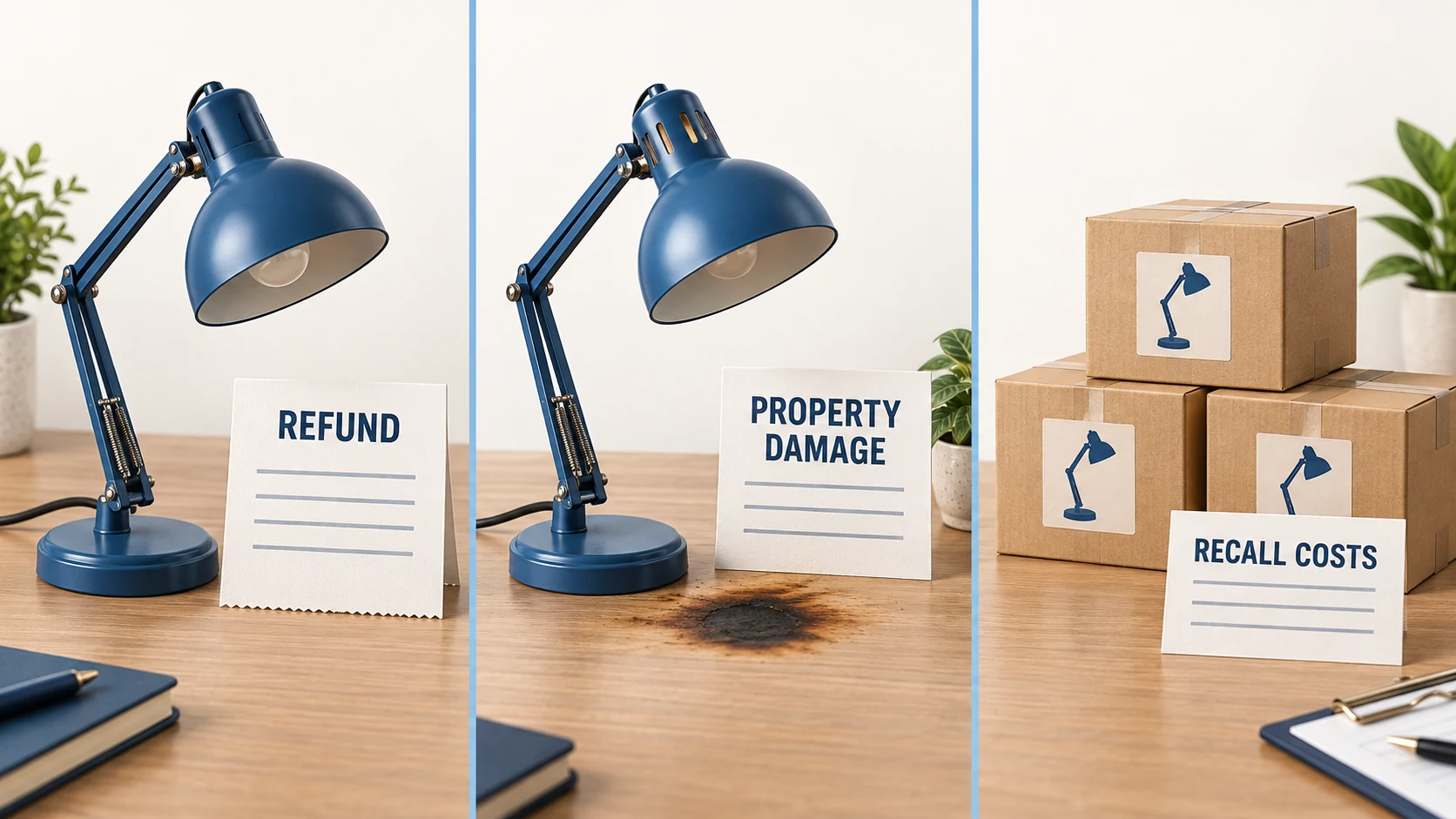
Consider a hypothetical desk lamp sold through your store and shipped by an overseas supplier. Three complaints could follow, with very different financial consequences:
| What happens | The cost you are trying to address | Coverage question |
|---|---|---|
| The lamp does not work | Refund, replacement and postage | Is this an ordinary commercial expense rather than an insured loss? |
| The lamp allegedly overheats and damages a customer’s desk | Defense and possible liability for damage to someone else’s property | Does the policy cover this product and alleged event? |
| A fault is identified across a batch | Notifications, retrieval, disposal and other recall expenses | Is appropriate recall coverage included, and does the event trigger it? |
A single “product problem” label hides those differences. Product liability generally addresses covered claims involving injury or damage to other property; it should not be treated as a warranty for the product you sold.
The US Small Business Administration’s insurance guidance identifies retailers and distributors among the businesses for which product liability is relevant. The fact that another company manufactured or packed the item does not, by itself, answer whether your business could be named in a claim.
Describe what the product does and how it is used when seeking a quote. An ordinary fabric organizer, a mains-powered lamp, a child’s feeding item and an ingestible supplement present different questions. Do not reduce all four to “general ecommerce accessories” on an application.
02
Match the loss to the type of coverage
Begin with the loss you need to finance, then ask which policy provision might respond. Buying several policies with reassuring names can still leave the particular loss outside their scope.
| Coverage to discuss | What it may address | What needs separate attention |
|---|---|---|
| General liability with appropriate product coverage | Covered third-party bodily injury or property-damage claims, including relevant product exposures | Product classes, exclusions and whether product coverage is actually included |
| Product recall | Defined costs of an insured recall event | Covered triggers, expenses, limits and whether replacement costs are included |
| Cyber | Covered breach response, third-party claims or specified interruption losses | Supplier/app incidents, security conditions, fraud sublimits and incident reporting |
| Cargo or goods-in-transit coverage | Covered physical loss or damage to goods in transit | Who owns the risk, insured routes, valuation, exclusions and who can claim |
| Property or a business owner’s policy | Relevant business property and other included coverages | Whether you actually own stock or equipment and where it is located |
| Excess or umbrella liability | Additional liability limits over qualifying underlying insurance | Which underlying policies and losses it follows; exclusions can remain |
For a carrier example, The Hartford describes product liability as included in its general liability offering, subject to availability and policy terms. That does not establish that every general liability quote from every insurer includes your product class.
The Hartford also distinguishes product recall expenses from product liability claims. Ask separately about retrieving stock and notifying customers; do not infer recall reimbursement from a liability limit on a certificate.
For cyber coverage, Travelers describes first-party response expenses and liability to others, with different insuring agreements. Use that distinction when discussing a customer-data breach, fraudulent supplier-payment instruction or store outage. They are not interchangeable events, and a policy may treat them differently.
These are explanations of published coverage categories, not recommendations that either carrier will accept your business. Obtain terms for the actual products and operating model.
What insurance should not replace in your budget
Keep normal returns, defective-item replacements, advertising losses and unprofitable orders in your operating plan. Do not assume a liability policy pays for poor sales, a marketplace suspension, a routine late delivery or every payment dispute.
If a broker identifies a specific policy that addresses an exposure, ask for the relevant provision and conditions. Until then, retain cash for the ordinary returns and refund process. An insurance application is not a reason to stop funding customer remedies.
03
Check which insurance is required for your business
Separate legal requirements from contractual ones. State law, employees, vehicles or regulated activities may create obligations. A marketplace, landlord, supplier agreement or wholesale customer can also impose insurance conditions. There is no useful universal answer based only on the word “dropshipping.”
A licensed professional familiar with your state and products can identify the applicable requirements. If your company is outside the US but sells to US customers, say so at the start: eligibility, claim jurisdiction and required policy wording may differ from those for a US-based retailer.
Amazon.com: current requirements and an announced change
Amazon’s published commercial-liability guidance describes obtaining and maintaining coverage within 30 days after exceeding $10,000 in gross proceeds in any one month on Amazon.com, or when Amazon otherwise requests it. It specifies at least $1 million per occurrence and in aggregate, alongside other policy conditions. Read the complete current requirements for your account; the sales threshold is not a general legal safe harbor.
A separate Amazon announcement has a November 2, 2026 effective date. It adds coverage requirements for products in categories with enhanced safety listing requirements regardless of that sales threshold, applying to new and existing listings. Examples include children’s products, cosmetics and ingestibles, and lithium-battery products; the category list is broader than these examples.
The same announcement says Mainland China sellers must use Amazon Insurance Accelerator for newly submitted policies from that date. Compliant third-party policies submitted before November 2 can continue until expiry, after which that route is required. These are announced future conditions as of this article’s September 21 check. Verify the official Amazon announcement and its linked requirements against your products, entity and renewal date.
Do not buy a policy merely because its limit looks large enough. The insured entity, product coverage, additional-insured wording and other conditions still matter. Nor should an Amazon-compliant policy be assumed to cover every sale through your own website or another marketplace.
04
Disclose the supplier and the complete product range
An insurer needs to know what your company actually does. Explain that orders are fulfilled by third parties, where those suppliers are located, whether you import the goods, whether products carry your brand, and where customers receive them.
Send a current product list and the relevant descriptions. If you plan to add electrical products after initially selling fabric goods, ask how that change affects coverage before listing them. A description accurate at application can become inaccurate as the catalog changes.
Tell the insurer about prior complaints, claims and known incidents when requested, even if the supplier says it will handle them. Give factual information rather than diagnosing liability yourself. The insurer’s acceptance should be based on the business it is actually being asked to cover.
For each supplier, retain enough information to identify the item supplied and investigate a complaint. Product specifications, purchase records, batch information where available, labels and safety-related documentation may matter. A general certificate for a different model is not evidence about the item you sold.
Your quality-control process reduces preventable failures and helps preserve useful records. It does not certify that a product is safe for every use or guarantee that an insurer will pay a claim.
05
Read the clauses that can change the claim outcome
Ask for the proposed policy forms and endorsements, not only the premium and certificate. A certificate summarizes insurance information; it is not a substitute for the contract that defines coverage.
Use the desk-lamp example to make the conversation concrete: “We sell this model under our store name, it is shipped from this supplier to US customers, and a customer alleges it damaged a desk. Which provisions would you assess?” The answer should identify coverage and relevant conditions rather than simply say “you have liability.”
| Policy detail | Question to resolve before purchase |
|---|---|
| Named insured and business description | Does the policy identify the legal entity and the actual retail/import/private-label activities? |
| Covered products and exclusions | Are any listed products, components, uses or allegations excluded? |
| Territory and jurisdiction | Where may the product be sold, where may the event occur, and where may a claim be brought? |
| Per-occurrence and aggregate limits | What can apply to one event, and what can be exhausted across the policy period? |
| Defense costs | Are defense expenses inside or outside the relevant limit? |
| Deductible or retention | What amount must the business fund, and when does the insurer’s obligation begin? |
| Policy trigger | Is coverage occurrence-based or claims-made, and what dates matter? |
| Notification and consent | How quickly must you report, and what spending or settlement needs approval? |
| Recall and other extensions | What specific expenses and triggers are covered, with what sublimits? |
Ask the broker to explain exclusions using your own catalog. An exclusion for a product type, ingredient, battery or particular use can matter more than the headline limit. Do not rely on a supplier’s assurance that “all our other sellers are insured.”
For an occurrence-based policy, the timing of the covered injury or damage is central. For claims-made coverage, the timing of the claim and reporting requirements, together with any retroactive date, can be decisive. Exact definitions vary. When switching carriers or closing the business, ask how earlier sales and later complaints are treated before allowing a gap or canceling coverage.
06
Do not rely on the supplier's certificate alone
A supplier’s insurance may protect the supplier under its own policy. That is not the same as confirming protection for your legal entity. Obtain the certificate through a verifiable channel and ask about the underlying coverage relevant to your relationship.
If your agreement calls for your business to be an additional insured, ask the insurer or broker to confirm the appropriate endorsement and its scope. Being mentioned in a commercial agreement or receiving a certificate does not, by itself, establish the coverage you expect.
Also separate insurance from the supplier’s promise to reimburse you. A contract might allocate responsibility for defective products, but recovering money can depend on the facts, contract, supplier’s resources and enforceability. Your own insurer should know about relevant agreements and rights of recovery.
For the lamp example, “the factory will replace the lamp” addresses a small part of the problem. It does not answer who handles the customer’s property-damage allegation or a wider batch investigation. Those arrangements belong in your risk-management plan, alongside the policy review.
07
Send insurers the same facts before comparing prices
Prepare one submission that every broker or insurer can evaluate. Otherwise, the cheapest quote may simply describe a narrower business.
Include your legal entity and location, websites and sales channels, current and forecast sales by market, full product categories, supplier and fulfillment countries, branding/import activities, relevant contracts, claims history and the protections you want assessed. Explain any inventory or equipment you own, including goods stored by someone else.
Ask each provider to identify exclusions, limits, deductibles or retentions, covered territories, defense-cost treatment and required endorsements. Confirm taxes, fees, installment costs and the effective date. These details make premiums comparable.
For budgeting only, imagine two hypothetical quotes with the same annual coverage scope: $900 and $1,400. At 2,000 orders a year, allocating those premiums evenly gives $0.45 and $0.70 per order. At only 500 orders, the same allocation becomes $1.80 and $2.80. These numbers are not market quotes, and dividing the premium does not create per-order insurance.
The $500 premium difference is worth evaluating against the terms, not just the order count. If the less expensive option excludes your main product, the allocation calculation is irrelevant. If it has a larger retention, model whether you could fund that amount while continuing customer service and operations.
There is no reliable universal premium for “a dropshipping store.” Product risk, jurisdiction, sales, claims history, limits and underwriting all affect the offer. Request a written quote based on your disclosed facts rather than borrowing a monthly price from an unrelated seller.
08
Prepare for a complaint before it becomes a claim
Decide who receives safety complaints and who contacts the insurer. A support ticket alleging a burn or property damage should not disappear into the same routine as a request for a different color.
Preserve the customer’s account, order record, product identification, supplier invoice, photographs and correspondence. Record facts and times. Avoid disposing of relevant goods or rewriting the original listing without preserving a copy. If the product appears unsafe, stop further release of the affected stock while the appropriate safety and reporting steps are assessed.
Notify the insurer through the policy’s reporting channel promptly, and follow its instructions about evidence, defense and settlement. Do not promise that the insurer will pay or negotiate a liability settlement without checking the applicable conditions. Urgent assistance and legally required actions still need timely attention.
Coordinate the customer response, supplier investigation and any required regulatory reporting. Insurance does not replace product-safety duties. Keep ordinary customer-service remedies separate from any claim decision so the support team does not give misleading assurances.
At renewal, revisit the product list and sales markets, not just the premium. New suppliers, private labeling, higher-risk categories and a change in where the business is based can make last year’s submission an incomplete description of this year’s exposure.
09
Insurance questions for dropshipping sellers
Do I need insurance if I never touch the product?
You may still face claims concerning something your store sold. Physical possession is only one part of the business model. Discuss your selling, importing and branding roles with a licensed insurance professional and check applicable contracts.
Does an LLC replace product liability insurance?
No. Entity structure and insurance address different issues. An LLC does not supply money to defend or pay a covered claim, and the scope of liability protection depends on the circumstances and law.
Will insurance pay for every refund or chargeback?
Do not assume so. Ordinary refunds and payment disputes need their own operating reserve and handling process. Any potentially relevant insurance depends on a specific covered event and the policy terms.
Can I buy one policy for worldwide sales?
Some policies can accommodate broader territories, but coverage territory and where a lawsuit can be brought need separate confirmation. Tell the insurer where the entity, suppliers and customers are located before buying.
Should I wait until Amazon asks for a certificate?
A platform’s request is only one trigger for reviewing coverage. Evaluate the product exposure before taking orders, then confirm the requirements for your marketplace, category and entity. The announced November 2, 2026 changes make relying on the sales threshold alone particularly unreliable for affected sellers.