
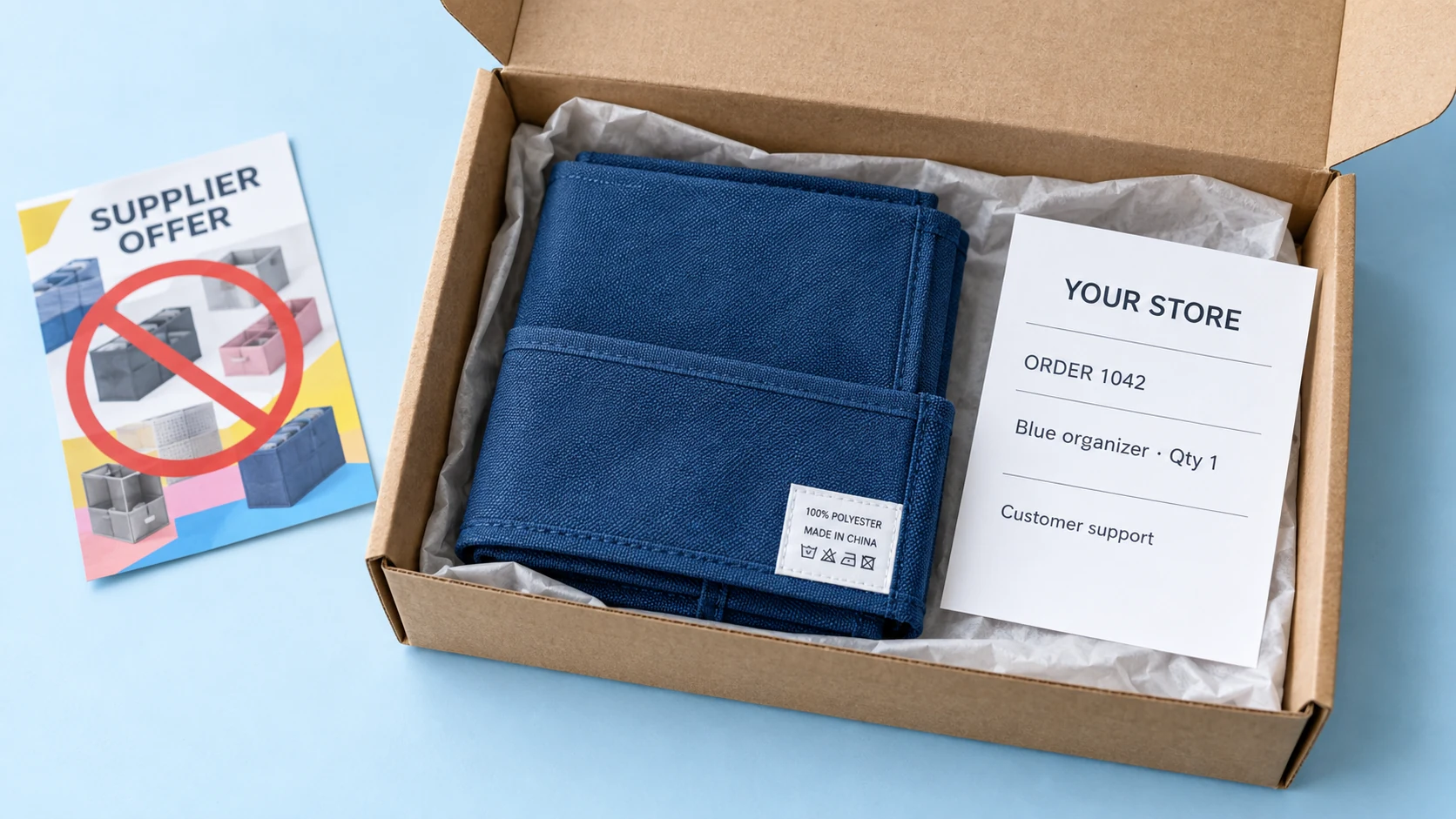
Blind dropshipping means a supplier ships directly to your customer using agreed neutral or retailer-facing packaging, without promoting its own business in the parcel. It commonly involves removing supplier marketing and wholesale price slips, or using your store’s packing slip. It does not authorize false shipment details or removal of required product labels and customs information.
For a customer, the benefit is a coherent order: the store they bought from, the product that arrives and the contact for help all make sense together. For the retailer, the work is agreeing which details can change and which must remain accurate.
01
What blind dropshipping changes
The order still follows an ordinary supplier-fulfilled route. Your customer buys from your store, you send the supplier the authorized order details, and the supplier packs and ships the goods. The difference is the agreed presentation of that shipment.
A plain mailer without a supplier advertisement may be enough. Another store may need its logo on a packing slip, a support email and a return reference. These are different levels of service, and the word “blind” does not tell the warehouse which one you mean.
| Arrangement | What it changes | What it does not establish |
|---|---|---|
| Neutral or blind fulfillment | Supplier-facing marketing and selected parcel paperwork | That the product is your exclusive design or that its origin is hidden |
| Branded packaging | Mailer, box, insert or packing slip carries your store identity | That every warehouse or shipping route supports the same materials |
| Private-label product | An agreed product carries your branding, subject to applicable requirements | That required manufacturer, origin or safety information can be deleted |
Providers sometimes use these terms differently. Describe the actual packing materials and documents you want instead of relying on the service name. Our dropshipping fulfillment guide covers the wider order and warehouse process.
02
Separate the documents inside and outside the parcel
Several documents can accompany one order, each serving a different purpose. Treating them all as “the invoice” is a common source of mistakes.
A packing slip tells the recipient what is in the shipment. It may show an order reference, item description, quantity and customer-support details. A supplier’s wholesale invoice records your purchase from that supplier. Your customer’s sales receipt records the retail transaction. A customs invoice provides information for border clearance. A transport label tells the carrier where and how to move the parcel.
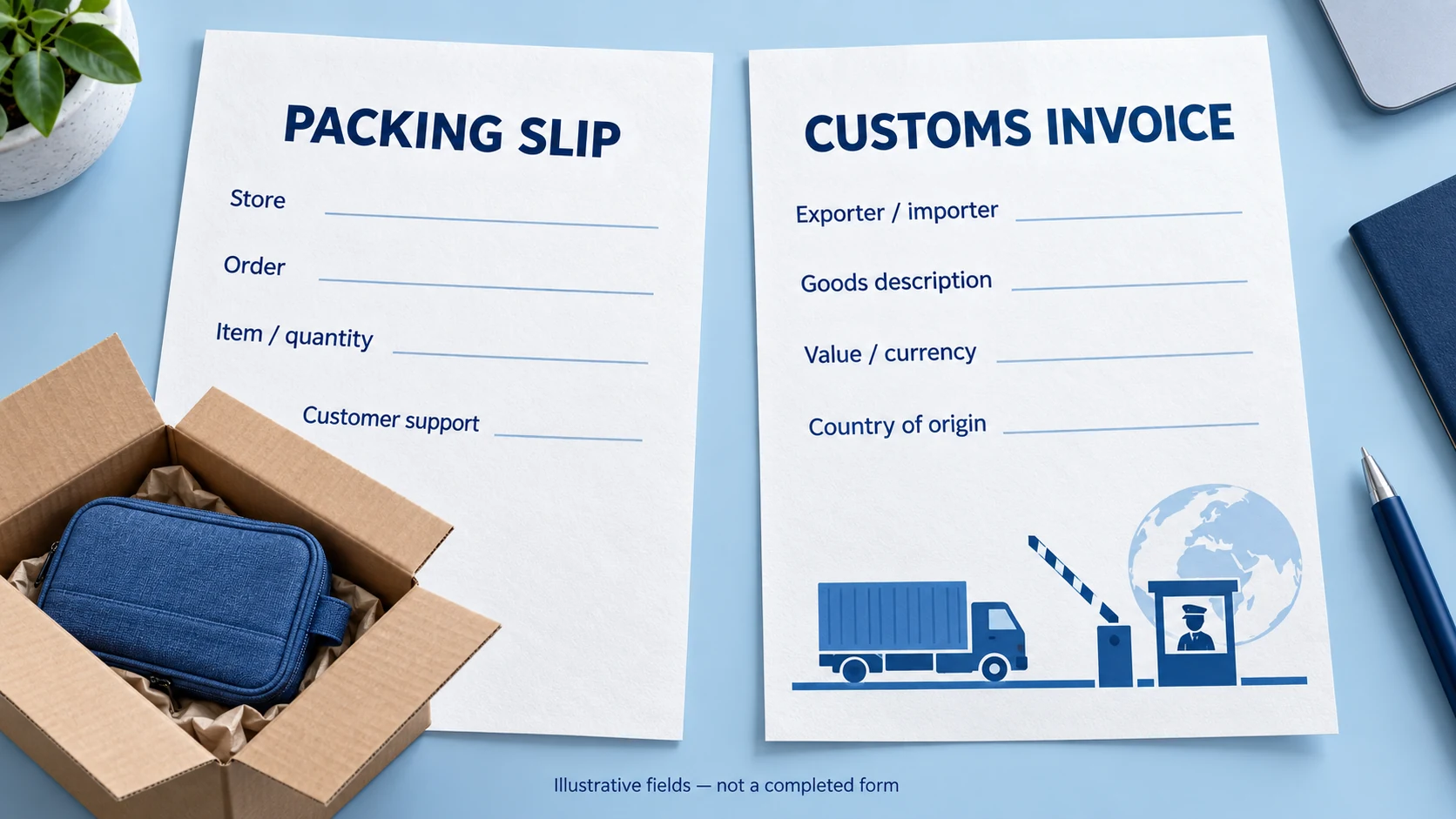
| Document or surface | Typical blind-fulfillment request | Information that still needs attention |
|---|---|---|
| Outer mailer or box | Use neutral packaging or an approved store design | Carrier labels, handling marks and any required warnings |
| Packing slip | Use the store name, order reference, items and support details | Correct variant and quantity; valid instructions for assistance |
| Supplier wholesale invoice | Keep the purchasing record with the retailer rather than adding a price advertisement to the parcel | Accounting, transaction and any required shipment records still exist |
| Customer receipt | Provide the retailer’s appropriate sales document | Accurate seller identity and transaction information |
| Transport label | Use an agreed, carrier-accepted sender arrangement | Truthful routing, recipient and return details |
| Customs invoice | Prepare the document required for the shipment | Accurate parties, goods, value, origin and other required data |
Ask the supplier which documents are printed, attached externally or sent electronically. Removing an optional wholesale price insert is a packaging choice. Changing the value on a customs declaration to conceal your buying price is a different action and is not part of a legitimate blind-shipping instruction.
DHL’s shipping-document guidance distinguishes transport labels from customs invoices and describes the parties, goods and transaction information used for clearance. Requirements vary with the shipment, destination and service. Have the carrier or broker confirm the correct documentation for that route.
03
Agree what the supplier will remove or replace
Make the instruction specific enough for someone packing the order to follow. For example, the following is a hypothetical specification for a retailer selling a fabric organizer:
Use a plain protective mailer. Do not include supplier discount cards, catalogs or an optional wholesale price slip. Include our approved packing slip showing the customer’s order reference, organizer color, quantity and support contact. Keep all required product information and shipment documents intact. Use only the sender and return details agreed for this carrier route. If the approved materials are unavailable, hold the order and contact us before substituting them.
The instruction answers practical questions a vague “blind ship please” message leaves open. It also identifies what to do when the warehouse cannot comply.
Attach the actual packing-slip file or template reference, with a revision date. Specify whether the slip is per order or per parcel. For a two-parcel order, a slip showing every item as enclosed can make a correct split shipment look incomplete.
Agree who approves a change, how the supplier records it and whether the instruction applies to all orders or only selected products. A note attached to one sample purchase may not automatically carry into future orders placed through an integration.
04
Check branding support for the actual fulfillment route
Published provider examples show why route-level confirmation matters. They are descriptions of each provider’s stated service, not evidence that every supplier offers the same arrangement.
Printful says its shipments do not include Printful branding, and it offers packing-slip personalization. The same help page notes that fulfillment-partner locations do not support custom packing slips or custom mailers. A retailer could therefore have a neutral shipment without all the requested branded elements.
Printify’s branding guidance ties inserts, gift messages and product-decoration options to supporting print providers. Availability needs to be checked for the actual product and provider combination, especially if an order is rerouted.
For a different kind of supplier, Global O-Ring and Seal describes a blind drop-shipment service that replaces its identifying information with the customer business’s details. That is a specific industrial supplier offering, not a universal description of what can be changed on every consumer product.
Ask whether an alternative warehouse, supplier-direct shipment or split parcel follows the same instructions. If branded mailers run out, decide in advance whether an approved neutral mailer is acceptable. If it is, the customer-facing promise should allow that variation.
05
Keep shipment origin and product labels accurate
Neutral packaging does not make an overseas shipment domestic. A return center in the buyer’s country also does not change where the outbound parcel started.
For sellers on eBay, the item-location policy requires accurate dispatch location in the listing and matching tracking information. Use the actual fulfillment arrangement when setting the delivery promise, even if the supplier’s marketing logo never appears.
Product labels are a separate matter from marketing inserts. In the US, the FTC’s apparel guidance explains that most textile and wool products need fiber content, origin and the identity of the manufacturer or another responsible business. Care-label requirements also apply to relevant manufacturers and importers. Other products and markets have their own identification, traceability or warning requirements.
Do not give a blanket instruction to remove all manufacturer information. Review the actual label and product category before approving any replacement. Your brand can appear alongside required information; a logo alone cannot substitute for it.
Amazon sellers also need to fit the marketplace’s dropshipping requirements, including the seller-of-record arrangement, parcel presentation and returns responsibility. Required product markings and seller identification must be resolved together. If a supplier cannot supply the product in an arrangement that meets both requirements, the product is not ready for that channel.
06
Plan the return address before printing it
A return address must lead to a place that can actually receive and identify the parcel. Replacing a supplier address with your office address is unhelpful if the office refuses deliveries or has no process for matching returned items to customers.
Distinguish an undeliverable parcel returning through the carrier network from a customer-initiated return. The first may follow the original transport label. The second may require a return authorization and a different receiving address. Tell the customer which process to use; do not assume a printed sender address covers both.
Suppose a retailer prints a domestic returns-center address on all parcels, but the center is contracted only for registered returns. A buyer sends a package there without a reference. The center may be unable to connect it to an order, leaving the retailer with a customer asking for a refund and no identified receipt.
Prevent that problem by agreeing how the center identifies an arrival, where the record is sent and who decides the next action. Retain the customer order number, returned SKU, condition evidence and receiving date. Decide whether the goods can be restocked, returned to the supplier or disposed of with authorization.
The supplier’s reimbursement rules and your customer obligations can differ. Keep a funded remedy process even if the supplier declines an ordinary change-of-mind return. Our dropshipping returns guide covers those responsibilities beyond the parcel label.
07
Inspect a sample parcel from the route you will use
Order a sample through the intended packing and shipping route before making a packaging promise to customers. A product sample shipped by a sales representative may bypass the warehouse instructions used for normal orders.
Review the parcel from the outside inward:
- Outer package: Is the mailer or box the approved type? Are there unintended supplier promotions or an old address beneath a new label?
- Transport label: Are the recipient and agreed sender/return details correct for the service? Does the route match what the store promises?
- Contents and paperwork: Do the packing slip, item, variant and quantity agree? Are required product labels, instructions and warnings present?
- Customer help: Can the customer identify the store and find valid support and return instructions without guessing which company to contact?
Keep photographs of the actual sample and compare them with the approved specification. If an insert is wrong, identify whether the issue came from the saved template, the order note or the warehouse packing process. Correct that cause and verify the affected element again.
Where two warehouses or fulfillment providers are likely to handle your assortment, inspect their outputs separately. One correct parcel proves what happened on that shipment; it does not establish that every route uses the same materials.
After launch, review customer photographs and return reasons for changes. A new supplier advertisement, different slip or missing instruction sheet can reveal a route or packing change worth investigating.
08
Calculate the extra handling and packaging cost
Blind fulfillment may already be part of a supplier’s standard process, or it may require paid work. Ask for the actual quote rather than assuming neutral packaging is always free.
The costs can include replacement packaging, removing optional inserts, printing a slip, storing custom materials, setup work and disposing of unused stock. A larger branded box may also change the shipping charge even if the product itself is unchanged.
For an illustrative quote, suppose the approved mailer costs $0.40 more than the standard packaging, the insert costs $0.10 and extra handling costs $0.35. That is $0.85 per parcel, or $85 for 100 parcels, before setup, storage or any freight difference. If an order splits into two parcels and the same charge applies to each, the packaging and handling addition is $1.70 for that order.
This example shows why the billing unit matters. Confirm whether the fee is per item, order, parcel or packing operation. Our fulfillment cost guide explains the surrounding charges; reconcile them with the supplier’s written quote before promising a delivered price.
09
When blind fulfillment is worth using
It is useful when the supplier’s ordinary marketing would confuse customers, when several suppliers need to present orders consistently, or when your support information should travel with the product. A simple neutral parcel with a correct slip can accomplish that without an expensive custom box.
It has less value when the underlying product, delivery and remedy are still unreliable. Replacing a logo will not correct the wrong variant or a shipment that misses the agreed window. Approve those basics alongside the parcel presentation.
Choose the minimum packaging change that solves the customer problem, record the specification and verify the route. Add more branding when its cost and operational requirements make sense for the business.
10
Blind shipping questions
Is blind dropshipping the same as private labeling?
No. Blind fulfillment concerns how the supplier presents the shipment. Private labeling concerns an agreed product carrying your brand. A neutral parcel can contain an ordinary branded product, and a private-label product still needs correct shipment documents and required markings.
Can I remove the supplier’s invoice?
You can agree not to include an optional wholesale invoice or price insert in the customer parcel. Keep the purchasing records and any documents required for the shipment. A customs invoice has a separate purpose and must contain accurate information.
Can my store appear as the sender?
An agreed retailer-facing sender arrangement may be possible, but the details must be accepted for the actual carrier service and return route. Do not print a fabricated address or imply a dispatch location the shipment does not use.
Will the customer be unable to identify the manufacturer?
Do not promise complete anonymity. Required labels, branded products, customs information or tracking may identify parties or locations. The practical objective is clear store presentation and support, with required facts preserved.
Who handles a customer complaint?
The retailer remains the customer’s contact. The supplier can help investigate and provide an agreed remedy, but neutral packaging does not transfer responsibility away from the seller.