
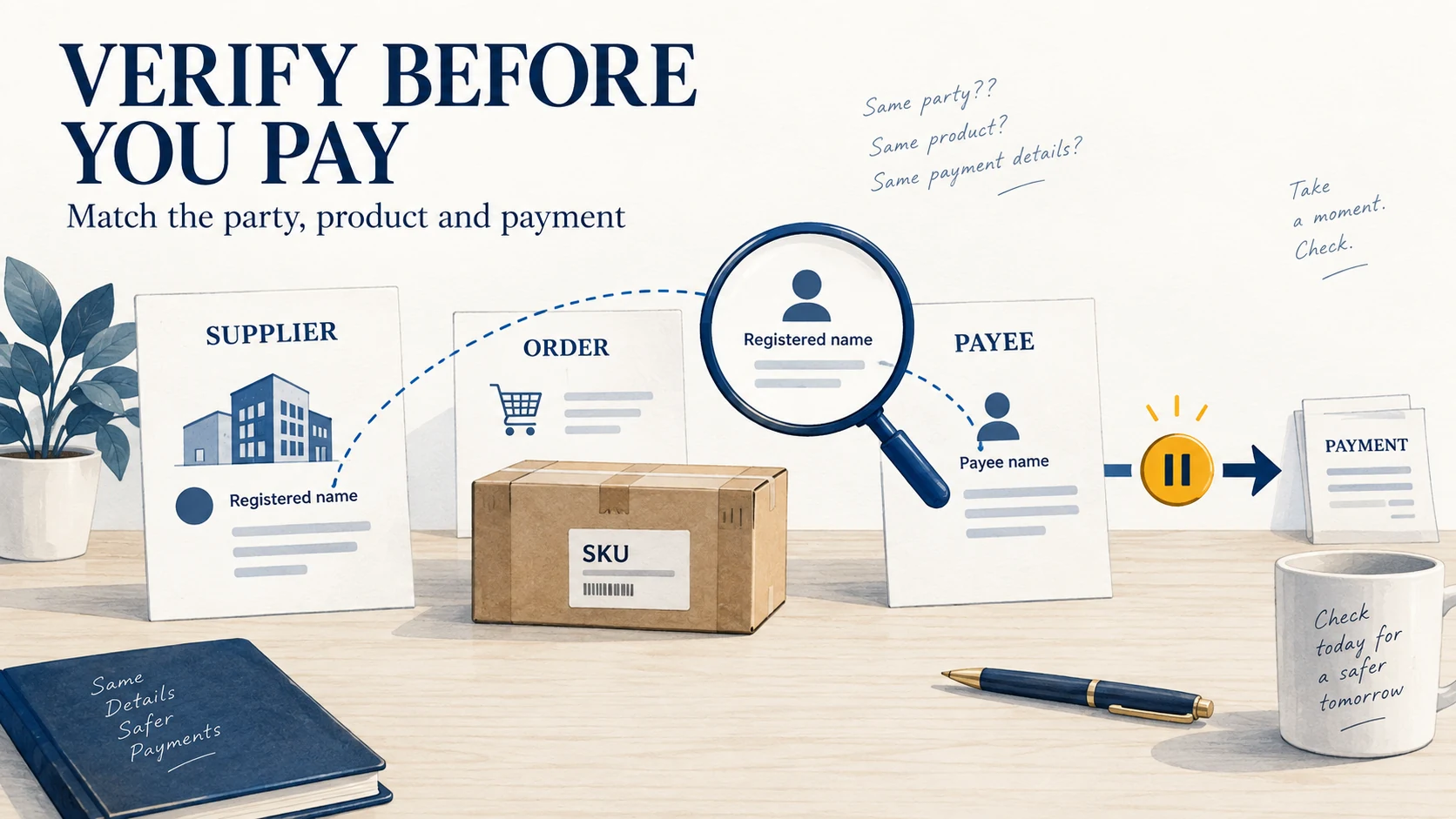
A dropshipping supplier deserves closer scrutiny when the company receiving your money, the goods being offered, or the fulfillment promise cannot be supported by consistent evidence. Pause payment over an unexplained beneficiary change or a material contradiction. A young business, a subscription fee or a shared warehouse needs context; none proves fraud on its own.
The useful question is what the finding prevents you from trusting. An incorrect bank account threatens the payment. An unverified stock location threatens the delivery promise. A vague damage policy threatens your margin after the sale. Treating all three as the same problem makes it harder to decide what to do next.
01
Start with the finding, not the accusation
A warning sign is a reason to investigate. Evidence of a false claim is stronger: for example, a supplier says a particular inspection company issued its report, and that company confirms the report number belongs to a different business. Even then, establish what happened before describing the supplier publicly as fraudulent.
Use the seriousness of the unresolved issue to control your next commitment:
| Finding | What it puts in doubt | Proportionate response |
|---|---|---|
| Bank details change shortly before payment, with pressure to act | Whether the recipient is authorized | Hold payment and verify through an independently established contact |
| Contract name, registration and beneficiary do not match | Which entity owes you the goods | Obtain and verify the explanation and collection authority |
| A claimed US-stock variant cannot be traced to an available dispatch location | Whether the promised route exists | Keep that delivery claim off your store until tested |
| The quote omits shipping, packaging or claim terms | Whether the offer is commercially acceptable | Complete the quote before comparing its price |
| The business is new or uses common catalog photographs | How much independent evidence is available | Seek stronger identity and product evidence; do not infer fraud from appearance |
Some suppliers will be legitimate but unsuitable. A made-to-order manufacturer may be unable to ship single units; a capable wholesaler may offer no returns for customer size changes. Those are reasons to choose another arrangement when your store needs those services. They are not evidence that the business is fictitious.
For the broader selection process, the dropshipping supplier guide explains how sourcing, stock ownership and fulfillment responsibilities fit together.
02
A changed payee deserves an immediate pause
Consider a hypothetical first order. You agree to pay Supplier A, receive an invoice, then get a message saying its account is under review and payment must go to an individual’s account before the price expires. The message includes a phone number for confirmation.
Do not use that new number as your only check. Contact the business through a number or account you independently established earlier, and ask it to confirm the invoice and payment instruction. The FBI’s business email compromise guidance specifically recommends independently verifying changes to payment procedures and account details. A familiar email thread can itself be compromised.
An affiliated company, payment processor or authorized export company may collect funds legitimately. That needs a documented relationship to the contracting supplier, not just a reassuring chat message. Establish who is selling the goods, who receives payment, why the names differ and which party will handle a dispute. Save the confirmed details with the order.
Urgency does not resolve an identity mismatch. If the supplier will not provide a verifiable explanation, keep the payment on hold. Losing a temporary discount is preferable to paying a party whose role you cannot establish.
03
Verify the business behind the catalog
Request the registered business name and registration number, then compare them with the appropriate official register where accessible. Check whether the name on the quotation and contract refers to that entity. An English trading name may differ from the registered local-language name; record the relationship rather than expecting every name to look identical.
Registration establishes an identity and recorded status. It does not prove stock availability, manufacturing capability, solvency or the quality of your next shipment. A copied registration document can also belong to a real business the person contacting you does not represent.
The physical address needs the same care. An office, registered address, factory, fulfillment warehouse and returns center can all be different places. A trader using a third-party warehouse may be entirely legitimate. Ask which location performs the work you are buying, and request evidence tied to that operation and your product.
Alibaba describes its Verified Supplier program as involving third-party onsite verification and an assessment report. Read the report’s company name, date, location and assessed capabilities. Treat it as evidence about those checks. It does not, by itself, approve every SKU for your destination market or inspect the goods allocated to your order.
Product documentation also has a scope. A report for a different model, material or manufacturer may not answer your product question. Match identifiers and, when the document matters to the purchase, verify it with the named issuer. A certificate image in a sales deck is not enough to resolve a mismatch.
04
A low price needs an itemized explanation
An unusually low quote can reflect a different specification, quantity, shipping arrangement or service level. It can also be a bait-and-switch. You cannot distinguish these possibilities by applying a universal percentage discount threshold.
Suppose one supplier quotes $6 for an item and another quotes $10 delivered. The first still needs $3.50 shipping and $0.80 packaging and handling. Its comparable cost is $10.30 before any other exclusions. The advertised $4 saving has disappeared without either supplier changing its price.
That example is illustrative, not a market rate. The same comparison must also match the exact variant, material, accessories, packed dimensions, dispatch origin and destination. A heavier replacement material or different box can change both product and freight cost.
Use a supplier quote comparison to make the exclusions visible. Ask for a validity period and what happens if a carrier surcharge changes after you accept. A quote that keeps changing only after payment is much more concerning than one that clearly states its limits in advance.
Membership and service fees need itemization too. Paid sourcing, software, branding and storage can be legitimate services. Identify what the charge buys, when it renews, whether it is refundable and whether you can assess the products before committing. Guaranteed earnings or a promise that the fee alone will produce sales offers no evidence about fulfillment quality.
05
Test the claims a website cannot prove
A paid sample should represent what the customer would receive: the exact variant, packaging and intended shipping route. A premium sample sent by express courier cannot establish the performance of the economy service you plan to sell.
Record the order date, the supplier’s acceptance, the first meaningful carrier event and delivery. A created label shows that shipment information exists; it does not prove a carrier has the parcel. If the tracking history starts later than expected, ask for an explanation and supporting handoff information rather than assuming either a successful dispatch or a scam.
On arrival, compare the item with the agreed specification. Look at size, material, accessories, labeling, damage, packing and any unrelated seller invoice or promotion. Photograph the parcel and retain the order reference. The sample approval guide provides a fuller way to record what was actually tested.
Refusal to provide any workable product verification before a substantial commitment is a reason to stop. But a refusal to sell one custom-made unit has a different explanation from a refusal to supply a stocked catalog sample. Ask whether there is an existing sample, a paid prototype, a small production run or an independent inspection option. If none fits your budget, the arrangement may simply be wrong for your stage.
A good sample is limited evidence. It does not prove every later unit, color or batch will match. Record whether substitutions are permitted, which changes require approval and how the supplier will identify the goods used in future orders.
06
Read the payment and remedy terms together
The payment method matters, but its name alone does not establish protection. A bank transfer to an account specified inside a legitimate platform order differs from a transfer requested through an unrelated chat. Card payments and platform transactions also have eligibility rules and deadlines; do not assume every commercial dispute is automatically refundable.
For Alibaba orders, the Trade Assurance explanation ties protection to the order arrangement and payment through Alibaba.com. Its buyer guide describes using the designated account shown in the order details. Record measurable product and shipment requirements in the actual order, and read the applicable claim terms before paying. A supplier badge is not a substitute for this transaction record.
Then read the supplier’s remedy policy as a practical sequence. For a damaged item, what evidence must you provide, by when, and to whom? Must the customer return it first? Who pays the return label and replacement shipment? Is the remedy cash, store credit or another unit?
Distinguish manufacturing defects from customer preference, wrong-size selection and delivery loss. A supplier may cover one and exclude another. Your customer-facing obligations and promises remain a separate matter; an unfavorable supplier policy can leave you paying the customer even when the supplier owes you nothing under its terms.
07
Set a small first commitment and an exit
Once identity and payment concerns are resolved, start with an amount and order volume you can support if something goes wrong. Include unfulfilled orders, prepaid wallet balances, packaging deposits and goods already committed to production when assessing exposure. Looking only at the next invoice understates what is at risk.
For an initial pilot, record a few useful outcomes: whether the agreed SKU shipped, whether the parcel entered the intended route, whether the supplier answered an exception clearly and whether the final invoice matched the quote. Define what finding would stop new orders. A repeated unexplained substitution, for example, should not be treated as a harmless communication issue.
If you suspect a fraudulent payment has already been sent, contact your financial institution promptly and preserve the invoice, messages, payment reference and account details. The FBI advises immediate contact with the financial institution in a suspected business email compromise. Report through the relevant platform and authorities as appropriate. Recovery is not guaranteed, so avoid sending another payment merely because someone claims it will unlock the first one.
08
Questions about supplier warning signs
Is a supplier charging a monthly fee a scam?
Not necessarily. Establish whether the fee pays for catalog access, software, sourcing or another defined service. Unclear charges and unverifiable promises are the concern. A paid plan can be legitimate and still offer poor value for your store.
Does a trading company count as a bad supplier?
No. A trader can provide consolidation, sourcing and communication that a factory does not offer. The problem is a false representation of its role or an inability to deliver the agreed service. Know which party controls production and which handles your order.
Can one test order prove a supplier is reliable?
It proves what happened on that order. Combine it with identity checks, written terms and monitored early orders. Increase your commitment as evidence improves, and recheck when the product, warehouse or payment arrangement changes.
What is the strongest reason to stop before paying?
An unresolved contradiction affecting who receives the money or what you will receive. A polished website cannot compensate for that gap, and a small trial payment does not make an unexplained recipient legitimate.