
A dropshipping refund policy should explain how customers cancel, report a problem, return an eligible item and get their money back. Give them the contact details, deadlines, costs and exceptions they need to act. Your store remains responsible for the customer rights that apply to its sale, even when a supplier handles fulfillment.
The difficult part is often behind the policy page. Can support stop an order? Will the return address accept the parcel? Can the store refund a customer before the supplier issues credit? Settle those questions for the products and markets you serve before promising a process to customers.
Below is a drafting structure with operating examples and selected official guidance checked on September 16, 2026. It needs adapting to your products, markets and actual return arrangements before use as a policy.
01
Separate the customer promise from supplier reimbursement
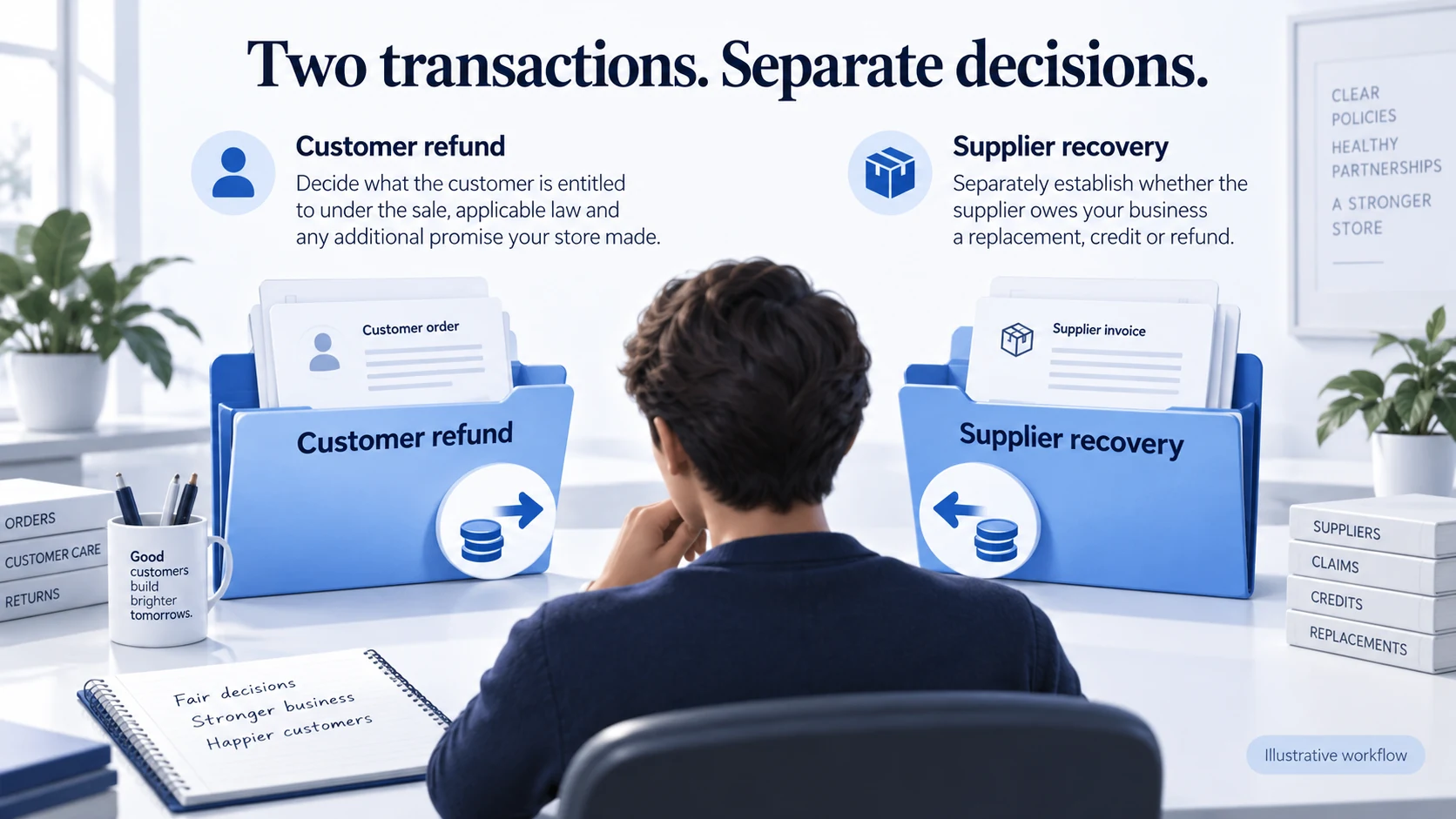
The customer paid your store, and your store paid a supplier or fulfillment business. Each relationship has its own terms. A claim deadline in the supplier agreement can be much shorter than the period in which the customer has a remedy.
Customer refund: apply the rights attached to the sale and any extra promise your store made. Give the customer one contact and a usable remedy.
Supplier recovery: claim the replacement, credit or refund due to your business, with the agreed evidence and within the supplier’s deadline.
Suppose a supplier allows seven days to claim for delivery damage. That deadline belongs in your internal claim procedure. Copying it into a blanket “no refunds after seven days” customer policy may conflict with consumer rights. Any gap between what you owe and what the supplier covers remains a cost to assess when choosing the supplier.
Shopify’s dropshipping compliance guidance also treats the merchant as responsible for its business and customer obligations. An app that forwards orders does not decide which promises the store may make.
A supplier conversation should establish four things: the problems covered, the return destination, the evidence required and the reimbursement timing. Unanswered questions need an operating decision; a vague policy exception will leave support with the same problem later.
02
Check the rules in the markets you serve
Keep three subjects distinct: statutory cancellation, remedies for faulty goods and any extra return period your store offers. A voluntary extension can be generous without changing the rights that already apply.
UK online sales
GOV.UK describes the ordinary online cancellation process in stages:
- The customer generally has 14 days after receiving the goods to notify the seller of cancellation.
- They then have another 14 days to return the goods.
- The seller must refund within 14 days of receiving the item back, including standard outbound delivery. The extra cost of a delivery upgrade need not be refunded.
Product-specific exceptions and faulty or misdescribed goods require separate consideration. UK guidance on returns and refunds.
A clause saying “the parcel must reach us within 14 days of delivery” collapses those stages and can cut short the customer’s permitted time.
EU consumer purchases
Your Europe describes a 14-day withdrawal period for covered distance purchases, with exceptions. Customers can generally bear change-of-mind return postage when properly informed beforehand; the trader bears the return cost for defective goods. National rules and the particular transaction still need checking. EU withdrawal and return guidance.
Country-specific implementation can affect practical design. For example, the Dutch ACM’s current dropshipping checklist says an online store located in the Netherlands must provide a Dutch return address and clearly disclose return information before purchase. That is a scoped Dutch requirement, not proof that one address rule applies worldwide. ACM’s dropshipping checklist.
US shipment delays
The FTC’s Mail, Internet, or Telephone Order Merchandise Rule addresses shipment promises and delays. Its business guidance explains the need for a reasonable basis for promised shipment timing and the required delay-consent or refund process when the seller cannot ship as promised. This rule is not a universal change-of-mind return window. FTC business guidance.
A US store should therefore review both its stated return offer and the rules relevant to cancellation, shipment, defective products and the states it serves. “Our supplier has already received the order” is not a complete answer to a customer who has a valid cancellation or refund right.
03
Decide what each type of request receives
Support needs a route for each request. Unused returns are only one category; a missing parcel or the wrong item calls for a different investigation.
- Cancellation before dispatch: confirm whether the fulfillment request can be stopped and how support communicates the result. Do not promise cancellation has succeeded before the supplier confirms it.
- Change of mind after delivery: explain the applicable period, how to notify the store, where to return the item and who pays the allowed return cost.
- Faulty, damaged or wrong goods: provide a reporting route and reasonable evidence requests. Determine the remedy under the applicable rights instead of automatically treating the request as an ordinary unwanted return.
- Missing or incomplete delivery: identify whether the issue is an entire parcel or one item in a split order, then investigate the correct shipment.
- Late delivery: distinguish a missed dispatch promise from a carrier delay and apply the relevant cancellation or remedy process.
Exceptions depend on the product and the applicable rule. Ordering an ordinary item from a supplier after checkout does not necessarily make it “custom.” Nor does opening any package automatically invoke a sealed-product exception.
Blanket clauses such as “sale items cannot be refunded” or “we are not responsible after shipping” can obscure valid remedies and conflict with customer rights.
04
Write the policy in language a customer can use
Customers usually arrive at this page with a specific task. Headings such as “Cancel an order,” “Return an item,” “Report damage” and “Check a refund” help them find it. Place a condition beside the action it affects.
The examples below show how to organize the wording. The final policy needs your verified contact, address and operating details, reviewed for the markets you serve.
Start a request
Name the support channel, ask for an order reference and explain the next step. Where a market requires a particular withdrawal method, include that too; an email contact alone may not satisfy it.
“Contact our support team with your order number and the item you need help with. Tell us whether you want to cancel, return an item or report a delivery or product problem. We will explain the applicable next step.”
A one-business-day response promise also needs a business schedule and weekend or holiday coverage. Use a time your team can consistently meet.
Explain return costs before purchase
Name the cost: outbound delivery, return postage or another deduction. Then say which party pays in each situation, after checking that the proposed charge or deduction is allowed. “Shipping is non-refundable” leaves too much unresolved.
For an optional change-of-mind benefit beyond the legal minimum, you can describe the verified terms of that benefit separately. Do not make its conditions appear to limit rights for faulty goods or statutory cancellation.
Describe evidence without creating an obstacle
A photograph of the item and parcel can help support understand damage. Evidence requests should be relevant and feasible: a dangerous product should not be operated for a video, and an unboxing video should not be an automatic condition of every valid remedy.
If a photo cannot show the defect, explain the next assessment step. Keep the customer informed while the supplier investigates; the customer should not need to negotiate with an unknown factory.
Explain refunds precisely
Tell the customer when the store initiates a refund, which payment route it uses and how that differs from the provider’s processing time. Where a money refund is required, store credit cannot be the only option.
“After supplier approval” gives the customer no useful date and may miss the deadline attached to the sale. Keep supplier approval in the business’s recovery procedure.
05
Make returns possible before you promise them
A dispatch warehouse may refuse consumer returns. Before using its address, confirm the recipient name, accepted products, receiving hours and identification requirements. Arrange how staff will match each returned parcel to an order.
The address and cost information must be disclosed when the applicable rules require it. Giving useful instructions after a request does not excuse hiding material pre-purchase information.
For international returns, obtain realistic carrier options. A customer returning a low-value product across borders may face paperwork and a cost disproportionate to its value. The store can consider a refund without return when appropriate, but that decision needs consistent authorization and must respect product-safety or disposal requirements.
Consider an illustrative return: a prepaid label costs $16, receiving and assessment cost $5, and the item has $8 in recoverable value. The return costs $13 more than that value ($16 + $5 − $8), before other factors. Those assumed costs make a no-return remedy worth considering in that case.
For a suspected unsafe item, ordinary resale economics should not control the decision. Obtain the appropriate safety guidance and do not instruct the customer to forward a hazardous parcel through an unsuitable service.
Our broader dropshipping returns guide covers the operational path from customer contact to return receipt and recovery. The policy should describe the service that path can deliver.
06
Fund the refund before supplier credit arrives
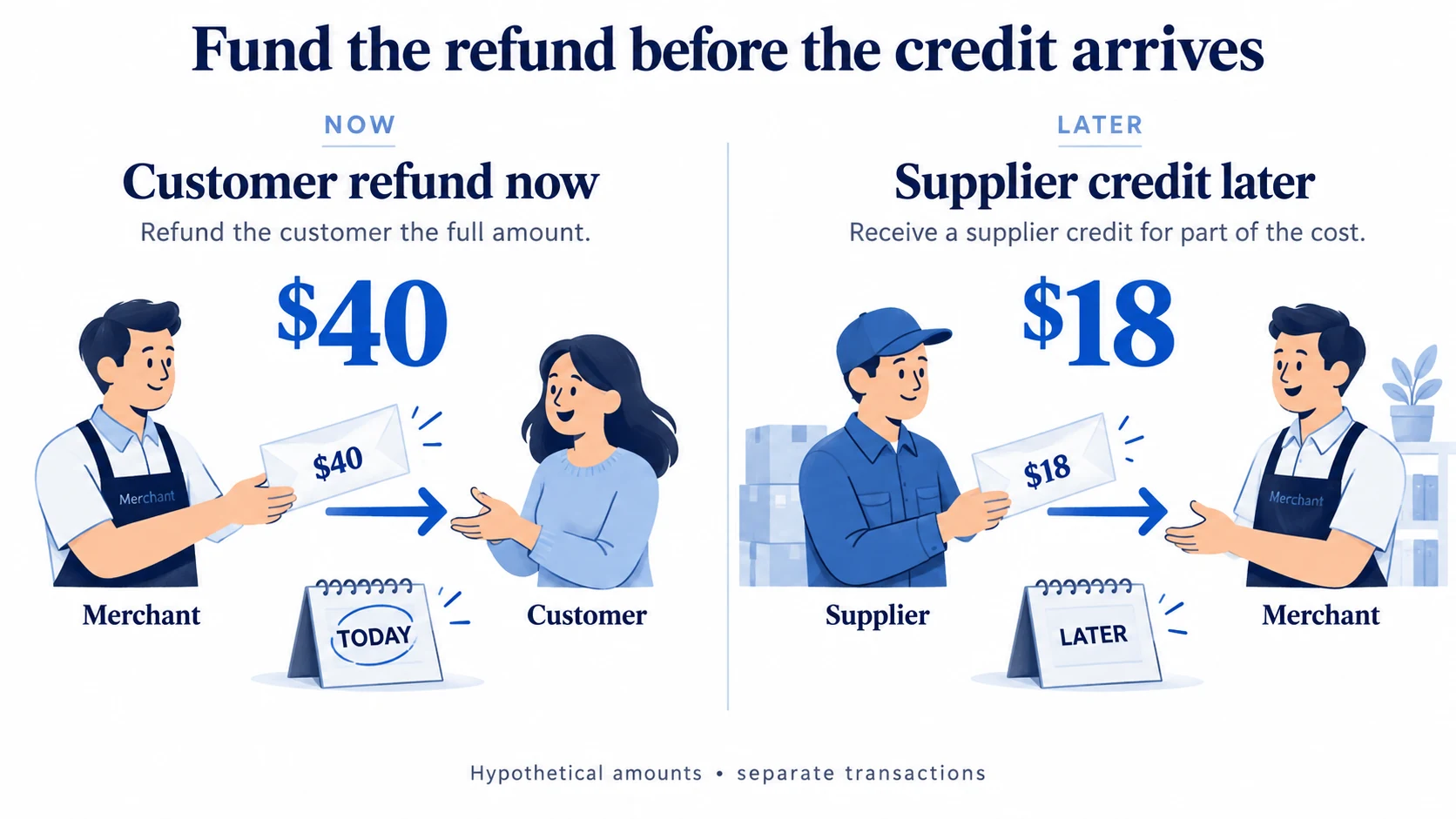
Supplier credit often follows a different timetable from the customer refund. Record the original customer payment, the refund and the supplier credit separately so support and finance can see what is actually due.
For example, a customer paid $40 for a damaged order whose supplier invoice was $18. If the customer is owed $40 now, the store must be able to pay that amount before the supplier’s $18 credit arrives. The later credit recovers part of the store’s costs; it is not another payment to the customer.
Keep a record of the refund amount, payment reference, reason, initiation date and any remaining adjustment. Before issuing another payment after a customer follows up, check the first transaction’s status. A pending refund and a failed refund require different actions.
Where a payment dispute is also open, check the payment provider’s instructions so the team does not issue duplicate remedies. Resolve the underlying customer claim through the proper process; a dispute should not become an excuse to stop communicating.
Review repeated reasons by product and supplier. A high volume of wrong-size requests may point to inaccurate measurements on the listing. Repeated missing accessories may require a packing change. Editing the refund policy alone will not remove either cause.
07
Test the policy against five order states
Give the draft to a teammate and have them follow these five requests. They should be able to find the next action without asking you to interpret the policy.
Order not dispatched: request a stop, confirm the fulfillment result and apply the correct cancellation process.
Delivered but unwanted: find the notification deadline, return deadline, address and permitted costs before sending the item.
Delivered with a fault: follow the fault-remedy process, with evidence suited to the actual problem.
Tracking unclear: identify the parcel, check for a split shipment and give an investigation update.
Refund initiated: locate the payment reference and distinguish a pending refund from a failed transaction before paying again.
Then check the same promises on product pages, checkout, confirmation emails and help pages. If one page says “free returns” and another requires customer-paid postage, correct the inconsistency before new orders rely on it.
Save the policy version and effective date used for each sale. When the supplier changes an address or claim procedure, update your internal instructions promptly and review what the change means for the promises already made to customers.
08
Frequently asked questions
Can I copy my supplier’s refund policy?
Use it to understand supplier reimbursement, not as a complete customer policy. Your sale may carry different rights, deadlines and obligations.
Do all dropshipping stores need a 30-day refund period?
No single voluntary period applies everywhere. Check the relevant consumer rules and any additional return promise you choose to offer. Explain statutory rights separately from optional extensions.
Can I refund without asking for the item back?
That can be an appropriate remedy in some situations. Consider the applicable rights, cost, evidence, product safety and potential misuse. Record who authorized the decision.
What if the supplier refuses to reimburse me?
Handle the customer entitlement separately, preserve the supplier evidence and pursue the commercial claim through the agreed process. Review whether the supplier’s terms leave an unacceptable ongoing gap.