
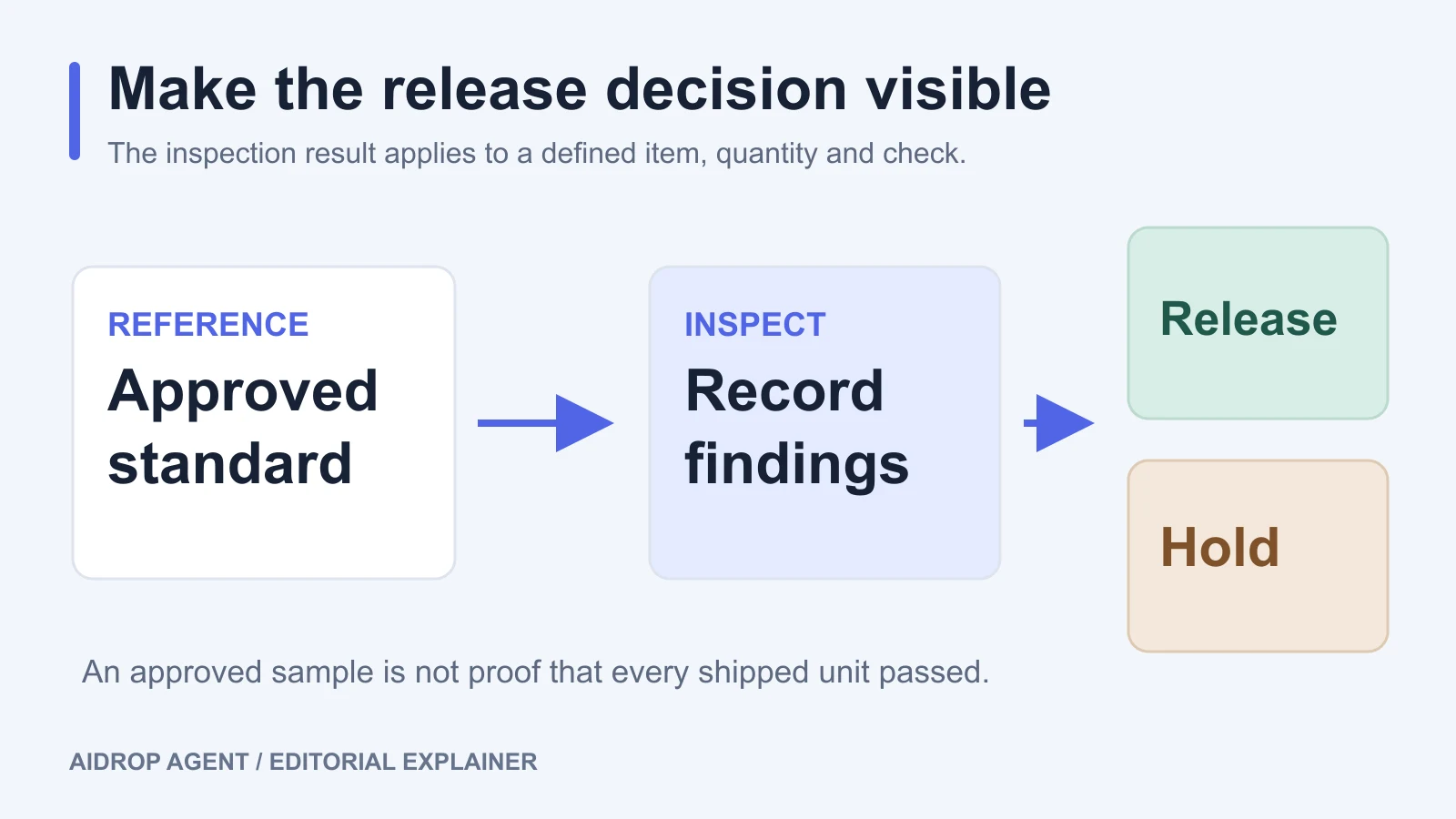
Dropshipping quality control starts with an approved product and written requirements. Someone with access to the goods checks them against those requirements, records the findings, and holds failed products until a release decision is made. Outbound checks then confirm that the correct item, accessories, and packaging go to the customer.
The practical question is what a supplier means by “QC passed.” It might mean a worker looked at the package, an inspector tested selected units, or every order received a defined check. Those are different services. Before paying for inspection or approving shipment, establish what was checked and which goods the result covers.
01
Turn the approved sample into instructions someone can follow
Keep the accepted sample, identify its SKU and variant, and record the approval date. Photograph the details that matter, including the packaging. Give the reference a version so an inspector can tell whether a later instruction replaces it.
A sample alone leaves room for interpretation. “Good quality” does not tell someone where to measure, what to operate, or which blemishes you would reject.
QIMA’s inspection-checklist guidance describes specifications, packaging and labeling requirements, on-site checks, and pass/fail criteria as parts of a usable checklist. Apply that principle to the product you sell.
For example, a zippered travel pouch could have the following inspection instructions. This is an illustrative working document, not a universal product standard.
| Item to define | Useful instruction | What needs your decision |
|---|---|---|
| Product identity | Compare SKU, color, and included accessories with the order and approved reference | Which variants and bundles are approved |
| Dimensions | Measure the stated points with the pouch in the agreed condition | Target dimensions, measurement method, and acceptable tolerance |
| Zipper operation | Follow the agreed opening and closing check; record snagging, separation, or failure | The procedure and acceptance requirement |
| Seams and finish | Examine the specified areas and photograph visible differences | Which examples are unacceptable and which cosmetic variations are allowed |
| Packing | Compare the unit protection, accessory placement, and package label with the approved packing reference | Packaging method and the correct customer-order configuration |
Set the tolerance before reviewing the inspection result. Do not invent one to excuse a failed measurement. Where the acceptable limit is unclear, resolve it with the supplier and a qualified product or inspection specialist before the batch proceeds.
Save rejected examples too. A photograph showing the exact seam problem can make an instruction clearer than several adjectives. Keep the public product description consistent with the version you approve.
02
Choose where the goods can actually be inspected
The right inspection arrangement depends on who can access the stock and when they can stop it from shipping. An app connection does not answer either question.
| Fulfillment arrangement | Inspection opportunity | Main limitation to resolve |
|---|---|---|
| Supplier ships each customer order | Agreed checks before packing or dispatch, plus sample and test orders | How the supplier records each check and prevents unchecked substitutions |
| Stock is reserved at a fulfillment warehouse | Incoming checks against an identifiable receipt, followed by order-level packing checks | Whether stock can be separated, held, and traced to customer orders |
| A production batch is being made | Checks at agreed production stages and before shipment | Access to the actual goods, the inspection plan, and authority to delay release |
For direct shipping, ask the supplier to describe its actual process. Who opens the product? Which checks happen every time? Are photos available only for exceptions or for each order? Can you request additional inspection, and what processing time or cost does it add?
If the supplier can only check the outer package, record that limitation. Decide whether that scope is sufficient for the product. Where an important function or fragile component cannot be checked, consider a different arrangement with physical inspection access.
For reserved inventory, define how the warehouse distinguishes inspected stock from goods that have just arrived. A shared shelf with no batch identification makes it harder to isolate a later problem.
Before engaging AIDrop Agent for a quality-control requirement, prepare the product reference, known failure, available stock location, and shipment deadline. Ask for the proposed checks, evidence, costs, exclusions, and release responsibility for that specific requirement.
03
Be precise about what a check can prove
A product can look correct while having a functional fault. It can operate during a brief check while still lacking required testing or documentation. Divide the scope accordingly.
An identity check compares the SKU, variant, accessories, and label with the order. An appearance check can record visible damage, contamination, finish problems, or differences from the approved reference. A functional check needs its own procedure and a stated result. Do not assume it is included in a service described simply as “inspection.”
For an electrical product, a power-on check would establish only what that check actually observed. It is not evidence of electrical safety, battery endurance, or every advertised performance claim. Do not ask warehouse staff to improvise hazardous or destructive tests.
Safety and compliance require a separate product- and destination-specific review. Shopify’s dropshipping guidance tells merchants to check applicable safety requirements, documentation, warnings, and recalls before selling. A supplier’s general certificate should not be treated as proof for an unidentified product version or market.
The same distinction applies to packaging. A photo can show that an insert was included or that a corner arrived crushed. It cannot establish that a packing method will protect every future parcel. When transit damage is a recurring issue, review the packaging and relevant testing with someone qualified to assess the product and shipping conditions.
04
Use batch sampling only when there is a batch to sample
Sampling is useful when examining every unit is impractical. Its meaning depends on what the sample represents. ASQ defines sampling in relation to a target population or product lot and identifies errors that can affect the conclusions.
That creates an important limit for dropshipping: a few photographs of orders taken from changing supplier stock do not establish a statistical result for a defined production batch.
Before requesting an AQL inspection, ask for the lot size, how the lot is identified, the sampling plan, how units will be selected, defect classifications, and the acceptance or rejection rules. ASQ’s quality glossary distinguishes acceptance sampling—the decision about a lot—from the plan that specifies sample sizes and acceptance criteria.
QIMA describes independently selecting units from the goods being inspected and evaluating them against the agreed checklist. That is materially different from asking a supplier to send photos of units it chose for display.
If the supplier cannot identify a lot, use an honest description such as “appearance checks on the listed orders.” Do not turn that into “the batch passed AQL.”
There is no single sample count or AQL setting this article can assign to every dropshipping product. The inspection plan needs to reflect the goods, risks, and applicable requirements. Passing a sampled inspection also does not establish that every unexamined unit is defect-free.
For safety-critical issues, seek product-specific professional guidance. A general sampling allowance is not permission to release an identified unsafe item.
05
Ask for a report that lets you make a decision
A useful report connects an observation to goods you can identify. Ask for the supplier, SKU, variant, batch or receiving reference, inspection date, quantity in scope, number of units examined, reference version, and the checks performed.
For each failure, include the requirement, observed result, quantity found, and a photograph or other appropriate evidence. Checks that were unavailable or not performed should say so explicitly. An empty cell can otherwise be mistaken for a pass.
Consider this illustrative pouch finding:
Product: Gray travel pouch, SKU and receiving reference recorded on the report.
Approved requirement: Zipper must complete the agreed opening and closing check without snagging.
Observed finding: One examined unit repeatedly snagged at the corner. The report identifies the unit and includes a video.
Scope: One failure was observed among the units examined. The report lists the examined quantity separately from the total quantity received.
Action: Hold the affected stock while the supplier and inspection owner determine the cause, affected scope, and correction. Record the evidence required before release.
This finding gives the merchant something to investigate. “Zipper quality poor” does not. Nor should one observed failure be presented as the defect rate of the entire shipment.
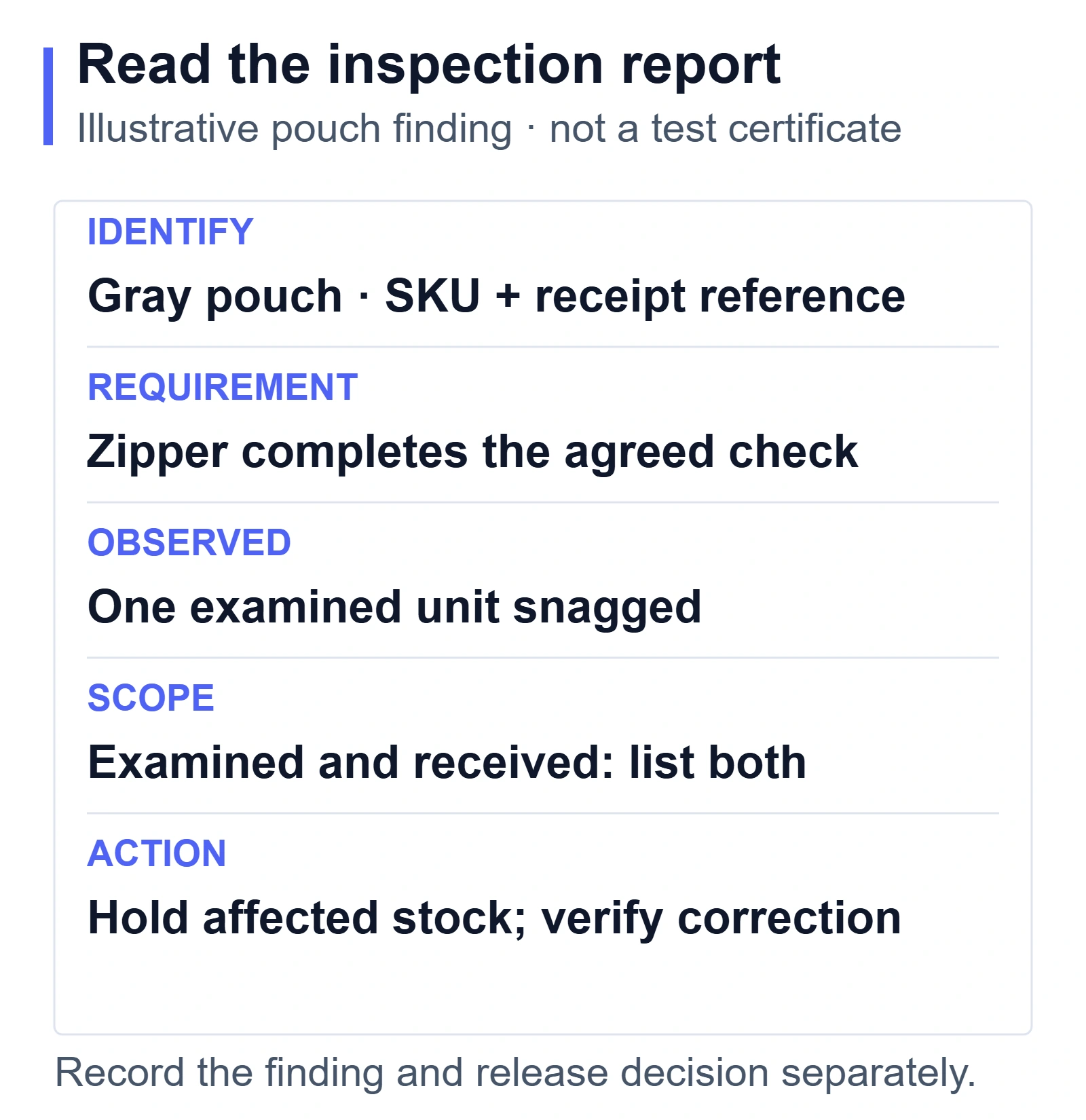
Keep the inspection result and release decision separate. An inspector reports what was observed against the agreed standard. The authorized decision-maker determines what happens next under the agreed requirements. If an exception is accepted, record the exact deviation and affected quantity; do not erase it by changing the report to an unqualified pass.
06
Hold failures, fix the cause and verify the correction
Before inspection begins, agree who can stop goods and who can authorize them to move again. Otherwise, a failure report may arrive after the carrier has collected the parcels.
When a defect appears, first identify the affected stock and orders. If the evidence points to one traceable receiving batch, isolate that batch for review. If different batches have been mixed and cannot be distinguished, a narrow hold may not be supportable. Establish the possible scope before continuing dispatch.
Then agree what will resolve the problem. A wrong label may require relabeling and another identity check. Missing accessories may require sorting and repacking. A functional failure may require replacement, supplier investigation, or a different product decision. The action should follow the observed defect.
For the pouch example, a supplier saying “we fixed the zipper” is incomplete. Ask what caused the snag, which units were corrected, and how the correction will be checked. Keep the original requirement and defect evidence available during reinspection.
Do not repeatedly draw new samples until one happens to pass while leaving the failed goods unchanged. Require a defined correction and a justified reinspection decision.
If evidence suggests a safety issue, hold the relevant goods and obtain product-specific guidance before resuming sales or shipment. A routine cosmetic exception process is not suitable for that decision.
Customer orders already dispatched need their own response. Communicate with affected customers and handle remedies under the applicable obligations and store policies. A reimbursement discussion with the supplier does not resolve the customer’s problem by itself.
07
Use customer complaints to improve the next inspection
Record the product, variant, order, and batch or supplier reference where available. Add the reported issue, supporting evidence, and confirmed outcome. Keep “customer reported” separate from “confirmed after review.”
Group problems by a useful cause: wrong variant, missing part, functional failure, visible damage, transit damage, or a product-description mismatch. Each may need a different correction.
Repeated zipper complaints may justify revisiting the functional check. Crushed packaging may require a packing and shipping review. Returns because the pouch is smaller than expected may point to unclear product-page measurements even when the item matches its specification.
Use comparable reporting periods and a stated denominator when calculating a rate. A manufacturing-defect count divided by inspected units answers a different question from customer complaints divided by delivered orders. Recent orders may also have had less time to produce complaints. Keep those measures separate.
If the product itself no longer meets the agreed standard, return to the product sourcing decision before increasing inspection around a weak product. For related fulfillment and inventory choices, the dropshipping hub provides the broader context.
08
Frequently asked questions
Can I control quality without holding inventory myself?
Yes, if a supplier, warehouse, or inspection provider can access the goods and carry out agreed checks before dispatch. Confirm the actual scope and hold process. If no one can inspect the relevant feature before shipment, that remains a limitation of the arrangement.
Should every dropshipping order be inspected?
Every order needs the correct product and packing, but inspection depth should reflect the product and agreed risk controls. Examining every unit for a defined issue can be useful, yet it does not detect defects outside the check’s scope. Some tests also consume or damage the tested unit.
When should an approved product be checked again?
Review it when the supplier, product specification, important material, packaging, or production conditions change, and when evidence shows a recurring problem. Routine inspection frequency should be agreed for the product and fulfillment arrangement. A successful original sample does not approve every future version.